
You sold some Bitcoin last year to buy a new car. Did you pay the tax? If you’re living in Russia and didn’t file a specific declaration for that trade, you might be sitting on a ticking time bomb. The days of treating cryptocurrency like invisible money are long gone. Since January 1, 2025, crypto taxation in Russia has shifted from a gray area to a strict regulatory framework under Federal Law No. 418-FZ. This law treats your digital assets as property, not magic internet money, which means every sale, swap, or payment is potentially taxable.
The Federal Tax Service (FTS) isn’t guessing anymore. They have dedicated channels for digital assets now. If you think holding Bitcoin for three years makes it tax-free like a vintage watch, think again. Crypto doesn’t get that exemption. You owe tax regardless of how long you held it. Let’s break down exactly what you need to do, how much you’ll pay, and where the traps are hiding.
Who Pays What: Individual vs. Corporate Rates
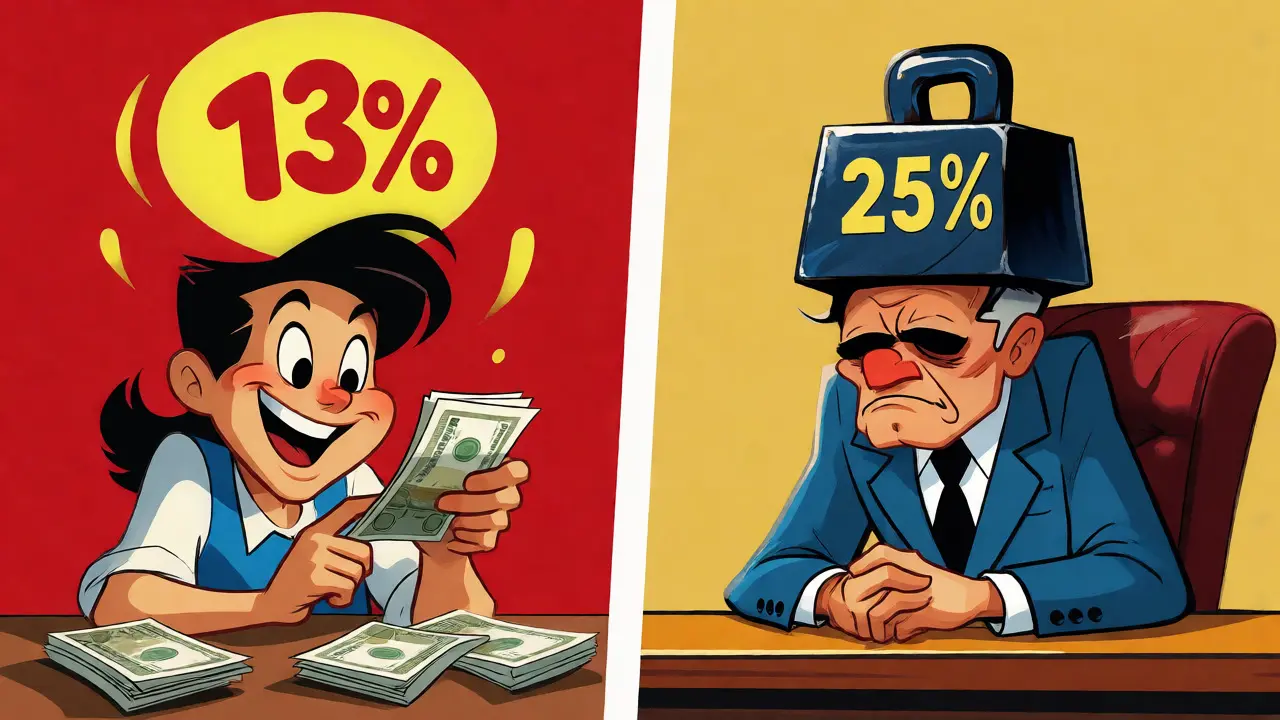
If you are an individual trader, your tax bill depends on how much profit you made. The system uses a progressive rate structure similar to other income sources. For annual cryptocurrency income up to 2.4 million rubles, you pay a flat 13%. Once your income crosses that threshold, the rate jumps to 15% on the excess amount. This applies to residents. Non-residents face a steeper flat rate of 30% on any crypto income sourced within Russia.
Companies play by different rules. If you run a business that mines or trades crypto, you can’t use simplified tax regimes like USN or ESHN. You must operate under the General Taxation System (OSNO). This subjects corporate profits to a 25% profit tax. It’s a higher bar than standard corporate taxes, designed to ensure large-scale operations contribute significantly to the budget.
| Taxpayer Type | Tax Rate | Threshold / Condition | Key Restriction |
|---|---|---|---|
| Individual Resident | 13% - 15% | Progressive based on annual income (>2.4M RUB) | No 3-year ownership exemption |
| Non-Resident | 30% | Flat rate on all income | Source-based taxation applies |
| Corporate Entity | 25% | Profit tax under OSNO regime | Cannot use special tax regimes (USN/AUSN) |
| Miners (Restricted Regions) | N/A | Prohibited operations | Banned in Dagestan, Chechnya, DPR/LPR until 2031 |
Calculating Your Tax Base: The Valuation Problem
Here is where most people trip up. How do you calculate the value of a coin when there are no domestic regulated exchanges? The law specifies that you must use market quotations from foreign trading organizers. But not just any exchange. The organizer must meet two strict criteria: daily trading volume exceeding 100 billion rubles and at least three years of publicly available quotation data. This effectively limits valid price sources to major global players like Binance or Coinbase, excluding smaller niche platforms.
You cannot simply pick the price you liked best on a Tuesday morning. You need documented evidence. The FTS requires detailed records including wallet addresses, transaction IDs, and exchange rates at the exact moment of the transaction. If you bought ETH on one platform and sold it on another, you need proof of both prices. Accounting firms report that verifying these foreign quotes is their biggest headache, often requiring specialized software or manual cross-referencing of historical charts.
Reporting Requirements and Deadlines
Gone are the days of silence. Mandatory quarterly reporting is now the norm. If you miss a deadline, expect fines up to 40,000 rubles per violation. Worse, if you underpay your taxes, penalties range from 15% to 40% of the unpaid amount, plus interest. That adds up fast if you’ve been ignoring crypto gains for several years.
There is a nuance regarding the reporting threshold. While you technically owe tax on any profit, the requirement to file a specific standalone declaration for small amounts has been debated. A previous threshold of 600,000 rubles was discussed, but current guidance suggests consolidating crypto income with securities transactions into a single tax base. This eliminates regulatory arbitrage but increases the complexity of your annual filing. You aren’t just filing a form; you are building a case for why your numbers are correct.
Mining Restrictions: Geography Matters
If you mine, location is everything. The government hasn’t just taxed mining; they’ve banned it in specific regions to manage energy loads. As of 2026, mining is completely prohibited in Dagestan, Chechnya, and the DPR/LPR territories until 2031. In other energy-rich areas like Irkutsk Oblast, Buryatia, and Zabaykalsky Krai, seasonal bans kick in during periods of energy deficit.
This isn’t just a suggestion. Operating a rig in a restricted zone can lead to equipment seizure and heavy fines. The Central Bank reported a 22% decline in domestic mining operations in early 2025 due to these restrictions. Many miners migrated to peer-to-peer platforms or moved their hardware to unrestricted regions. If you plan to mine, check the current status of your region before buying a single GPU.

Common Pitfalls and Expert Insights
Don’t assume that swapping one crypto for another is tax-free. Under the new framework, many swaps are treated as disposal events, triggering a taxable event. If you traded BTC for ETH, you realized a gain or loss on the BTC portion. Tracking this across multiple wallets is tedious but necessary.
Experts warn against underestimating the documentation burden. A survey by accounting firm Acsour found that 89% of firms needed weeks of training to handle crypto tax calculations properly. User forums reflect this struggle, with some individuals spending dozens of hours calculating liabilities for a single month. The absence of domestic regulated exchanges complicates verification, making it hard to prove the "fair market value" used in your calculations.
On the positive side, the VAT exemption for crypto transactions is a win. Previously, uncertainty about VAT caused transaction costs to spike by 15-20%. Now, buying and selling digital assets doesn’t incur additional sales tax, aligning Russia with global standards where crypto is often treated as currency-like for VAT purposes.
Looking Ahead: Digital Ruble and Future Amendments
The landscape is still evolving. The Central Bank launched a pilot program for the digital ruble in late 2025, focusing initially on welfare payments. While this won’t replace Bitcoin, it creates a state-controlled alternative that may influence how private cryptocurrencies are perceived. Additionally, amendments to Federal Law No. 418-FZ were debated in mid-2025 to clarify ambiguities around small transactions and multi-wallet holdings.
Expect stricter enforcement as the FTS integrates better with blockchain analytics tools. The initial grace period is over. If you haven’t cleaned up your records, start now. Use specialized crypto tax software that supports Russian reporting formats. Keep screenshots of exchange balances, download CSVs of all trades, and store them securely. When the auditor comes knocking, your paper trail is your only defense.
Do I pay tax if I hold crypto for more than three years?
No. Unlike other movable property such as cars or real estate, cryptocurrency does not qualify for the three-year ownership exemption under Article 217 of the Tax Code. You must pay tax on the gain regardless of how long you held the asset.
What happens if I fail to report my crypto transactions?
You face fines up to 40,000 rubles for reporting violations. If you underpay taxes, penalties range from 15% to 40% of the unpaid amount, plus accrued interest. Repeated non-compliance can lead to more severe legal scrutiny.
Can companies use the Simplified Taxation System (USN) for crypto?
No. Corporate entities involved in cryptocurrency activities must use the General Taxation System (OSNO). Special regimes like USN, AUSN, or ESHN are explicitly prohibited for crypto-related businesses, subjecting them to a 25% profit tax.
Is mining legal everywhere in Russia?
No. Mining is completely banned in Dagestan, Chechnya, and the DPR/LPR territories until 2031. Other regions like Irkutsk Oblast have seasonal restrictions during energy deficits. Always verify local regulations before starting operations.
How do I determine the value of my crypto for tax purposes?
You must use market quotations from foreign trading organizers with daily volumes over 100 billion rubles and at least three years of public data. Domestic prices alone are insufficient without supporting external verification.