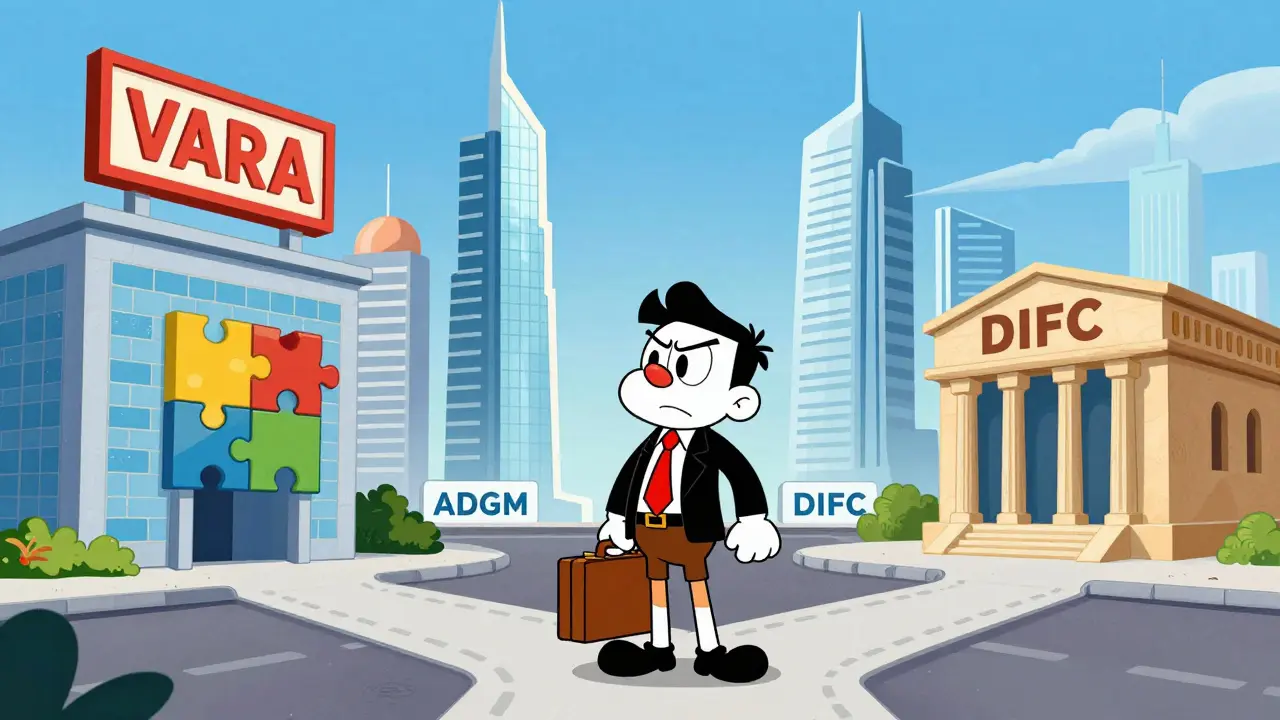
Starting a crypto business used to mean navigating a legal gray area where one wrong move could shut you down. That era is over for the United Arab Emirates. Today, the UAE offers one of the clearest, most structured regulatory environments in the world for digital asset companies. But clarity comes with complexity. You aren't just picking a location; you are choosing between different regulators, each with its own rules, fees, and culture.
If you are planning to launch an exchange, a wallet provider, or a token issuance platform in 2026, understanding the difference between VARA, ADGM, and DIFC is not optional-it is the foundation of your business survival. This guide breaks down exactly how these systems work, what they cost, and which path fits your specific business model.
The Regulatory Landscape: Who Controls What?
The UAE does not have a single 'one-size-fits-all' regulator for crypto. Instead, it operates on a multi-layered framework established by federal laws and enforced by specialized local authorities. The backbone of this system is Cabinet Resolution No. (111) of 2022. This resolution made it illegal to conduct any virtual asset activity in the UAE without a license from either the Securities and Commodities Authority (SCA) or a designated local authority.
This means you cannot simply register a general trading company and start handling crypto. You need a specific virtual asset license. The three main hubs you will encounter are:
- VARA (Virtual Assets Regulatory Authority): Based in Dubai, this is the world's first dedicated virtual asset regulator. It covers all of Dubai except the DIFC.
- ADGM (Abu Dhabi Global Market): An international financial free zone in Abu Dhabi regulated by the FSRA. It focuses heavily on institutional-grade finance.
- DIFC (Dubai International Financial Centre): A common-law financial hub in Dubai regulated by the DFSA. It bridges traditional finance and crypto.
Choosing the right one depends on whether you are targeting retail users in Dubai, institutional investors globally, or if you need deep integration with traditional banking infrastructure.
VARA: The Modular Approach for Dubai
For many startups and mid-sized firms, VARA is the go-to choice because of its modular licensing structure. Unlike other jurisdictions that give you a blanket license, VARA requires you to apply for specific activities. This prevents scope creep and ensures you only pay for what you do.
VARA divides licenses into several categories. If you want to run an exchange, you apply for an Exchange License. If you want to hold funds for clients, you need a Custody License. Common activities include:
- Fiat-to-virtual asset broker services
- Virtual asset-to-virtual asset broker services
- Transfer services
- Custody and wallet provision
- Token issuance
The capital requirements vary significantly based on the risk profile of the activity. For lower-risk activities like advisory services, paid-up capital might be around AED 100,000 ($27,000). However, for high-risk activities like operating an exchange or providing custody, the requirement jumps to AED 1.5 million ($408,000).
Be prepared for significant upfront costs beyond capital. Application fees range from AED 40,000 to AED 100,000, and annual supervision fees sit between AED 80,000 and AED 200,000. VARA also enforces strict fit-and-proper checks on directors and shareholders, ensuring that the people running the show have clean records and relevant experience.
ADGM: Institutional Grade Regulation
If your target audience consists of hedge funds, family offices, or large corporations, ADGM might be the better fit. Regulated by the Financial Services Regulatory Authority (FSRA), ADGM operates under a common law framework similar to London or New York. This familiarity attracts global institutional players who prioritize legal certainty over speed.
ADGM’s approach is less modular than VARA’s and more focused on comprehensive financial services. They issue permissions for dealing in investments, arranging deals, managing funds, and operating multilateral trading facilities. The barrier to entry is higher. ADGM expects robust compliance frameworks, advanced technology security, and substantial operational history from its applicants.
While VARA is often praised for being startup-friendly, ADGM is viewed as the premium choice for established financial entities. The licensing process here involves rigorous stress testing of your business plan and compliance manuals. If you are building a DeFi protocol that needs to interface with traditional banks, ADGM’s reputation can open doors that VARA might not.

DIFC: Bridging TradFi and Crypto
The DIFC sits in a unique position. It is located in Dubai but operates independently of VARA. Regulated by the DFSA, it uses a principles-based regulation approach. This means rather than prescribing every technical detail, the DFSA sets high-level outcomes and lets firms decide how to achieve them.
DIFC is ideal for businesses that want to operate in Dubai but need the trust associated with traditional financial centers. It is particularly strong for fund management and advisory services involving digital assets. The DFSA has been proactive in updating its rules to cover crypto-assets, treating them as investments when they meet certain criteria. If your business model relies heavily on relationships with legacy banks and insurance providers, DIFC’s ecosystem offers seamless integration.
Cost Comparison and Decision Matrix
To help you visualize the differences, here is a breakdown of the key attributes for each regulator. Note that exact fees can change, so always verify with current official guidelines.
| Feature | VARA (Dubai) | ADGM (Abu Dhabi) | DIFC (Dubai) |
|---|---|---|---|
| Regulator Type | Dedicated Virtual Asset Regulator | Financial Services Regulator (FSRA) | Financial Services Regulator (DFSA) |
| Licensing Structure | Modular (Activity-Specific) | Comprehensive Permission | Principles-Based |
| Min. Capital (High Risk) | AED 1.5 Million | Variable (Often Higher) | Variable |
| Best For | Exchanges, Wallets, Startups | Institutional Funds, Banks | Fund Managers, Advisors |
| Legal Framework | Civil Law / VARA Rules | Common Law | Common Law |

Step-by-Step Setup Process
Once you have chosen your regulator, the actual setup follows a logical sequence. While details vary, the core steps remain consistent across VARA, ADGM, and DIFC.
- Company Formation: Incorporate your entity within the respective free zone. You will need a local service agent or physical office space depending on the zone's requirements.
- Business Plan Submission: Draft a detailed business plan outlining your revenue models, target market, and technological infrastructure. Regulators scrutinize this heavily to assess viability.
- AML/CFT Compliance Manual: Develop a robust Anti-Money Laundering and Combating the Financing of Terrorism policy. This must include customer due diligence (CDD) procedures, transaction monitoring tools, and reporting mechanisms.
- Fit and Proper Checks: Submit background checks for all directors, shareholders, and key executives. Any past financial misconduct will likely result in rejection.
- Technology Audit: Prove that your systems are secure. This often involves third-party audits of your code, cybersecurity measures, and data protection protocols.
- License Approval: After reviewing your documentation, the regulator issues a conditional or full license. VARA, for instance, may issue a temporary license while finalizing ongoing requirements.
Common Pitfalls to Avoid
Many applications get stuck not because the business idea is bad, but because the preparation is weak. Here are three common mistakes:
- Underestimating Compliance Costs: Hiring a qualified Chief Compliance Officer (CCO) is mandatory in many cases. This is not a part-time role. Budget for top-tier talent.
- Vague Business Models: Regulators reject applications that say 'we will explore various opportunities.' Be specific. Will you trade Bitcoin? Ethereum? Stablecoins? Define your scope clearly.
- Ignoring Tax Implications: While free zones offer tax benefits, ensure your structure complies with UAE Corporate Tax laws. Recent updates require careful structuring to maintain exemptions.
Future Outlook: CBDCs and Integration
The UAE is not standing still. The Central Bank of the UAE is piloting the Digital Dirham, a Central Bank Digital Currency (CBDC). This initiative aims to modernize cross-border payments and integrate seamlessly with private sector crypto solutions. As this rolls out, expect new opportunities for licensed firms to act as intermediaries between the public blockchain economy and the traditional banking system.
Furthermore, the SCA continues to refine token classifications, distinguishing between utility tokens, security tokens, and payment tokens. This clarity reduces legal ambiguity for investors and issuers alike. Staying updated with these federal guidelines is crucial, even if your primary license is from a local authority like VARA.
How long does it take to get a crypto license in UAE?
The timeline varies by regulator and complexity. With VARA, the process typically takes 3 to 6 months if all documentation is complete. ADGM and DIFC may take longer, often 6 to 9 months, due to their rigorous institutional review processes. Delays usually occur during the fit-and-proper checks or if additional information is requested regarding your compliance framework.
Can I operate a crypto business in mainland UAE?
Yes, but you must obtain approval from the Securities and Commodities Authority (SCA). Mainland operations allow you to serve the entire UAE market directly without needing a free zone intermediary. However, the SCA's requirements are stringent, and the process is generally more complex than applying through specialized free zones like VARA or ADGM.
What is the minimum capital required for a VARA license?
Minimum paid-up capital ranges from AED 100,000 for low-risk activities like advisory services to AED 1.5 million for high-risk activities such as exchanges and custody services. This capital must be deposited in a UAE bank account and verified before license issuance.
Is cryptocurrency legal in the UAE?
Yes, cryptocurrency itself is legal, but unlicensed business activities are prohibited. Under Cabinet Resolution No. (111) of 2022, any entity engaging in virtual asset activities must hold a valid license from the SCA or a designated local authority. Individuals can buy and sell crypto, but businesses must comply with strict regulatory standards.
Which is better: VARA or ADGM for a startup?
For most startups, VARA is the better choice due to its modular licensing structure and relatively faster processing times. ADGM is designed for institutional players with higher capital reserves and complex financial structures. If you are a small team launching a niche wallet or trading platform, VARA’s flexibility allows you to scale gradually.
Lisa Chong
July 15, 2026 AT 15:19They are watching us. Every transaction is a data point for the surveillance state. The UAE is just the tip of the iceberg in this globalist plot to eliminate privacy entirely. Do not trust these 'regulators'. They want to control your wealth and your soul. It is all about power and control, plain and simple. Wake up people before it is too late.
Ran Tao
July 17, 2026 AT 01:03Oh please 🙄 You people really think VARA cares about you? It is all about the elite institutions who can afford the AED 1.5 million capital requirement. The rest of you are just pawns in their game 😂. I love how everyone pretends this is 'democratizing' finance when it is literally building higher walls for the poor. Drama much?
Heather Austin
July 17, 2026 AT 15:17i mean if u actually read the post varas modular approach is pretty smart for startups tbh. u dont need a blanket license which saves cash. but yeah the fees are no joke. i helped a friend set up in adgm last year and the compliance manual alone took months. its not easy but its better than operating in the gray area where they can shut u down overnight.
Brad Semp
July 17, 2026 AT 18:02The distinction between civil law frameworks like VARA and common law jurisdictions such as ADGM or DIFC is paramount for institutional risk management. Most retail commentators fail to grasp that legal certainty trumps speed by an order of magnitude when dealing with cross-border fiduciary duties. One does not simply 'pick a location'; one selects a jurisprudential ecosystem that aligns with long-term asset protection strategies.
Korn Arrieta
July 19, 2026 AT 10:46Stop pretending this is complicated. It is basic business logic. If you cannot afford the compliance officer you do not deserve to run a financial entity. The article mentions underestimating costs which is exactly why half these crypto projects fail within six months. Weakness gets purged from the market efficiently.
Jackie D
July 20, 2026 AT 08:56hey brad thats a lot of big words but im sure some folks here are just trying to figure out where to start. maybe break it down simpler? i know for me the tax implications part was super confusing. does anyone else feel like the corporate tax updates are moving faster than we can keep up with? its kinda wild how fast things change in this space.
Ruth Williams
July 21, 2026 AT 02:08It is quite amusing to witness the uneducated masses attempting to navigate sophisticated regulatory environments without proper guidance. The DFSA principles-based regulation requires a level of intellectual maturity that most internet commenters clearly lack. Only those with substantial resources and genuine expertise should attempt to operate within the DIFC framework. Ignorance is not a strategy.
Sophie Nakasako
July 22, 2026 AT 20:32I think there is a lot of value in understanding why different regulators exist. It reflects the diverse needs of the market. For those feeling overwhelmed by the choice between VARA and ADGM, consider what your core values are as a business. Do you prioritize speed and flexibility or institutional trust and stability? Both paths have merit depending on your vision.
Kristy Morrow
July 23, 2026 AT 14:32you say clarity comes with complexity but really it just means more red tape for the little guy. i bet the big banks love this setup because it keeps them safe while squeezing out innovation. typical establishment move. why do we always have to conform to their rigid structures instead of creating our own systems
John Harman
July 24, 2026 AT 02:50Look man I have been in crypto since 2013 and let me tell you something. VARA is the way to go if you are starting small. Everyone talks about ADGM being premium but unless you are bringing in hedge funds from day one you will bleed money on compliance. Just get the exchange license and focus on product. Stop overthinking the legal stuff.
Kat Barr
July 25, 2026 AT 11:45Wow! This guide is so helpful!! 😍 I was totally lost about the difference between DIFC and VARA. Thank you for breaking it down! 🙏 It makes me feel much more confident about my startup idea. Keep posting good content like this!!! 💖✨
Logan Edmison
July 25, 2026 AT 16:15the whole concept of centralized regulation in a decentralized world is oxymoronic at best. they try to box in the infinite potential of blockchain with finite laws. it wont work in the long run. technology always outpaces legislation. we are just seeing the early stages of this inevitable clash. interesting times ahead tho.
Michelle Walker
July 26, 2026 AT 08:35You are missing the point entirely. The fit-and-proper checks are non-negotiable. If you have a criminal record you are out. Simple. The system works to protect investors from fraudsters. Stop complaining about barriers to entry and start improving your credentials. Weakness has no place in finance.
Shay Thomson
July 26, 2026 AT 17:05I can see both sides of this argument passionately. On one hand the strict regulations provide necessary safety nets for the public. On the other hand they stifle the very innovation that makes crypto exciting. Perhaps there is a middle ground where we can have responsible freedom. We need dialogue not division.
Melissa Beckwith
July 28, 2026 AT 02:13Having navigated the licensing process myself I can attest that the timeline estimates are optimistic at best. The back-and-forth with VARA regarding technical audits alone consumed three months of my life. Furthermore the requirement for a local service agent adds unnecessary bureaucratic friction that many foreign entrepreneurs underestimate significantly. Ensure your documentation is flawless because any minor discrepancy will result in immediate rejection and significant delays in your operational launch schedule.
Josephine Finlayson
July 29, 2026 AT 18:27This is a very comprehensive overview indeed! It is wonderful to see such detailed information shared openly. For those considering the ADGM route, remember that the community support is quite strong once you are established. Please ensure you consult with local legal experts before making any final decisions. Best wishes to everyone embarking on this journey!