
You want to trade your Ethereum for Solana without handing over your private keys. You hear about CriptoSwaps and wonder if it’s the next big thing in decentralized finance or just another risky platform that might vanish overnight. The short answer? Be extremely cautious. As of early 2026, CriptoSwaps lacks the transparent track record, verified security audits, and clear regulatory standing that established platforms like Coinbase or Kraken offer.
In a market where high-profile breaches at exchanges like Bybit and WazirX have shaken user confidence, choosing a platform with limited public data is a significant gamble. This review breaks down what we know about CriptoSwaps, compares it to safer alternatives, and helps you decide whether your funds are safe enough to risk on this specific service.
The Current State of CriptoSwaps
When you search for detailed technical specifications, whitepapers, or official documentation for CriptoSwaps, you hit a wall. Unlike major competitors such as Binance or Kraken, which publish regular proof-of-reserves audits and compliance reports, CriptoSwaps operates in the shadows. The only substantial reference to the platform comes from third-party review sites like Cashback Forex (CBFX), but even these sources often lack deep, verifiable data on transaction speeds, fee structures, or security protocols.
This opacity is a major red flag in 2026. After the U.S. SEC updated its digital asset framework and global bodies like the G20’s Financial Stability Board pushed for stricter operational standards, reputable exchanges have moved toward full transparency. They provide clear fee schedules, list their supported blockchains explicitly, and undergo independent security audits. If a platform cannot provide this basic information, you should treat it as high-risk.
How Crypto Swaps Actually Work
To understand why CriptoSwaps might appeal to some users, you need to understand the broader category it belongs to: crypto swaps. A crypto swap is the direct exchange of one cryptocurrency for another in a single transaction.
Unlike traditional centralized exchanges where you deposit funds into an account held by the company, modern swap platforms often use smart contracts to facilitate peer-to-contract transactions. This means you connect your wallet-like MetaMask or Trust Wallet-and the trade happens directly on the blockchain. You never give up custody of your assets.
This model offers several advantages:
- No KYC Required: Many swap platforms allow anonymous trading, bypassing identity verification.
- Cross-Chain Capability: You can swap tokens across different blockchains (e.g., USDT on Ethereum to MATIC on Polygon) without bridging manually.
- Speed: Transactions settle in seconds rather than waiting for order books to match.
However, this convenience comes with risks. If the smart contract has a bug, or if the platform is a honeypot designed to steal funds, there is no customer support team to call. Your money is gone.
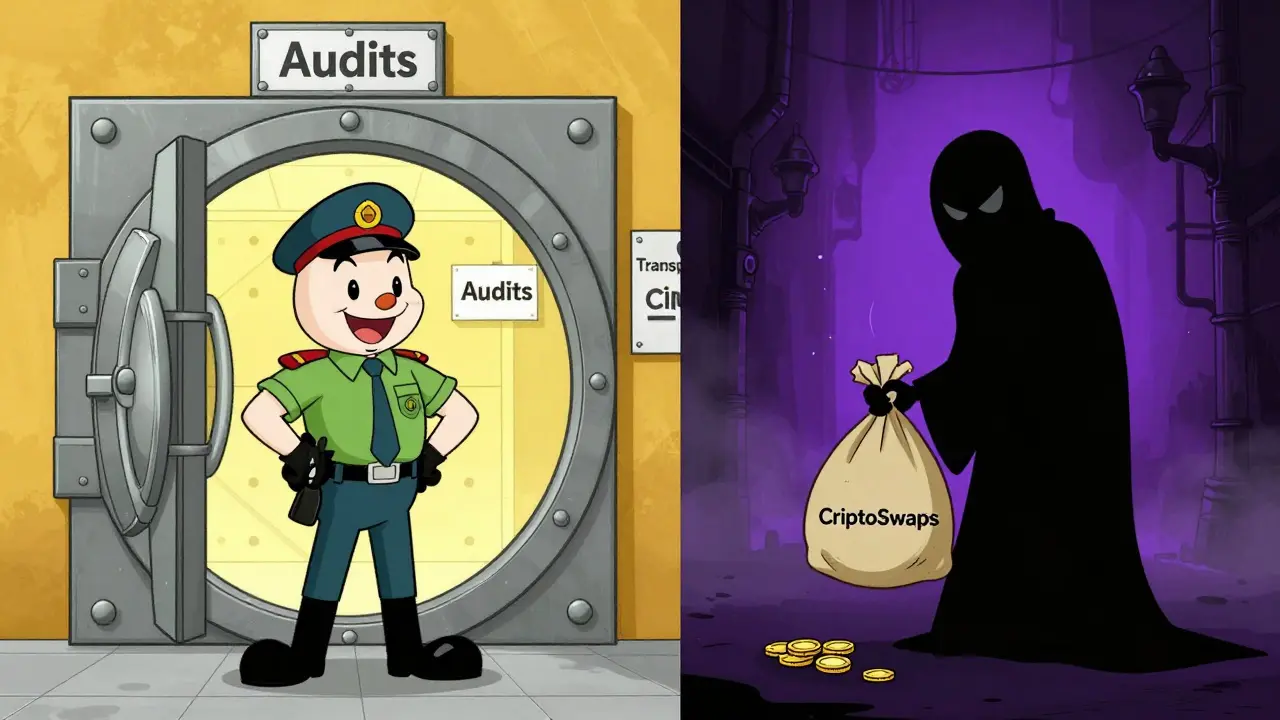
Security Red Flags to Watch For
In 2025 and 2026, security is the primary metric for judging any crypto service. Following the turbulent events of 2024, including the Bybit breach and the WazirX attack, users now demand higher standards. Here is what legitimate platforms provide, and what CriptoSwaps appears to lack:
| Feature | Top-Tier Exchanges (e.g., Kraken) | Obscure Platforms (e.g., CriptoSwaps) |
|---|---|---|
| Proof-of-Reserves Audits | Regular, publicly verifiable | None found |
| Smart Contract Audits | By firms like CertiK or OpenZeppelin | Not published |
| Regulatory Compliance | SEC/FCA registered or compliant | Unknown/Unclear |
| Cold Storage Security | Multi-layered, hardware-backed | Unverified |
| Fraud Detection | AI-powered monitoring | Not specified |
If you see a platform promising "instant, no-KYC swaps" but cannot show you who audited their code, assume they are not secure. In the world of decentralized finance (DeFi), trust is earned through code transparency, not marketing promises.
Fees and Hidden Costs
One of the biggest draws of swap services is lower fees compared to traditional exchanges. Centralized exchanges often charge trading fees ranging from 0.1% to 0.5%, plus withdrawal fees. Swap platforms typically charge a spread-a difference between the buy and sell price-which can be competitive.
However, with obscure platforms like CriptoSwaps, the fee structure is rarely transparent. You might encounter:
- High Slippage: The final amount you receive is significantly less than quoted because the platform manipulates the price.
- Gas Fee Markups: The platform may add a premium to the network gas fees you pay for the transaction.
- Hidden Network Fees: Some platforms fail to disclose that certain chains require additional fees for cross-chain bridges.
Before using any swap service, check if they display the estimated output amount clearly before you confirm the transaction. If the interface is confusing or hides the total cost, walk away.
Better Alternatives for Crypto Swaps in 2026
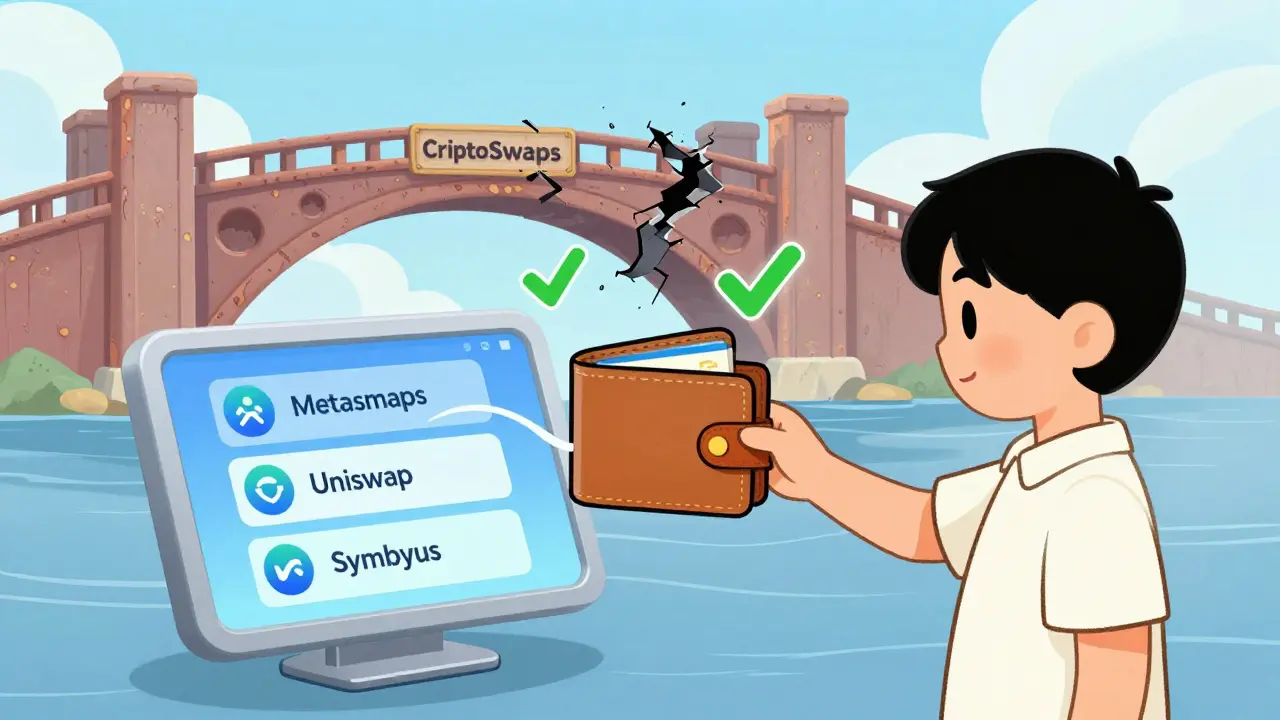
If you want the benefits of fast, cross-chain swaps without the security risks of unknown platforms, consider these established alternatives:
- Symbiosis.finance: A leading cross-chain liquidity protocol that allows instant swaps across multiple blockchains. It uses smart contracts for peer-to-contract trading and has undergone rigorous audits.
- Jupiter (Solana): The dominant aggregator on the Solana network, offering deep liquidity and low fees for SOL-based trades.
- Uniswap: The largest decentralized exchange on Ethereum. While it doesn’t do cross-chain swaps natively, it is the gold standard for security and transparency.
- Kraken: For those who prefer centralized exchanges, Kraken offers strong security, regulatory compliance, and a wide range of trading pairs, including stocks and ETFs.
These platforms have proven track records, active communities, and clear fee structures. They also respond to market changes quickly, such as implementing AI-powered fraud detection after recent industry breaches.
Who Should Avoid CriptoSwaps?
CriptoSwaps is not suitable for most users. Specifically, you should avoid it if:
- You are new to cryptocurrency and unfamiliar with wallet management.
- You plan to store large amounts of value on the platform.
- You require customer support for failed transactions.
- You care about regulatory compliance and tax reporting.
Even experienced traders should exercise extreme caution. The lack of verifiable data means you have no way to assess the platform’s solvency or security posture. In a market where scams are sophisticated, taking unnecessary risks is not worth the potential savings on fees.
Final Verdict: Proceed with Extreme Caution
CriptoSwaps exists in a gray area of the crypto market. While it may offer the allure of fast, anonymous swaps, it fails to meet the basic standards of transparency and security expected in 2026. Without published audits, clear fee structures, or regulatory compliance, it poses a significant risk to your funds.
Instead of gambling with obscure platforms, stick to established aggregators like Symbiosis or Uniswap for decentralized swaps, or regulated exchanges like Kraken for centralized trading. Your financial security is more important than finding the absolute lowest fee.
Is CriptoSwaps a scam?
There is no definitive proof that CriptoSwaps is a scam, but there is also no evidence that it is safe. The lack of transparent ownership, security audits, and regulatory compliance makes it highly risky. Treat it as potentially fraudulent until proven otherwise.
What are the fees for using CriptoSwaps?
CriptoSwaps does not publish a clear fee schedule. Users may encounter hidden costs such as high slippage, markup on gas fees, or unexpected network charges. Always check the estimated output before confirming a transaction.
Can I use MetaMask with CriptoSwaps?
While many crypto swap platforms support MetaMask, there is no confirmation that CriptoSwaps integrates with it. Connecting your wallet to an unverified site can expose your funds to malicious smart contracts.
Is CriptoSwaps regulated by the SEC?
No. There is no record of CriptoSwaps being registered with the U.S. Securities and Exchange Commission (SEC) or any other major regulatory body. This lack of oversight increases the risk for users.
What is the safest way to swap crypto in 2026?
Use well-known, audited decentralized exchanges like Uniswap or Symbiosis for cross-chain swaps. For centralized trading, choose regulated platforms like Kraken or Coinbase that provide proof-of-reserves and customer support.
Why is transparency important for crypto exchanges?
Transparency ensures that the exchange holds sufficient reserves to cover user deposits and that its security measures are robust. Without audits and public reporting, users cannot verify if their funds are safe.
Does CriptoSwaps require KYC verification?
It is unclear if CriptoSwaps requires Know Your Customer (KYC) verification. Many obscure swap platforms operate without KYC to attract anonymous users, but this also means there is no recourse if funds are stolen.

Robert Smith
May 4, 2026 AT 08:53Just keep your keys in a cold wallet and use Jupiter for Solana swaps. It’s literally built for that exact purpose now 🌊
Felix Eduardo Velasquez
May 5, 2026 AT 11:35The fundamental issue with platforms like CriptoSwaps is not merely technical opacity, but the philosophical rejection of accountability. In a decentralized ecosystem, trust is a scarce resource that must be earned through verifiable proof, not marketing hype. When an entity refuses to publish audits or disclose ownership, they are effectively asking you to gamble on their integrity without any collateral. This is not innovation; it is a regression to the wild west era of crypto where rug pulls were commonplace. We have moved past that. The mature market demands transparency as a baseline requirement for participation. If you cannot verify the code, you cannot trust the contract. And if you cannot trust the contract, you should not send funds to it. The risk/reward ratio here is severely skewed against the user.
Emily A
May 6, 2026 AT 06:28Oh my gosh, this article is so spot on! 😱 I was actually thinking about trying some random swap site because I wanted to avoid KYC, but reading this made me realize how dangerous that is. Thank you for breaking down the security red flags so clearly. It’s scary how many people still fall for these 'anonymous' traps. Always stick to the big names like Uniswap or Kraken, seriously! 💖
Jan Conrad
May 7, 2026 AT 05:27I’ve been looking into cross-chain bridges lately and it’s fascinating how complex the security landscape has become. The mention of Symbiosis.finance is interesting-I haven’t used them yet, but their audit history looks solid compared to the shadowy entities mentioned here. Does anyone else feel like the barrier to entry for safe DeFi usage is getting higher? You basically need to be a security researcher just to swap ETH for SOL safely now.
Emily A
May 7, 2026 AT 19:13@Jan Conrad totally agree! It’s exhausting sometimes 😩 But yeah, checking the audits is non-negotiable. I learned that the hard way back in 2022 when I lost some DAI on a sketchy bridge. Never again! Stick to the audited ones only!
Emily A
May 8, 2026 AT 19:41Also, does anyone know if Symbiosis supports all the major L2s right now? Or just the big ones?
Jan Conrad
May 10, 2026 AT 06:55@Gabby Puche From what I’ve seen, they support Ethereum, BSC, Polygon, Arbitrum, Optimism, and a few others. It’s not every single chain, but it covers the majority of liquidity. The key is that they don’t rely on wrapped assets in the same risky way some other bridges did.
Emily A
May 11, 2026 AT 18:20Awesome thanks for the info Jan! 🙏
Gabby Puche
May 13, 2026 AT 08:15You guys are doing great by staying informed! 🌟 It’s really important to protect our digital assets. I always tell my friends to double-check everything before clicking. Stay safe out there! ✨
Lynne Teperman
May 14, 2026 AT 21:18the silence from criptoswaps is deafening really. no audits no team no nothing. just vibes and promises. i prefer my coffee black and my exchanges transparent. why take the risk when kraken exists. its just basic logic honestly. dont touch it.
its me
May 15, 2026 AT 14:35You’re all missing the point entirely. The fact that you’re blindly trusting centralized giants like Coinbase and Kraken shows how thoroughly you’ve been brainwashed by institutional narratives. True freedom lies in the anonymity of the unregulated. Yes, there is risk, but there is also liberation from the surveillance state. By demanding KYC and audits, you are voluntarily signing up for financial slavery. I don’t care about your ‘security’ when it comes at the cost of my privacy. These obscure platforms are the only thing standing between us and total control by the banks. Wake up.
Felix Eduardo Velasquez
May 17, 2026 AT 00:46@its me Your argument conflates privacy with security, which is a logical fallacy. Privacy is a right, but security is a necessity for asset preservation. One can have privacy without using fraudulent platforms. Using a mixer or a privacy coin on a secure network achieves anonymity without exposing users to honeypot contracts. Demanding audits does not equate to supporting surveillance; it equates to supporting mathematical verification. Your romanticization of 'risk' is not libertarianism; it is negligence disguised as ideology. Do not mistake incompetence for freedom.