
Cloud bills are getting out of hand. If you are managing large datasets, AI training models, or even just a growing personal archive, the monthly invoice from Amazon S3 or Google Cloud can feel like a leak in your boat. You pay for what you store, but you also pay for retrieval, bandwidth, and the premium price of centralized infrastructure. Enter decentralized storage. It promises to cut those costs by up to 80%, but the reality is messier than a simple price tag. The question isn't just "is it cheaper?" It is "what exactly are you paying for, and where do the hidden fees hide?"
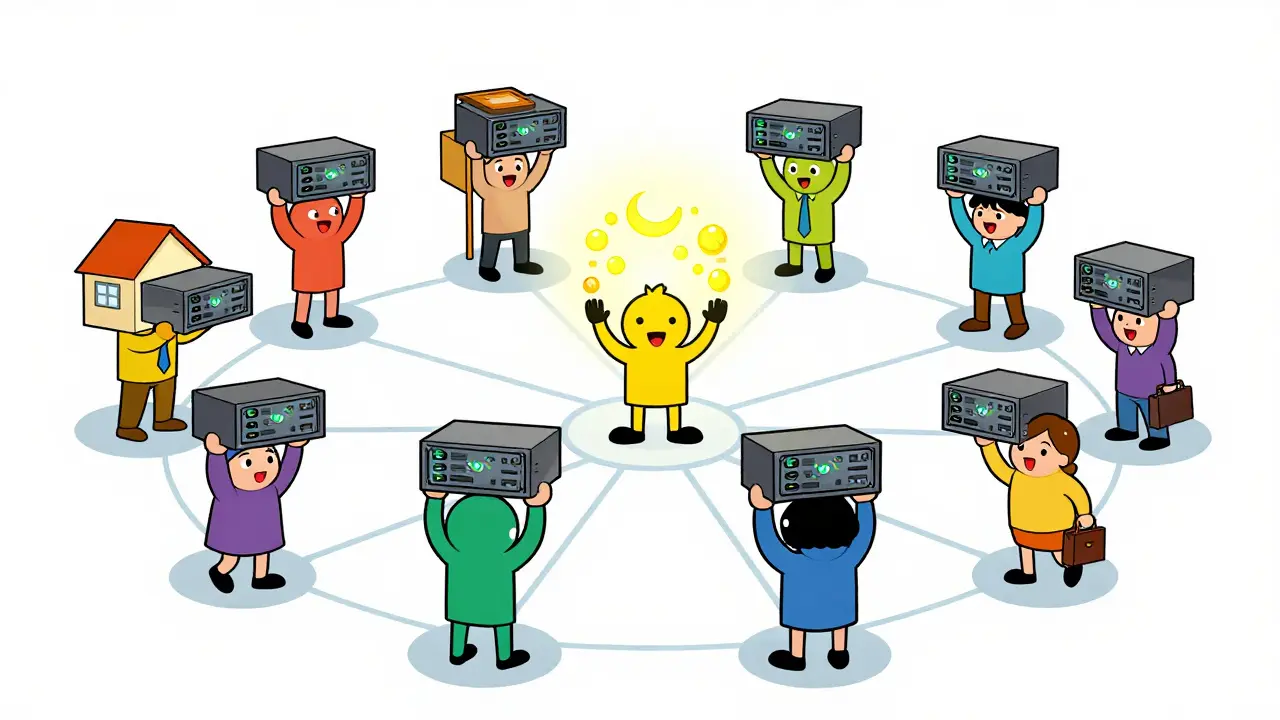
In 2026, decentralized storage has moved from experimental crypto-projects to viable enterprise alternatives. Platforms like Filecoin, a blockchain-based storage network that incentivizes users to rent out unused hard drive space, Storj, a decentralized cloud storage platform using Tardigrade protocol for secure data distribution, and Sia, a peer-to-peer storage marketplace utilizing smart contracts for data hosting are actively competing with traditional giants. But their economic models differ wildly. Some charge pennies per terabyte but nickel-and-dime you on downloads. Others offer stability at a higher base rate. Understanding these nuances is the only way to save money without sacrificing reliability.
The Big Picture: Centralized vs. Decentralized Pricing
Let’s look at the raw numbers first. According to research published by CoinGecko in late 2023, which remains a strong baseline for 2025-2026 market trends, the average cost for 1TB of storage per month on decentralized networks was approximately $2.11. Compare that to the average centralized provider charging around $9.88. That is a 78.6% reduction. For individual users, saving $7 a month might not change your life. For an enterprise storing petabytes of data, that difference translates into hundreds of thousands of dollars annually.
The disparity becomes even starker when looking at enterprise-grade object storage. Amazon S3, the industry standard for scalable cloud storage, charges roughly $23.00 per TB per month for standard storage. In contrast, Filecoin offers equivalent capacity for as low as $0.19 per TB per month. That is a 121x price difference. Why such a gap? Centralized providers build massive, energy-intensive data centers with redundant power, cooling, and physical security. They sell you convenience and SLAs (Service Level Agreements). Decentralized networks utilize idle hard drives in homes, small businesses, and server closets around the world. You are renting spare capacity, not premium real estate.
However, this model introduces volatility. Centralized prices are stable; they go up slowly over time due to inflation and infrastructure costs. Decentralized prices are tied to cryptocurrency tokens. When the token price crashes, storage providers may earn less and exit the network, reducing supply and potentially driving prices up-or causing data loss if redundancy fails. This trade-off between cost and stability is the core decision you must make.
Breaking Down the Costs by Platform
Not all decentralized storage solutions are created equal. Each platform uses different consensus mechanisms, encryption standards, and economic incentives. Here is how the major players stack up in terms of cost structure as of mid-2026.
| Platform | Storage Cost ($/TB/Month) | Egress/Download Fee ($/TB) | Best Use Case |
|---|---|---|---|
| Filecoin | $0.19 - $0.50 | $0.10 - $0.50 (varies by gateway) | Cold storage, archival, large-scale backups |
| Storj | $4.00 | $7.00 | Enterprise applications, active data access |
| Sia | $1.00 - $2.00 | Low (included in contract mostly) | Budget-conscious developers, long-term holds |
| Arweave | One-time fee (~$100/TB lifetime) | Free/Low | Permanent records, immutable data |
| BTFS | $2.24 | Variable (TRON ecosystem) | Web3 apps, TRON-based projects |
Filecoin stands out for its incredibly low storage rates. Its proof-of-replication and proof-of-spacetime mechanisms ensure data is actually stored, but the reliance on the FIL token means prices fluctuate. During bear markets, when FIL drops, providers may leave the network, temporarily raising costs or risking redundancy. However, for static data-like the Internet Archive’s Wayback Machine-it is unbeatable.
Storj takes a different approach. It charges a fixed $4.00 per TB for storage, which is higher than Filecoin but lower than AWS. The catch is the egress fee: downloading data costs $7.00 per TB. If you store data and rarely touch it, this is fine. If you are running a video streaming service or frequently accessing logs, those download fees will eat your savings alive. Storj is designed for enterprise integration, offering APIs that mimic S3 compatibility, making migration easier for developers.
Sia uses Reed-Solomon erasure coding to split files into segments, requiring only a portion of them to reconstruct data. This efficiency keeps costs low, typically between $1-$2 per TB. However, Sia’s pricing is heavily influenced by Siacoin volatility and contract formation fees. Sometimes, the fee to set up a new storage contract exceeds the monthly storage cost itself, making it better suited for long-term, infrequent changes rather than dynamic workloads.
Arweave operates on a one-time payment model. You pay once, and your data is stored forever. At roughly $100 per TB upfront, it seems expensive compared to monthly subscriptions. But if you need permanent, immutable storage-for legal records, historical archives, or NFT metadata-this eliminates the risk of forgotten subscription renewals leading to data loss.
Hidden Costs: Egress, Bandwidth, and Volatility
When comparing decentralized storage to centralized clouds, many users focus solely on the "storage per TB" metric. This is a mistake. The total cost of ownership includes three often-overlooked factors: egress fees, bandwidth limits, and cryptocurrency volatility.
Egress Fees: In centralized clouds, AWS offers free inbound data transfer but charges for outbound. Decentralized networks vary. Storj explicitly separates storage and egress, charging $7/TB for downloads. Filecoin relies on gateways, some of which are free, others paid. If you are building an application where users frequently download files, you must budget for this. A user on Reddit noted saving $12,000 annually on 50TB of storage via Filecoin but having to allocate extra funds for egress fees when retrieving critical datasets. Always calculate your read/write ratio.
Bandwidth and Retrieval Speed: Decentralized storage is not built for high-speed, low-latency access. Retrieving a file requires gathering pieces from multiple nodes across the globe. This introduces latency. For hot data-active databases, live web assets-centralized SSDs or CDN-backed services are still superior. Decentralized storage shines for cold data: backups, archives, and media libraries that are written once and read rarely.
Cryptocurrency Volatility: Most decentralized storage platforms require you to hold and spend their native token (FIL, STORJ, SC, etc.). If the token value drops 50% overnight, your purchasing power doubles, which sounds great. But if the token price collapses, storage providers may find it unprofitable to host your data and withdraw from the network. This can lead to reduced redundancy and slower retrieval times. To mitigate this, some enterprises use hedging strategies or stick to platforms with more stable tokenomics, like Storj’s hybrid model.
Who Should Switch? Decision Criteria for 2026
Should you migrate your data to a decentralized network? The answer depends on your specific use case. Here is a quick decision framework:
- Choose Filecoin if: You have massive amounts of static data (petabytes), need censorship resistance, and want the lowest possible storage cost. Ideal for archives, scientific data, and backup repositories.
- Choose Storj if: You need enterprise-grade API compatibility (S3-like), predictable monthly billing, and moderate access frequency. Good for startups and SMBs moving away from AWS without wanting to manage crypto wallets daily.
- Choose Arweave if: Data immutability is non-negotiable. You need to prove that a document existed at a certain time and cannot be altered. Perfect for legal, medical, or journalistic records.
- Stick with Centralized Cloud (AWS/Azure) if: Your data is "hot," requiring millisecond latency, high throughput, and complex compute integration. Decentralized storage does not yet replace compute-heavy environments.
For AI developers, the landscape is shifting. Training models requires vast datasets. Storing these datasets on Filecoin or emerging protocols like Walrus (anticipated to launch fully in 2026) can reduce infrastructure costs significantly. However, feeding data back into the training pipeline requires fast retrieval, which remains a bottleneck. Hybrid architectures-using decentralized storage for raw data lakes and centralized edge servers for active processing-are becoming the norm.

Implementation Challenges and Best Practices
Moving to decentralized storage is not plug-and-play. You will face technical hurdles. First, you need a cryptocurrency wallet and sufficient tokens to pay for storage and transactions. Onboarding typically takes 3-5 hours for technically proficient users, according to Alchemy’s 2025 developer survey. You must understand concepts like sharding, erasure coding, and node redundancy.
Second, data recovery is more complex. In AWS, you click "restore." In decentralized storage, you rely on the network’s health. If too many nodes go offline, your data fragments may become unrecoverable. Always maintain a local copy or a secondary backup until you are confident in the network’s stability. Monitor your data’s health regularly using dashboard tools provided by platforms like Storj or Filecoin’s Lotus client.
Third, consider the regulatory environment. The EU’s Digital Markets Act and evolving US regulations are scrutinizing data sovereignty. Decentralized storage distributes data globally, which can complicate compliance with GDPR or HIPAA. Ensure the platform you choose allows you to geofence nodes or encrypt data end-to-end with keys you control. End-to-end encryption is standard in most decentralized protocols, meaning even the storage providers cannot read your data-a significant privacy advantage over centralized clouds.
Future Outlook: Where Are Prices Heading?
The decentralized storage market is projected to grow at a 35% CAGR through 2030, reaching billions in valuation. As hardware costs drop-HDD prices approaching $0.01/GB by 2025-the theoretical floor for storage costs continues to fall. New entrants like Walrus aim to optimize for AI-specific workloads, potentially closing the performance gap while maintaining cost advantages.
Hybrid storage architectures are also emerging. Combining SSDs for speed and HDDs for capacity within decentralized networks could offer the best of both worlds. Expect platforms to introduce more user-friendly interfaces, abstracting away the complexity of crypto payments and node management. By 2027, we may see decentralized storage integrated seamlessly into operating systems and cloud dashboards, making the transition invisible to the end-user.
For now, the cost savings are real, but they require diligence. Do not just chase the lowest $/TB number. Look at the total cost including egress, assess your access patterns, and choose a platform whose economic model aligns with your data’s lifecycle. Decentralized storage is no longer a niche experiment; it is a strategic financial decision for any organization serious about scaling efficiently.
Is decentralized storage cheaper than AWS S3?
Yes, for storage alone. Filecoin can cost as little as $0.19/TB/month compared to AWS S3's ~$23.00/TB/month. However, you must account for egress fees and potential volatility. For cold storage, decentralized options are significantly cheaper. For hot, frequently accessed data, AWS may remain more cost-effective due to lower retrieval costs and higher performance.
What are the hidden costs of decentralized storage?
The main hidden costs are egress (download) fees, bandwidth limitations, and cryptocurrency transaction fees. For example, Storj charges $7/TB for downloads, which can exceed storage costs if you retrieve data often. Additionally, volatility in token prices can affect the long-term affordability and stability of your storage contracts.
Can I use decentralized storage for my website's images?
Generally, no. Decentralized storage has higher latency and variable retrieval speeds. Websites require fast, consistent loading times. Use decentralized storage for backups or archival copies of your assets, but serve live content from a CDN or centralized cloud object storage like AWS S3 or Cloudflare R2.
Is my data safe on decentralized networks?
Data safety depends on redundancy and encryption. Most platforms use erasure coding to split files into encrypted shards stored across multiple nodes. As long as enough nodes remain online, your data is recoverable. However, unlike centralized providers, there is no single company liable for data loss. Always verify the platform's uptime history and maintain local backups for critical data.
Do I need to know blockchain to use decentralized storage?
Basic knowledge helps, but it is not strictly necessary. You will need to set up a digital wallet and purchase cryptocurrency to pay for storage. Platforms like Storj offer user-friendly dashboards that abstract much of the blockchain complexity. However, understanding concepts like gas fees, token volatility, and private key management is crucial for avoiding costly mistakes.