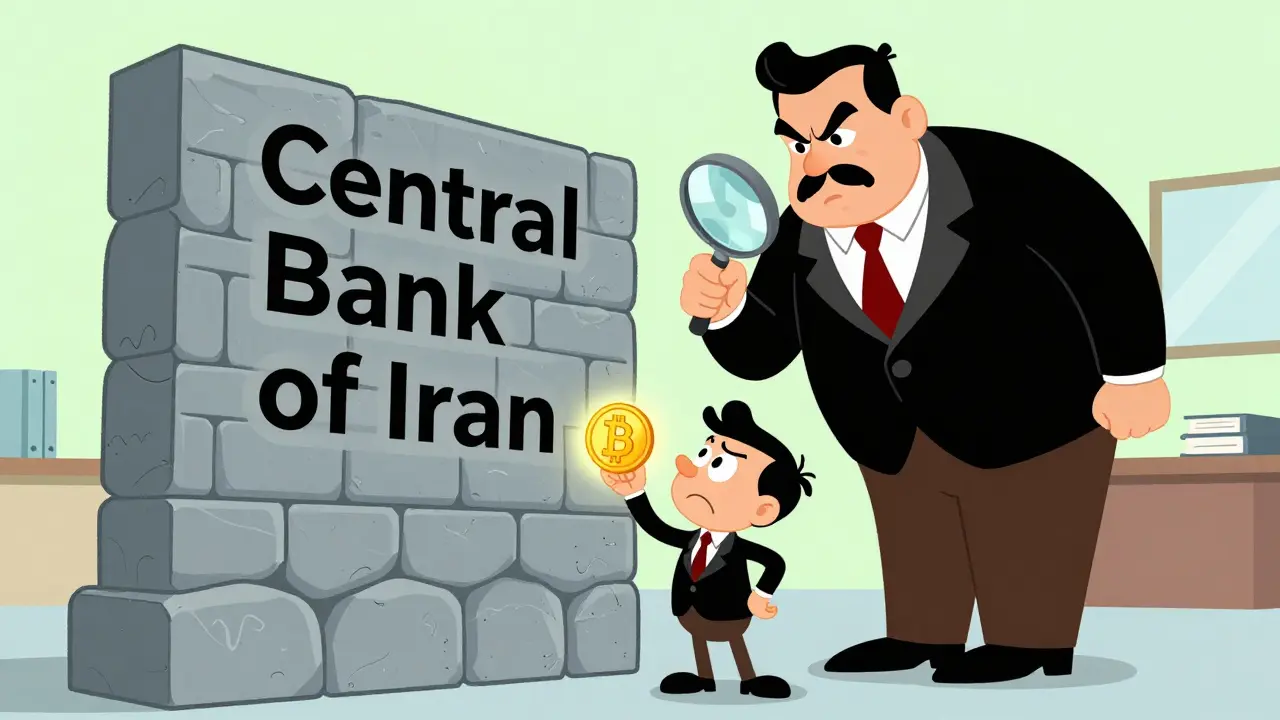
If you're running a business in Iran, you've probably noticed that the answer to "Can I accept crypto?" isn't a simple yes or no. It's more like a "yes, but only if you follow a very specific, government-monitored path." While the country hasn't banned the use of digital assets entirely, the regulatory walls are high, and the oversight is absolute. If you try to bypass the official channels, you're not just risking a fine-you're risking your entire operation.
| Feature | Legal Requirement / Status |
|---|---|
| Direct Customer Payments | Prohibited (Must use CBI-approved intermediaries) |
| Primary Regulator | Central Bank of Iran (CBI) |
| Required Tool | Foreign Exchange (FX) Card |
| Tax Rate | 25% on profits over 50 million rials |
| Advertising | Banned since February 2025 |
The Legal Framework: Who Holds the Keys?
To understand if you can legally take payments, you have to look at the Presidential Directive No. 1403/12456 issued in early 2025. This document essentially handed all the power to the Central Bank of Iran (CBI). In short, the CBI is the only entity that can license, oversee, and set the rules for both global coins like Bitcoin and stablecoins.
Here is the catch: you cannot simply set up a wallet and tell your customers to send coins there. That would be illegal. To stay on the right side of the law, businesses must operate through CBI-approved exchanges. This ensures that every single conversion from cryptocurrency to Iranian rials happens through a designated account that the government can see in real-time. The CBI doesn't just monitor these transactions; they have 100% data access rights. In the eyes of the regulator, transparency is non-negotiable.
The FX Card Hurdle and Operational Constraints
One of the biggest headaches for business owners is the mandatory use of the Foreign Exchange Card (or FX Card). This isn't just a payment method; it's a control mechanism. Under the "Resilience of the Foreign Exchange System" Bill, any business using crypto for trade is essentially entering a foreign exchange contract with the state.
If you use a crypto transaction to acquire goods or services, you are often required to return an equivalent amount of foreign currency to the FX Card system within one year. This creates a massive cash-flow problem. In fact, around 74% of surveyed businesses report that this repatriation requirement is their biggest struggle, often forcing them to take out high-interest loans-averaging 22.4% annually-just to meet the government's deadline.
Then there is the issue of crypto legal status Iran regarding promotion. Since February 2025, there has been a total advertising ban. You can't put a "We Accept Bitcoin" sticker in your window or post it on your Instagram page. You can accept the payment if the customer asks and you have the licenses, but you cannot actively market it as a payment option.
Taxes, Mining, and the Cost of Non-Compliance
If you've been treating your business crypto holdings as a tax-free piggy bank, the party is over. As of August 15, 2025, the "Law on Taxation of Speculation and Profiteering" is in full effect. If your business makes a profit on crypto trading exceeding 50 million rials (roughly $1,000 USD), you're looking at a 25% tax rate. For those with massive gains, the rates can climb as high as 35% for profits over 500 million rials.
For those tempted to start a side-mining operation to offset costs, be careful. The government has become aggressive toward unlicensed mining. Following major power outages in late 2024, the state began shutting down unauthorized rigs. If you're caught mining without a license, you'll face an immediate shutdown and fines totaling 200% of the electricity costs you consumed. The state views electricity as a strategic resource, not a free perk for miners.

Getting Licensed: The Step-by-Step Process
Actually getting the green light to accept crypto is a bureaucratic marathon. You don't just sign up for an account; you apply for a license. The CBI uses a three-tier verification system that is notoriously slow, with an average processing time of 23 business days.
- Document Submission: You must provide 17 specific documents. This includes your commercial registration, tax identification, and-crucially-energy consumption certificates to prove you aren't illegally mining.
- Technical Integration: You must integrate the CBI's API gateway. This isn't a simple plug-and-play; the API requires 55 specific data points for every transaction. This adds about 4.7 seconds to your checkout time, which might not sound like much, but it impacts the user experience.
- Ongoing Reporting: Once you're live, the work doesn't stop. You have to use Form CR-2025/07 for monthly reporting. Most accountants report that this adds about 8.3 hours of extra work every month just to keep the books straight for the CBI.
Stablecoins and the Shift Away from Tether
For a long time, Tether (USDT) was the gold standard for stability in Iran. However, that changed in July 2025 when Tether froze 42 Iranian-linked addresses, locking up about $12.7 million. This sent a shockwave through the merchant community. It proved that relying on a single, centralized issuer based in the US or abroad is a massive risk.
As a result, we're seeing a huge migration toward DAI and other decentralized stablecoins, often utilizing the Polygon network. By 2026, experts predict that nearly 85% of business transactions will move away from USDT to avoid the risk of sudden freezes. If you're setting up your payment flow today, diversifying your stablecoin options is the only way to ensure your funds don't vanish overnight.

Real-World Examples: Who is Doing it Right?
Despite the red tape, some are thriving. Take Digikala, the e-commerce giant. They managed to process $4.2 million in crypto transactions in Q1 2025 by sticking strictly to the approved channels and the CBI API. They didn't try to cut corners, and as a result, they've had zero compliance violations.
On the other hand, smaller businesses are struggling. Many users of platforms like Wallex.ir report a 32% rejection rate for small business license applications. The system is heavily weighted toward larger entities that can afford the 17-document audit and the high cost of specialized compliance consultants.
Looking Ahead: The Rise of the Digital Rial
The endgame for the Iranian government isn't actually Bitcoin or Ethereum-it's the "Rial Currency." This Central Bank Digital Currency (CBDC), slated for pilot testing in late 2025, is designed to be "electronic cash." The goal is to give businesses the efficiency of digital payments without the "uncontrollable" nature of global cryptocurrencies.
When the Digital Rial becomes mainstream, the need for global crypto as a payment bridge will likely drop. The government wants the speed of blockchain but the control of a traditional ledger. Until then, businesses will continue to navigate this tightrope-balancing the need for modern payment methods with the crushing weight of state surveillance and foreign exchange obligations.
Can I accept Bitcoin directly into my own private wallet?
No. For a business, this is illegal. All transactions must go through Central Bank of Iran (CBI) approved exchanges and use the mandated API gateway to ensure the government has 100% visibility into the transaction.
What is the FX Card and why do I need it?
The Foreign Exchange Card is a government tool used to track and control the flow of foreign currency. Businesses using crypto for trade must use this card and are often required to return an equivalent amount of foreign currency to the system within one year.
Do I have to pay tax on crypto profits in Iran?
Yes. Under the Law on Taxation of Speculation and Profiteering (August 2025), profits exceeding 50 million rials are taxed at 25%. Higher profits can be taxed up to 35%.
Is it legal to advertise that my shop accepts cryptocurrency?
No. As of February 2025, there is a strict ban on promoting cryptocurrency payment options through any media channel, including social media and physical signage.
Which stablecoin is safest for businesses in Iran?
Due to the 2025 Tether (USDT) freezes, many businesses are shifting to decentralized options like DAI, often utilizing the Polygon network to avoid centralized issuer risks.
How long does it take to get a crypto license from the CBI?
On average, the process takes about 23 business days, provided you have all 17 required documents, including tax IDs and energy certificates.
EDOZIEM MICHAEL
April 12, 2026 AT 02:11money is just a collective hallucination anyway so adding another layer of digital rules is just a dance of shadows
Chidinma Sandra okafor
April 12, 2026 AT 17:21Oh please, imagine thinking a government that can't even manage its own currency would successfully run a CBDC. Absolutely laughable. We see this pattern everywhere and it always ends in a disaster that only the poor suffer for. Typical state control theater.
Samson Selleck
April 14, 2026 AT 09:31The systemic inefficiency here is palpable. Integrating a legacy bureaucratic framework with a decentralized protocol via a proprietary API gateway is a textbook example of cognitive dissonance in regulatory design. The latency introduced by those 55 data points is an egregious affront to high-frequency transactional throughput.
James Bone
April 14, 2026 AT 23:14Honestly, if you're actually paying 25% tax on crypto in a place like that, you're basically asking to be robbed. It's a moral failure to support systems that punish innovation just to fund a bloated central bank. Wake up people.
Adam Auksel
April 15, 2026 AT 02:35It's really interesting to see how different countries adapt! 🌍 Even with the red tape, some businesses are finding a way to grow. Keep exploring those options! 🚀
Aaliyah BROTHERS
April 15, 2026 AT 06:40Total surveillance state!!! They want EVERY SINGLE PENNY tracked!!! This is exactly how it starts people!!! The "Digital Rial" is just a fancy name for a digital shackle!!! Absolutely disgusting that they think they can just freeze funds on a whim!!! WAKE UP!!!
Heather Warren
April 16, 2026 AT 20:29Moving to DAI on Polygon seems like a very smart move for anyone wanting to avoid centralization. It is a great way to keep your funds safe while still using the technology.
Kieran Smith
April 17, 2026 AT 22:49that fx card thing sounds like a total nightmare tho. imagine having to pay back the gov just cuz you did a trade... sounds crazy lol
Surender Kumar
April 18, 2026 AT 21:33polygon is definitely the way to go for low fees. hope more small shops find a way to make it work despite the rules
daniella davis
April 19, 2026 AT 06:38omg please... as if anyone actually believes the 23 day processing time is just "slow". it's obviously just a way for them to take bribes behind the scenes lol. i've seen this a million times
Lela Singh
April 20, 2026 AT 13:19Diversify your portfolios! 💥 Use decentralized bridges! Stay agile!
7stargee Emmanuel Obani
April 22, 2026 AT 00:1525% tax is a joke 🤡
Kelly Cantrell
April 22, 2026 AT 20:42This is all just a front for the globalists to test how to implement social credit scores through currency. They use these regions as laboratories before they bring the same "API gateways" to our own shores. It's too obvious.
Terrance Hausmann
April 23, 2026 AT 04:34It's a tough situation, but I think it's important to remember that every country is just trying to find its footing with this new tech. Maybe if we approach it with more empathy and less judgment, we can find a middle ground where innovation and regulation coexist peacefully without crushing the small business owner.
Will Dixon
April 23, 2026 AT 06:44just use a vpn and a foreign account man. dont let them track ya
Lauren Abrams
April 23, 2026 AT 15:26I wonder if the shift to DAI will actually lower the overall risk or if it just moves the point of failure to the smart contract level instead of the issuer level.