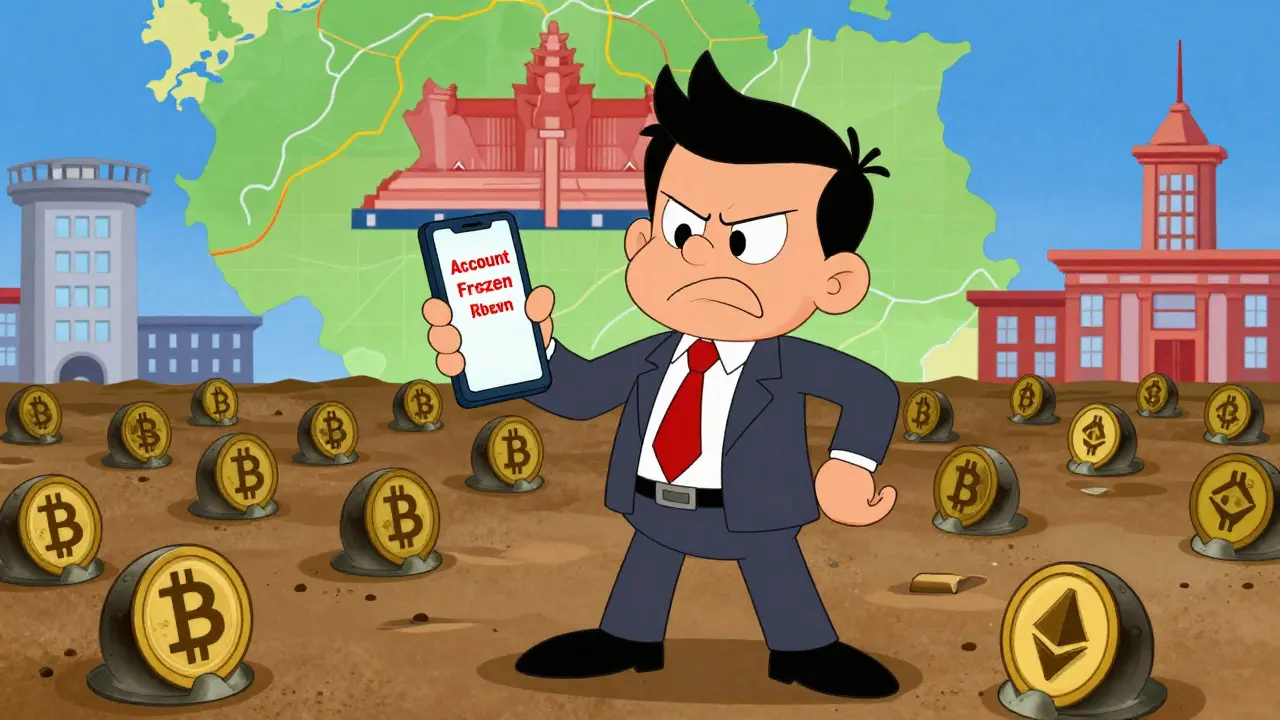
Trying to send money or trade cryptocurrency in Cambodia right now feels like walking through a minefield. One minute you’re using an app, the next your bank account is frozen because a transaction triggered an automated flag. For years, the country was a gray zone for digital assets, but that changed dramatically with new rules enforced by the National Bank of Cambodia (NBC) in early 2025.
If you are living in Phnom Penh, running a business in Siem Reap, or just trying to send remittances home, these restrictions directly impact how you move money. The NBC has moved from a vague warning to a strict legal framework that splits crypto into two very different buckets. This article breaks down exactly what is allowed, what is banned, and how you can navigate the system without losing your funds.
The Two-Tier System: Group 1 vs. Group 2 Assets
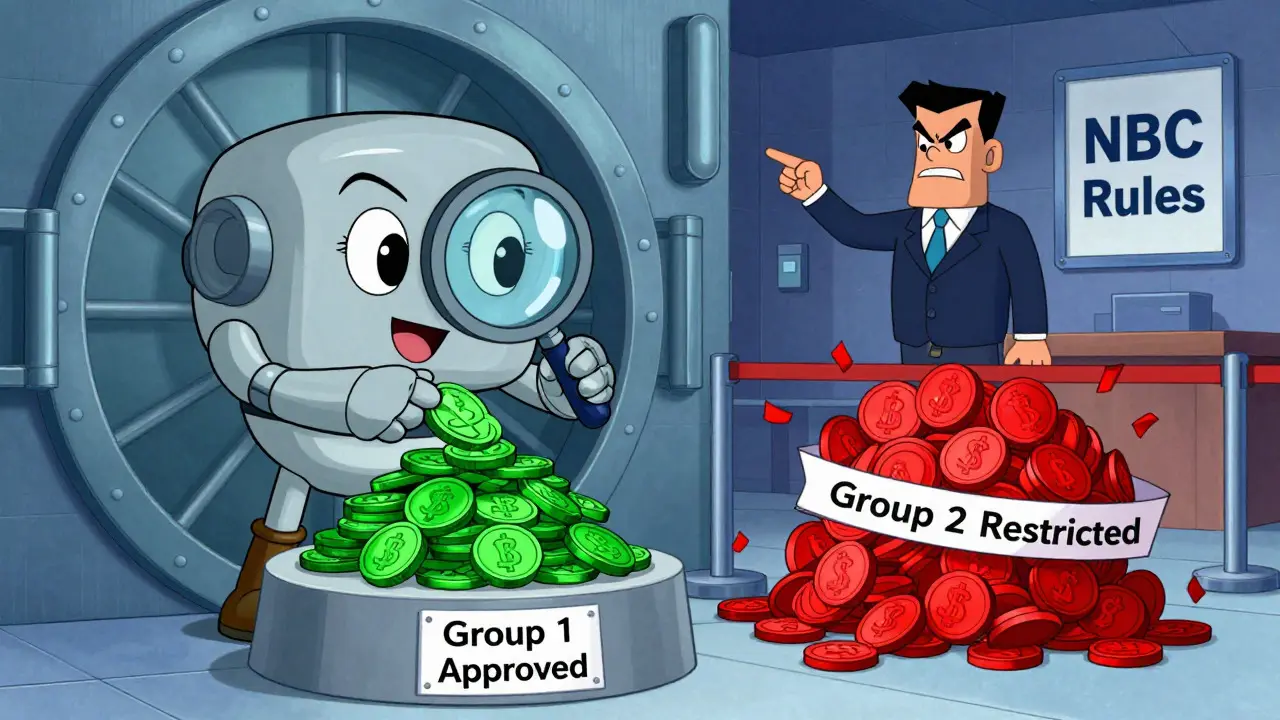
The core of the current restriction lies in Prakas B7-024-735 Prokor, a regulation passed in late December 2024 and effective January 2025. This rule creates a formal classification system for all digital assets. Understanding this split is crucial because it determines whether a bank will touch your money or block it entirely.
- Group 1 (Approved): These include tokenized securities and approved stablecoins backed by traditional assets. Think of these as digital versions of cash or bonds. Banks can hold these, but only up to 15% of their Tier 1 capital. They must get prior approval from the NBC before investing.
- Group 2 (Restricted): This includes Bitcoin, Ethereum, and other unbacked cryptocurrencies. Commercial banks are prohibited from holding these on their balance sheets. However, they can provide services like custody or exchange if they have specific NBC approval and follow strict anti-money laundering (AML) protocols.
This distinction matters because most retail users want to trade Group 2 assets. Since banks cannot hold them directly, the friction increases significantly when you try to convert fiat currency (like USD or Riel) into Bitcoin via a bank transfer.
Why Did the Rules Tighten? The Scam Center Crisis
You might wonder why Cambodia, which previously tolerated crypto, suddenly cracked down so hard. The answer isn’t just about financial stability; it’s about international pressure and reputation.
In September 2024, the U.S. Department of the Treasury’s Office of Foreign Assets Control (OFAC) sanctioned several Cambodian entities linked to online scam centers. These centers often used virtual currencies to launder money from victims worldwide. By December 2024, the Telecommunication Regulator of Cambodia (TRC) blocked access to 16 major offshore exchanges, including Binance, Coinbase, and OKX, citing lack of local licensing.
The NBC’s goal is clear: stop illicit flows to avoid further sanctions while protecting the domestic banking sector from volatility. As Chea Serey, Director General of Financial Institutions Regulation at the NBC, stated, the framework is necessary to prevent a collapse similar to Thailand’s Bitkub crisis, which could destabilize Cambodia’s $28 billion banking sector.
How Banks Are Enforcing the Ban
For the average user, the enforcement happens at the point of entry-your mobile wallet or bank app. Here is what you need to know about the operational reality:
- Auto-Flagging Systems: Most major banks and e-wallets like Wing Money have implemented AI-driven monitoring. If you make three small transactions to a known P2P platform within a short window, your account may be frozen for 14 days pending review.
- The Travel Rule: Any transaction exceeding $3,000 must comply with the FATF’s ‘Travel Rule.’ This means your identity and the recipient’s details must be shared between institutions. Suspicious activities must be reported to the Anti-Money Laundering Committee (AMLC) within 24 hours.
- Licensing Hurdles: To operate legally, Crypto Asset Service Providers (CASPs) must join the SERC FinTech Regulatory Sandbox. As of early 2025, only two entities-Royal Group Exchange and certain Bakong-based platforms-have received full authorization.
This creates a bottleneck. If you try to use an unlicensed offshore exchange, your bank transfer will likely fail or trigger a freeze. If you use a licensed provider, you face higher fees and stricter documentation requirements.
| Feature | Licensed Platforms (e.g., Royal Group Exchange) | Unlicensed/Offshore Exchanges (e.g., Binance P2P) |
|---|---|---|
| Bank Transfer Acceptance | High (Pre-approved channels) | Low (High risk of freeze/rejection) |
| Daily Limits | Up to $5,000 (with verification) | Variable (Depends on peer seller) |
| Fees | ~0.8% - 1.5% | ~0.1% - 0.5% (but hidden risks) |
| Account Freeze Risk | Very Low | d>High (14-day freezes common)|
| Regulatory Status | SERC Approved | Blocked/Unregulated |
The Rise of Project Bakong as the Alternative
While restricting open blockchain networks, the NBC is pushing its own solution: Project Bakong. Launched in 2020 with support from Japan’s JICA, Bakong is a blockchain-based payment system that connects 62 banks and processes millions of daily transactions.
As of Q4 2024, Bakong reached 65% population penetration, serving 12.4 million users. It allows instant transfers between banks and e-wallets without the high fees of traditional cross-border wires. However, critics argue that Bakong is a closed loop. It does not integrate with open decentralized finance (DeFi) protocols, meaning you still can’t easily move Bakong-balance funds into Bitcoin without going through a licensed intermediary.
Dr. Tran Thi Minh, a Fintech Specialist for Southeast Asia at the World Bank, notes that while Bakong proves Cambodia’s technical capacity, the refusal to connect to open networks limits its potential for global financial inclusion.

Real-World Impact on Users and Businesses
The restrictions have created a divide between casual users and serious traders. For small-scale remittances, the system works reasonably well if you stick to licensed apps. But for larger volumes, the friction is significant.
For Retail Traders: You will notice longer processing times. Fiat-to-crypto conversions now take an average of 15 days due to compliance checks. Trustpilot reviews for services like Wing Money show a drop in ratings specifically regarding crypto features, with many users complaining about excessive documentation requests.
For Businesses: Legitimate businesses seeking funding face hurdles. AgriTech startup RiceX managed to secure $2 million in stablecoin funding through NBC-approved channels, but it took 10 days of approval processes. Meanwhile, smaller startups struggle with the 90-120 day timeline required for banks to get CASP authorization.
For the Unbanked: Paradoxically, the crackdown hurts those it aims to protect. With 68% of rural Cambodians lacking formal bank access, crypto was a viable alternative for receiving remittances. Now, with banks wary of any crypto-linked activity, these populations face higher barriers to entry.
What Comes Next? 2026 Outlook
The trend for 2026 is tighter control, not relaxation. The NBC’s roadmap includes mandatory real-time transaction monitoring for all crypto-fiat conversions. Expect more P2P platforms to be restricted as the government tries to close loopholes.
International pressure remains high. With South Korean exchanges seeing a 1,400x increase in transactions with sanctioned Cambodian entities in 2024, the U.S. Treasury may impose further sanctions. This forces Cambodian banks to over-comply, meaning even legitimate transactions might get flagged out of caution.
However, there is a silver lining for institutional players. If you are a large enterprise, working through the SERC sandbox offers regulatory certainty. The cost is time and paperwork, but the security of knowing your funds won’t be frozen overnight is valuable.
Can I still buy Bitcoin in Cambodia?
Yes, but it is difficult. You cannot buy it directly through most commercial banks. You must use a licensed Crypto Asset Service Provider (CASP) like Royal Group Exchange. Using unlicensed offshore exchanges via P2P methods carries a high risk of having your bank account frozen.
Why was my Wing Money account frozen?
Your account was likely frozen due to auto-flagging systems detecting patterns associated with P2P crypto trading. The NBC requires banks to monitor for suspicious activity. If you made multiple small transfers to unknown peers, the system may have flagged it for a 14-day review to ensure no money laundering occurred.
Is Project Bakong safe to use?
Yes, Project Bakong is highly secure and regulated by the National Bank of Cambodia. It is designed for fiat currency transfers (USD and Riel). While it uses blockchain technology, it operates as a closed system connected to licensed banks, making it safer than open decentralized wallets for everyday payments.
Which crypto exchanges are legal in Cambodia?
As of early 2025, only entities authorized under the SERC FinTech Regulatory Sandbox are fully legal. Currently, this includes Royal Group Exchange and specific Bakong-integrated platforms. Major global exchanges like Binance and Coinbase are blocked at the ISP level and considered unlicensed locally.
Will the restrictions ease in 2026?
Unlikely. The NBC’s 2025-2026 roadmap indicates a tightening of controls, including mandatory real-time monitoring for all crypto-fiat conversions. The focus remains on preventing illicit flows and promoting the domestic CBDC pathway via Bakong rather than integrating with global crypto markets.
Namrata Mapgaonkar
August 6, 2026 AT 10:18omg this is so stressful to read :( i just want to send money to my family in phnom penh without getting flagged by some ai robot. it feels like living in a surveillance state now. why can't we just trust people? :/
Pernelia Wahkan
August 7, 2026 AT 22:37The bifurcation of assets into Group 1 and Group 2 is a fascinating, albeit draconian, maneuver by the NBC. It essentially creates a two-tier financial citizenship where only the compliant or the wealthy can navigate the crypto landscape with ease. The reliance on Project Bakong as a closed-loop solution is particularly intriguing; it’s a digital walled garden that prioritizes control over true decentralization. One must wonder if this stifles innovation more than it protects the populace.
Subhash Kashyap Dm
August 8, 2026 AT 18:10they are watching you every move matters the scam centers were just an excuse to crush freedom of capital flow. bakong is a trap a honeypot for your data while they freeze your accounts if you deviate from their script. wake up sheeple the fed wants your money under glass not in your wallet. no privacy no freedom just compliance chains binding your soul to the bank ledger forever
Billy Cunningham
August 10, 2026 AT 15:11This article made me feel so anxious 😰 I checked my Wing Money app three times today just to be sure everything was okay. It’s scary how quickly things can change 📉
Ed Wallace
August 10, 2026 AT 18:40It seems we are witnessing the dawn of a new era in monetary philosophy, one where sovereignty is traded for security. The NBC’s approach mirrors a broader global trend towards centralized digital currencies, effectively ending the experiment of wild west crypto. While it brings stability, does it also bring stagnation? Perhaps the friction is necessary to filter out the noise, but at what cost to the individual’s autonomy?
Joshua Hofford
August 12, 2026 AT 16:29Hey everyone! Look on the bright side, right? At least we have Royal Group Exchange now. It’s all about finding the silver lining in these regulatory clouds. Sure, the fees are higher, but think of the peace of mind! We’re building a safer financial future together, even if it means filling out a few extra forms. Stay positive and keep those remittances flowing safely! ✨
Marcia Albert
August 14, 2026 AT 10:31I’ve been watching this unfold from afar, and it’s quite a spectacle. The way they’ve carved out these 'approved' zones feels like drawing lines in the sand against a rising tide. It’s messy, chaotic, and honestly, a bit absurd. But then again, isn’t that just human nature trying to tame the wild beast of technology? Let’s see who blinks first.
Emma Smith
August 15, 2026 AT 13:00you think you own your money but really you are just renting access to value through their benevolent gatekeepers. the travel rule is just spyware for your wallet tracking every whisper of dissent in the form of transaction history. soon they will tax your thoughts too if they are linked to unbacked assets. join the resistance use cash go off grid before the net closes completely around us all
Ed Mitchell
August 16, 2026 AT 12:04THEY ARE LYING TO YOU ALL OF IT IS A COVER UP FOR THE ELITES STEALING YOUR SAVINGS UNDER THE GUISE OF ANTI MONEY LAUNDERING LAWS WHICH ARE MERELY TOOLS OF OPPRESSION AGAINST THE COMMON MAN WHO DARES TO HOLD VALUE OUTSIDE THEIR CORRUPT SYSTEMS WAKE UP BEFORE THEY FREEZE YOUR LIFE AWAY FOREVER AND EVER AMEN
Erica Johnson
August 17, 2026 AT 23:13Oh please, let’s not pretend this is complicated. If you’re doing anything shady, you deserve to get caught. The rules are simple: follow them or lose your account. It’s not rocket science, it’s basic compliance. Stop complaining and start reading the terms of service. :)
Ken G
August 18, 2026 AT 15:17moral decay is evident when people complain about losing access to stolen goods. the system works because most people are lazy and dishonest. if you cant handle a few forms you dont deserve financial freedom. keep your head down and do what you are told otherwise you are part of the problem not the solution
Lorraine Surringer
August 19, 2026 AT 17:02Listen here sweetie, its not about control its about protection. you think you know better than the experts? please. stop whining and adapt to the new normal. its either that or stay poor and confused. embrace the bakong life its the only way forward for civilized folks like us xoxo