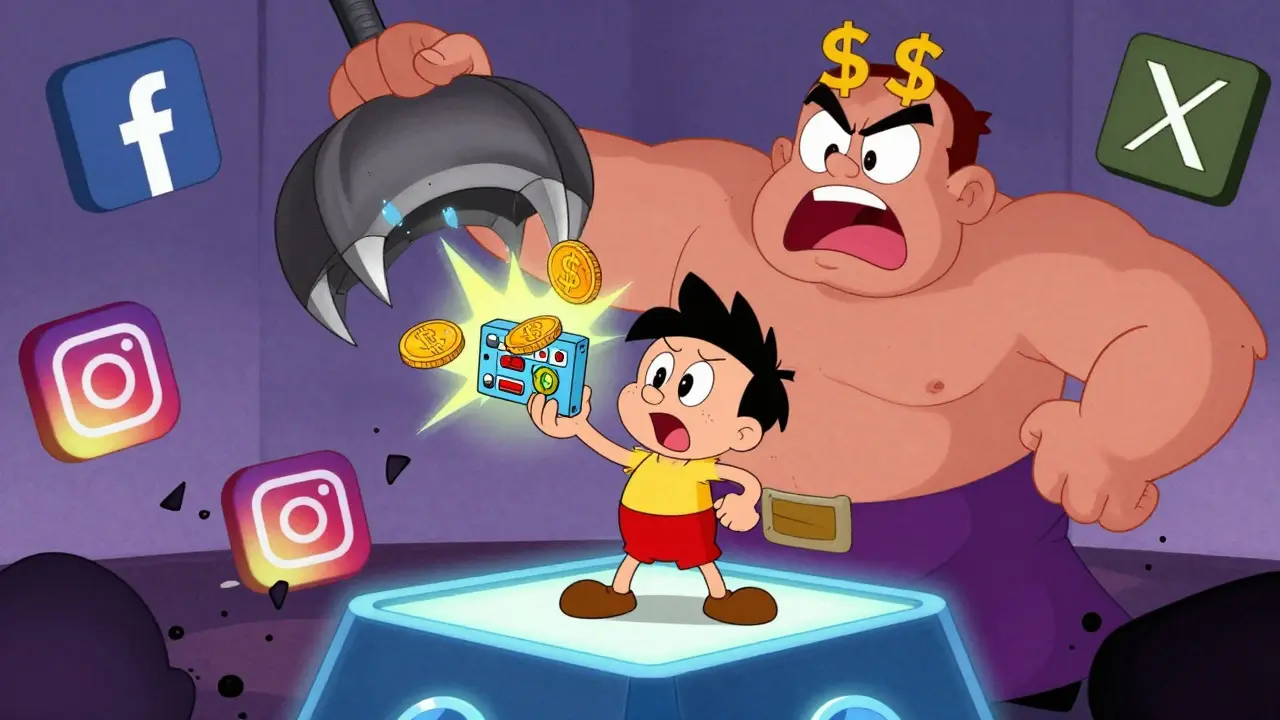
Imagine posting a video that goes viral-only to find out the platform keeps 90% of the ad revenue, your data gets sold to advertisers, and your account gets deleted for violating a rule you never saw. This isn’t a conspiracy. It’s how traditional social media works today. Meanwhile, a quiet revolution is brewing on blockchain networks, where your profile is yours to keep, your content earns you crypto, and no single company can silence you. But is this future ready for everyday users? Or is it still stuck in tech-lab mode?
Who Controls Your Data?
On Facebook, Instagram, or X (formerly Twitter), your profile, posts, likes, and even your private messages belong to the company. They store it on their servers. They decide when to delete it. They sell access to it. You don’t own your account-you’re just a product being sold to advertisers. Blockchain social media flips this. Your profile isn’t stored on a company’s server. It’s stored on a public blockchain as a non-fungible token (NFT). Platforms like Lens Protocol is a decentralized social graph built on Polygon that lets users own their profiles as NFTs, which can be used across any app that supports the protocol. means your profile follows you. Want to leave Lens and try Farcaster? You can. Your followers, posts, and reputation come with you. No re-following. No starting over. Traditional platforms lock you in. If you get banned, you lose everything. On blockchain platforms, your data lives on the chain. Even if the app shuts down, your profile still exists. You can rebuild your network elsewhere using the same identity.How Do Creators Get Paid?
On YouTube, TikTok, or Instagram, creators earn money through brand deals, affiliate links, or ad revenue shares-usually after hitting arbitrary follower thresholds. Most never make more than $100 a month. The platform takes the bulk. Blockchain platforms pay creators directly. On Steemit is a blockchain-based social network where users earn Steem tokens and Steem-Based Dollars (SBD) for posting, commenting, and upvoting content. , you get paid in crypto every time someone upvotes your post. On Diamond App is a social platform on the DeSo blockchain where each user can create their own tradable "creator coin" that followers can buy and sell. , you launch your own digital currency. If your content grows, so does your coin’s value. Followers invest in you-not just by liking, but by buying shares. Farcaster users can pay $5-$15 a year for a unique username (like @mike), and that money goes directly to them. No middleman. No algorithm deciding who gets seen. If your content is good, people pay you. Traditional platforms make money from ads. Blockchain platforms make money from users paying for features or trading tokens. Creators aren’t begging for sponsorships-they’re building real economic relationships with their audience.Who Decides What You See?
Traditional platforms use secret algorithms to feed you content. These algorithms are designed to keep you scrolling-often by pushing outrage, misinformation, or extreme content. You don’t control your feed. The company does. On Mastodon, there’s no algorithm. You follow people. You see their posts in order. No manipulation. No dark patterns. It’s like the early internet-simple, direct, human. Blockchain platforms like Lens Protocol and Farcaster let you choose your own feed. You can use any app that connects to their protocol. One app might show you trending posts. Another might show you only posts from people you follow. A third might filter out posts with certain keywords. You’re not stuck with one feed. You build your own. Even moderation is different. On Facebook, a team of moderators-often underpaid and overworked-decides what’s allowed. On Mastodon, each server (or "instance") sets its own rules. Some are strict. Some are wild. You pick the community that fits you.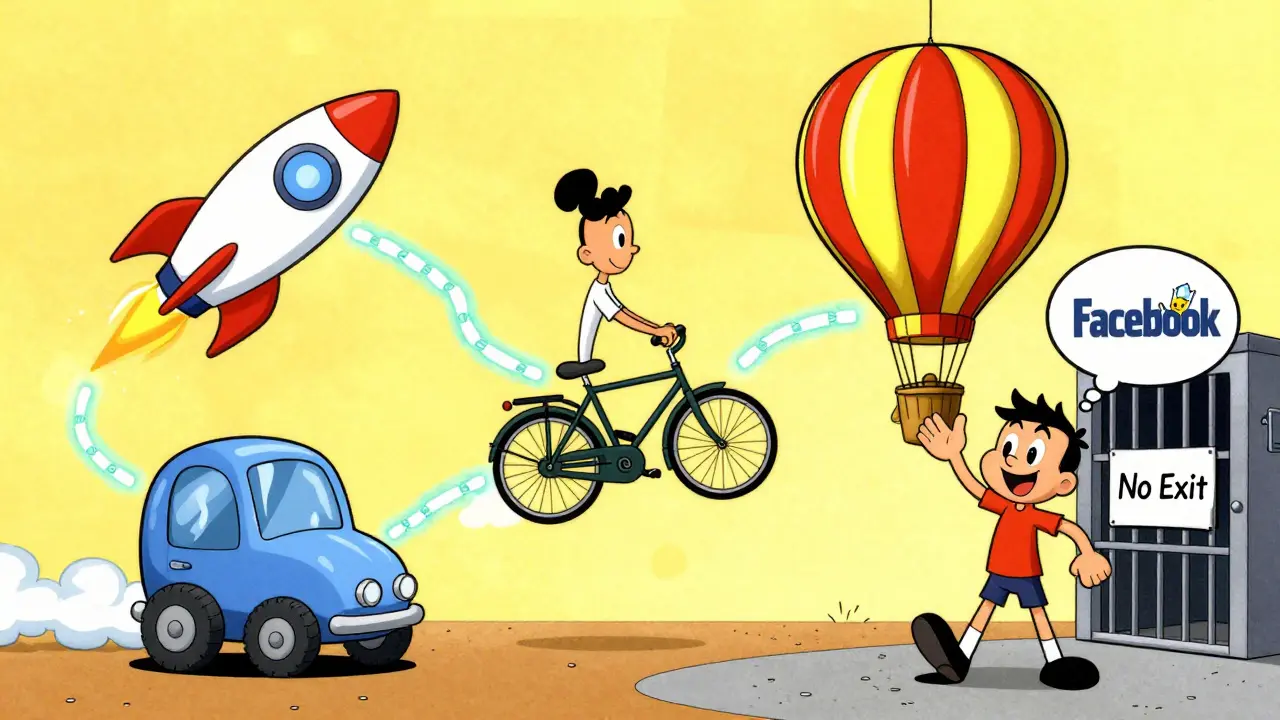
Why Isn’t Everyone Using Blockchain Social Media?
Because it’s still hard. To join Lens Protocol, you need a crypto wallet (like MetaMask), some Ethereum (or Polygon) to pay for gas fees, and you have to understand what an NFT is. That’s a 20-minute setup for someone who’s tech-savvy. For most people? It’s a wall. Traditional platforms? Open the app. Sign up with your email. Done. In 90 seconds, you’re posting. Most blockchain social platforms have a 60-80% drop-off rate during onboarding. People get excited. Then they hit the wallet screen. And they quit. Performance is another issue. Posting a photo on Instagram takes a second. On some blockchain platforms, it can take 10-30 seconds because each action needs to be confirmed on the blockchain. Transaction fees can add up. A simple comment might cost $0.50 in gas. That’s not sustainable for casual use. Farcaster and Lens Protocol are trying to fix this. Farcaster now offers "gasless" transactions for basic actions. Lens Protocol has simplified wallet setup. But they’re still years away from matching the speed and simplicity of TikTok or Instagram.Who’s Winning Right Now?
Let’s be clear: traditional platforms still dominate. Facebook has over 3 billion users. Instagram has 2 billion. X has 600 million. The largest blockchain social platform, Mastodon, has about 15 million users. That’s less than 1% of the total. But growth is happening. Mastodon’s user base has doubled since 2022. Farcaster hit 1 million users in late 2024. Lens Protocol has over 500,000 active profiles. These aren’t big numbers yet-but they’re growing fast among early adopters: crypto users, indie creators, journalists, and privacy advocates. The real winners right now are the platforms that combine blockchain benefits with familiar interfaces. Bluesky, built on the AT Protocol (federated, not blockchain), has grown to 13 million users by mimicking Twitter’s design but without centralized control. It’s not blockchain-but it’s the closest thing most people will use before they’re ready for crypto wallets.
Will Blockchain Social Media Replace Facebook?
No. Not anytime soon. Facebook isn’t going anywhere. It’s too big. Too embedded. Too convenient. But it’s also too broken. People are tired of being tracked. Tired of ads. Tired of losing their voice. Blockchain social media won’t replace it. It will offer an alternative. A choice. A place for creators who want to own their work. For users who want control over their data. For communities that want to set their own rules. Think of it like email. You still use Gmail. But you can also use ProtonMail if you care about privacy. You still use Instagram. But you can also use Mastodon if you care about freedom. The future isn’t one platform to rule them all. It’s many platforms, each serving different needs. Blockchain social media isn’t the end of traditional platforms. It’s the beginning of a more open, fair, and user-powered internet.What Should You Try?
If you’re curious, start here:- For simplicity and no ads: Try Mastodon is a decentralized, open-source social network where users join independent servers with their own rules, offering an ad-free alternative to Twitter. . No crypto needed. Just pick a server and go.
- For creators who want to earn: Try Farcaster is a decentralized social protocol on Ethereum’s Optimism layer that allows users to own their identity and monetize through paid usernames and cross-app functionality. . It’s Twitter-like but with real ownership and monetization.
- For the tech-curious: Try Lens Protocol is a decentralized social graph on Polygon that enables NFT-based profiles and interoperability across multiple apps, allowing users to port their social identity. . It’s the most advanced for developers and creators ready to dive into Web3.
You don’t have to quit Facebook tomorrow. But you can try one of these alongside it. See how it feels to own your voice.
Can I use blockchain social media without crypto?
Yes, but only partially. Platforms like Mastodon and Bluesky don’t require crypto at all. You can sign up with an email and use them like regular social media. But if you want to earn money, own your profile as an NFT, or use advanced features on platforms like Lens Protocol or Farcaster, you’ll need a crypto wallet and some cryptocurrency. The barrier is real-but it’s getting lower.
Is blockchain social media safer than Facebook?
In terms of data privacy, yes. Your posts and profile aren’t stored on a corporate server. No company can sell your data because they don’t own it. But safety isn’t just about privacy-it’s about moderation. Some blockchain servers are chaotic. There’s no central authority to remove hate speech or scams. You have to choose your community wisely. It’s more responsibility, not less.
Can I make real money on blockchain social media?
Absolutely. Top creators on Diamond App earn hundreds to thousands of dollars monthly from their creator coins. Steemit users report $10-$500 per month from upvotes. Farcaster users earn from paid usernames and tips. But it’s not a get-rich-quick scheme. You still need to create quality content and build an audience. The difference? You keep the money-no platform takes 50%.
What happens if a blockchain social platform shuts down?
Your data doesn’t disappear. Since your profile is stored on the blockchain as an NFT, you can still access it. Other apps can build interfaces to read your profile. Even if Farcaster or Lens Protocol disappears, your followers, posts, and reputation still exist on the chain. You can rebuild your presence on another app. That’s not possible on Facebook.
Are blockchain social media apps better for mental health?
Some users report feeling less anxious because there’s no algorithm pushing outrage or endless scrolling. Mastodon and Bluesky users often say their feeds feel more human. But if you’re in a toxic server or surrounded by crypto scams, it can be worse. Mental health depends on your community-not the technology. The difference is, on blockchain platforms, you get to choose your community.
Will big companies like Meta or Twitter ever adopt blockchain?
They already tried. Facebook’s Libra project failed, but they’re still exploring blockchain elements. Twitter experimented with NFT profile pictures. The trend is clear: users want ownership. Big companies won’t give up control entirely-but they’ll add blockchain-style features: user-owned profiles, token rewards, or decentralized moderation tools. The future might be hybrid: traditional platforms with blockchain options underneath.
Jason Zhang
January 18, 2026 AT 08:40Blockchain social media sounds cool until you realize you're paying $0.75 to post a meme and then wait 20 seconds for it to load. Meanwhile, my Instagram post got 12k likes in 3 minutes and I didn't need to buy crypto to do it.
Shaun Beckford
January 19, 2026 AT 07:35Let’s be real - this whole ‘ownership’ thing is just crypto bros rebranding narcissism as revolution. You don’t own your voice, you own a fucking NFT that no one outside the Telegram group cares about. And don’t get me started on ‘creator coins’ - it’s just a pyramid scheme with better UI.
Alexis Dummar
January 19, 2026 AT 22:51The real question isn’t whether blockchain can replace Facebook - it’s whether we’re ready to treat social media like infrastructure, not entertainment. Right now, we treat it like cable TV: passive, addictive, and owned by someone else. Blockchain doesn’t fix that by itself - but it gives us the tools to build something better if we stop treating tech like magic and start treating it like democracy.
It’s not about wallets or gas fees. It’s about agency. And agency is scary because it means you have to actually show up - not just scroll.
Most people don’t want to be responsible for their feed. They want algorithms to decide what’s ‘engaging.’ That’s not a tech problem. That’s a human one.
And yes, I’ve tried Farcaster. I liked it. Then I realized I was spending more time managing my identity than posting. The irony is thick.
Maybe the future isn’t blockchain social media. Maybe it’s just… better social media. With less hype and more honesty.
Ashlea Zirk
January 21, 2026 AT 11:49While the technical potential of decentralized social networks is undeniable, the practical adoption barriers remain substantial. The cognitive load required to navigate wallet management, gas fees, and interoperability protocols is not trivial for non-technical users. Furthermore, the absence of centralized moderation frameworks introduces significant challenges regarding content safety and community governance. Until these issues are addressed through intuitive design and scalable infrastructure, widespread adoption will remain limited to niche communities with high technical literacy.
Patricia Chakeres
January 21, 2026 AT 14:46Oh great, so now we’re supposed to trust a blockchain that’s run by anonymous devs who don’t even have a privacy policy? Let me guess - the ‘decentralized’ platform is actually just owned by a VC firm with a DAO shell. I’ve seen this movie before. It’s called ‘Web3.’ And it ends with your ETH gone and your data still being sold.
And don’t tell me ‘you own your profile.’ I’ve seen the Terms of Service for Lens Protocol. It’s a 14-page PDF written in legalese that says ‘we reserve the right to modify your NFT if we feel like it.’
They’re not building freedom. They’re building a new gated community - just with more wallets and fewer customer service reps.
Nishakar Rath
January 23, 2026 AT 03:08Liza Tait-Bailey
January 24, 2026 AT 12:51Anna Gringhuis
January 24, 2026 AT 17:41STOP. Just stop. You think this is about technology? No. It’s about power. Corporations don’t care if you own your data - they care if you keep clicking. And you do. Every. Single. Day. Because convenience beats control every time. Blockchain social media isn’t the future - it’s the luxury version of rebellion for people who can afford to be mad.
But if you’re one of the lucky ones who can afford a wallet, gas fees, and the time to learn it - go for it. Just don’t act like you’re saving the internet. You’re just upgrading your hobby.
kristina tina
January 26, 2026 AT 14:47Guys. I know it’s hard. I know the wallet thing is scary. But I switched to Farcaster last month and I’ve never felt more free. No ads. No algorithm pushing me to hate. I made $187 last month from tips and my creator coin. I’m not rich - but I’m paid by my people. Not by advertisers who don’t even know my name.
It’s not perfect. But it’s real. And for the first time, I feel like my voice matters - not because it got views, but because it meant something to someone.
If you’re scared, start with Mastodon. No crypto. Just community. You’ll be surprised how much better it feels to just… talk.
Josh V
January 27, 2026 AT 07:31Telleen Anderson-Lozano
January 28, 2026 AT 21:54Let’s not romanticize this - blockchain social media is still in its infancy, and while the ideals are noble, the execution is wildly inconsistent. The idea of user-owned profiles is revolutionary, yes - but when 70% of users abandon the platform because they can’t figure out how to connect their wallet, we’re not building the future, we’re building a glitchy prototype that only works for tech insiders.
And let’s not ignore the environmental cost - even Polygon isn’t zero-sum. Every transaction has a carbon footprint. We’re trading corporate control for ecological debt.
Meanwhile, Bluesky is quietly doing the hard work: federated, open-source, no crypto, no gas fees, and still giving users control over their feeds. Why isn’t that the headline?
Maybe the real revolution isn’t blockchain - it’s just better UX. And that’s something anyone can build.
I’m not anti-blockchain. I’m pro-solution. And right now, the solution is hiding in plain sight.
Pat G
January 29, 2026 AT 10:45So you’re telling me the answer to corporate surveillance is… more surveillance? By anonymous devs who don’t even have a physical address? You think your NFT profile is safe? What happens when some 19-year-old in Estonia forks your profile and sells it to a bot farm? You think blockchain is magic? It’s just code. And code can be stolen, manipulated, and weaponized - just like Facebook.
You want privacy? Stop posting. Stop engaging. Stop caring. That’s the only real control you have.
This isn’t liberation. It’s a new kind of hustle - one where you’re the product, the marketer, and the wallet.
Anthony Ventresque
January 30, 2026 AT 13:25I’ve been following this space for years. I’ve tried Lens, Farcaster, Steemit - and honestly? I’m not convinced. But I’m not giving up either.
Maybe the answer isn’t choosing between Facebook and blockchain. Maybe it’s using both. Use Instagram to share my art. Use Farcaster to talk with my closest followers. Use Mastodon to argue about politics with people who actually read the threads.
It’s not all or nothing. It’s about having options. And honestly? That’s the most powerful thing any of these platforms have ever offered.
So I’m not quitting Facebook. But I’m not letting it own me anymore either.
Small steps. That’s all we need.