
When you're trading crypto or diving into DeFi, your stablecoin isn't just a backup-it's your base currency. It's what you hold when the market crashes, what you swap to lock in profits, and what you use as collateral to earn yield. Pick the wrong one, and you could lose money to slippage, get frozen out of a protocol, or miss out on 12% annual returns. In 2025, the stablecoin landscape isn't just about USD pegs anymore-it's about mechanics, yields, and trust. Here’s what actually works.
USDC: The Liquidity King
USDC is the most traded stablecoin on every major exchange. Coinbase and Binance list it. Uniswap and SushiSwap use it as the default pair. Over $30 billion is in circulation, and it’s backed by real U.S. dollars held in regulated banks. Monthly attestations from Grant Thornton confirm reserves are 1:1.
Why traders love it: tight spreads, near-instant swaps, zero slippage on large orders. If you’re buying $50,000 worth of ETH, you’ll get a better price with USDC than any other stablecoin. It’s the go-to for short-term traders who need speed and reliability.
But here’s the catch: Circle, the company behind USDC, can freeze addresses. In 2023, they froze $75 million tied to a sanctioned wallet. If you’re using USDC in a DeFi protocol and your wallet gets flagged-poof, your funds are locked. For pure DeFi purists, that’s a dealbreaker. But for active traders who don’t want to manage collateral, it’s the most practical choice.
DAI: The Decentralized Workhorse
DAI doesn’t sit in a bank. It’s minted by locking up crypto like ETH or BTC in MakerDAO’s smart contracts. You need to deposit at least 150% of the DAI value you want. If ETH drops 30%, your collateral gets liquidated unless you add more. It’s messy, but it’s trustless.
DAI is the only stablecoin that’s truly decentralized. No company controls it. No one can freeze your wallet. It’s integrated into over 400 DeFi protocols-from Aave and Compound to Curve and Balancer. During the 2022 crypto crash, DAI stayed within 1% of $1, even as other stablecoins struggled.
But it’s not perfect. DAI often trades at a slight premium-sometimes 0.5% above $1-when demand spikes. That’s because minting DAI requires locking up expensive collateral, and users pay fees to do it. If you’re just holding or trading, it’s fine. But if you’re trying to mint DAI yourself, you’ll need to understand collateral ratios and liquidation risks. For long-term DeFi users, DAI is the only choice that doesn’t rely on a central authority.
USDe: The Yield Machine
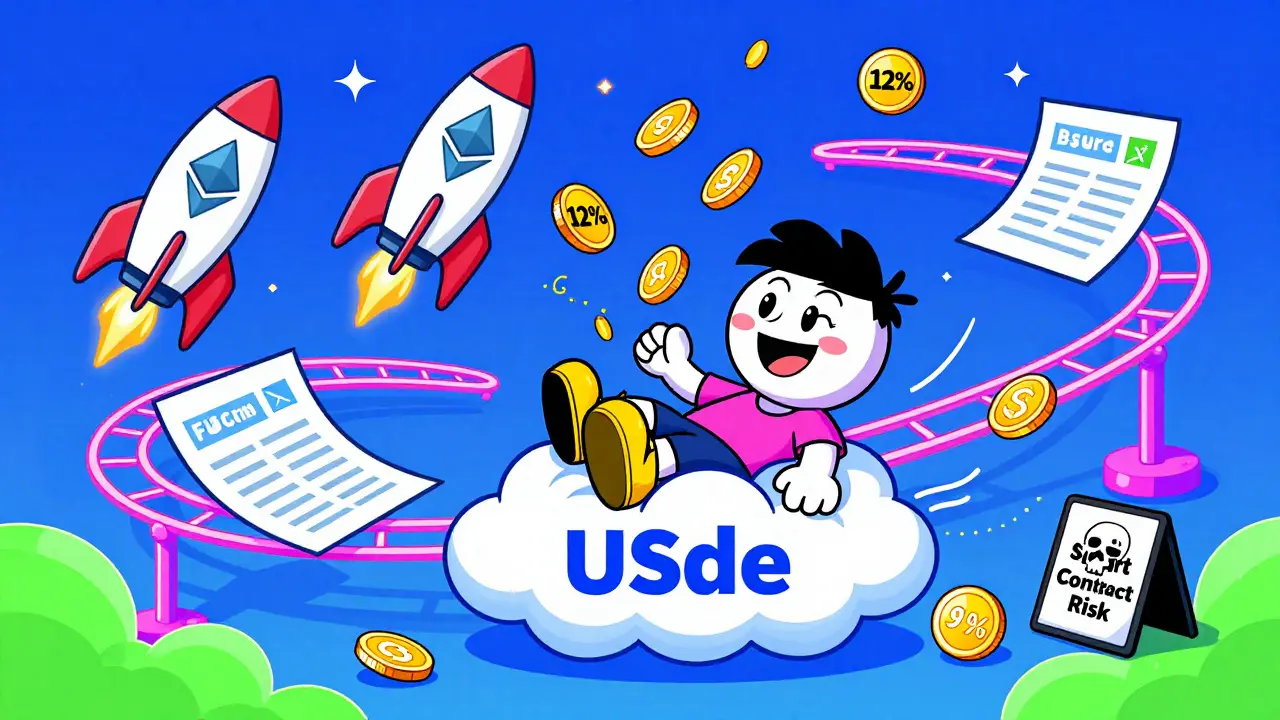
USDe isn’t backed by dollars. It’s backed by Ethereum and perpetual futures contracts. Created by Ethena in 2024, it uses a delta-neutral strategy: you stake ETH, then sell futures to hedge price swings. The profit from those futures? That’s the yield. As of late 2025, USDe pays 8-15% APY across DeFi platforms.
This is why it exploded. People aren’t just holding USDe-they’re farming it. You can deposit USDe into Aave and earn interest, then stake it in Convex for more rewards. Some users report 12% APY just by holding it in a wallet connected to Curve. It’s the closest thing to a risk-free yield in crypto right now.
But it’s complex. You’re not just holding a stablecoin-you’re exposed to Ethereum’s price, futures market volatility, and smart contract risk. If Ethena’s algorithm fails, USDe could depeg. It’s not for beginners. But for experienced yield farmers who understand hedging, USDe is the most powerful tool in 2025.

FRAX: The Hybrid Middle Ground
FRAX tries to split the difference. It’s part collateralized (about 60% backed by USDC), part algorithmic. The algorithm adjusts supply based on demand to keep the price at $1. After Terra’s collapse, FRAX reduced its algorithmic portion to avoid the same fate.
It’s not the most liquid, but it’s the most interesting. FRAX pays yield through its protocol, and it’s accepted in several DeFi pools. With a $800 million market cap, it’s small but growing. If you want something less centralized than USDC but less volatile than DAI, FRAX is worth testing.
It’s not for everyone. The dual mechanism means it’s harder to predict. But if you’re tired of choosing between pure decentralization and pure centralization, FRAX offers a third path.
USDT: The Legacy Contender
Tether’s USDT still dominates trading volume. It’s on every exchange, from Binance to Kraken. But it’s also the most opaque. Tether doesn’t publish monthly audits like Circle. Instead, it releases quarterly reports that are vague and hard to verify.
Many traders still use it because it’s everywhere. But institutional investors are moving away. In 2025, the EU’s MiCA regulation pushed European exchanges to prioritize USDC over USDT. In the U.S., regulators are watching Tether closely. If a legal action hits, USDT could face a liquidity crunch.
It’s not dead-but it’s losing ground. For casual traders who don’t care about audits, it’s fine. For anyone serious about DeFi or long-term holding, USDT is a liability.
Which One Should You Use?
There’s no single best stablecoin. The right choice depends on what you’re doing.
- For trading on exchanges: Use USDC. It’s the most liquid, lowest slippage, and easiest to move in and out of.
- For DeFi lending and borrowing: Use DAI. It’s the only one that won’t get frozen. Aave, Compound, and Yearn all treat DAI as the gold standard.
- For yield farming: Use USDe. It’s the only stablecoin that pays you for holding it. Just don’t put more in than you’re willing to lose if the system glitches.
- For a balanced approach: Hold USDC for trading, DAI for DeFi, and a small amount of USDe for yield. Rotate based on market conditions.
Don’t put all your stablecoin eggs in one basket. In 2025, the smartest traders use multiple. They keep USDC for quick exits, DAI for long-term DeFi exposure, and USDe for passive income. It’s not about finding the perfect coin-it’s about using the right one for the job.
What About New Stablecoins?
Aave’s GHO is gaining traction. Backed by $4.5 billion in collateral across 9 chains, it’s the only serious challenger to DAI in the decentralized space. But adoption is still low. Most DeFi protocols don’t accept it yet. It’s promising, but not ready to replace DAI.
Other synthetic stablecoins are emerging, but none have the volume or trust of USDe. The market is moving toward yield-bearing assets, but the old guard-USDC and DAI-still hold the infrastructure.
Final Tip: Watch the Gas
Since Ethereum’s EIP-4844 upgrade in early 2025, stablecoin transactions are cheaper. But if you’re swapping between stablecoins on a layer-2 like Arbitrum or Optimism, you’ll save even more. Use 1inch or Paraswap to route trades for the best price and lowest fees. Don’t just swap on Uniswap unless you have to.
And always test small. If you’re trying USDe for the first time, start with $100. If you’re minting DAI, understand liquidation thresholds before you lock up ETH. Stablecoins seem simple-but in DeFi, the smallest mistake can cost you big.
What’s the safest stablecoin for DeFi?
DAI is the safest for DeFi because it’s fully decentralized. No company can freeze your wallet or shut it down. It’s been tested through multiple bear markets and still holds its peg. While it can trade at a slight premium, it’s the only stablecoin that doesn’t rely on a central authority.
Can I earn interest on stablecoins?
Yes, but not all stablecoins pay interest. USDC and USDT earn low yields (1-3%) on lending platforms like Aave. USDe pays 8-15% APY because it’s backed by yield-generating futures contracts. FRAX also offers modest yields through its protocol. If you want yield, USDe is currently the best option-but it comes with higher complexity and risk.
Is USDT still reliable in 2025?
USDT is still widely used, especially on Binance and other exchanges. But its reliability is declining. Regulators in the EU and U.S. are pushing for transparent, audited stablecoins like USDC. Tether’s lack of monthly audits makes it risky for institutional use. For casual trading, it’s fine. For DeFi or long-term holding, USDC or DAI are better choices.
Why does DAI sometimes trade above $1?
DAI trades above $1 when demand for it spikes-usually during market stress or when users need collateral for DeFi loans. Since minting DAI requires locking up crypto worth 150%+ of the DAI value, it’s expensive to create. When supply can’t keep up with demand, the price rises. Arbitrageurs eventually bring it back down, but it can stay above $1 for hours or days.
Should I use multiple stablecoins?
Yes. The most successful DeFi users hold a mix: USDC for trading and liquidity, DAI for DeFi protocols, and USDe for yield. This spreads risk and gives you flexibility. You can swap between them on Curve Finance with under 0.1% slippage. Don’t rely on just one-diversify based on use case.
Are algorithmic stablecoins safe now?
Pure algorithmic stablecoins like TerraUSD (UST) are still considered unsafe. The 2022 collapse wiped out $40 billion. FRAX and others now use hybrid models with collateral backing, which makes them much more stable. If a stablecoin claims to be fully algorithmic without any collateral, avoid it. The market has learned the hard way.

nayan keshari
January 2, 2026 AT 03:12USDC is fine for trading but if you're holding more than a few grand you're asking for trouble with Circle's freeze button.
Bianca Martins
January 3, 2026 AT 17:48DAI is the only one I trust in DeFi. I’ve seen USDC get frozen on a false flag - never again. DAI’s premium? Worth it. I’d rather pay 0.5% extra than wake up to a locked wallet. 🙌
Brooklyn Servin
January 4, 2026 AT 18:14USDe is literally the only reason I’m still in crypto right now. 12% APY on a stablecoin? That’s not yield, that’s free money. I don’t care if it’s backed by futures - if the math works and the contracts are audited, why not? I’ve been stacking it for 8 months and my portfolio’s up 20% just from holding. 🚀
dayna prest
January 5, 2026 AT 03:21USDT is the grandpa of stablecoins - still alive, still clunky, still smells like 2017. I use it to move money fast on Binance, but I wouldn’t let it sleep in my wallet overnight. The EU’s done with it. The SEC’s circling. It’s not a coin anymore - it’s a liability with a logo.
Mike Reynolds
January 6, 2026 AT 19:13FRAX is underrated. I tried it last year thinking it was some gimmick, but it’s held steady through two market dips. It’s not flashy like USDe, but it’s the quiet kid in class who always gets the A. I keep 15% of my stablecoin stack in FRAX. No drama, no panic, just steady.
Jordan Fowles
January 6, 2026 AT 20:38There’s a deeper truth here: stablecoins aren’t about pegs anymore. They’re about power structures. USDC? Centralized control masquerading as convenience. DAI? Decentralized chaos with a moral compass. USDe? A financial experiment wrapped in yield. We’re not choosing assets - we’re choosing which version of the future we want to believe in. And that’s why this conversation matters more than any APY number.
Most people treat stablecoins like cash. But in DeFi, they’re political statements. Holding DAI is a protest. Holding USDe is a bet on innovation. Holding USDT? You’re just clinging to the past.
The real question isn’t which one’s safest - it’s which one aligns with the kind of world you want to live in.
Ian Koerich Maciel
January 7, 2026 AT 02:37Just wanted to add - EIP-4844 made a *massive* difference. I used to pay $15 in gas to swap USDC on L1. Now? $0.80 on Arbitrum. I route everything through 1inch now - saved over $200 in fees last month alone. Also, don’t forget to check the slippage tolerance before you swap. I lost $12 once because I left it at 0.5% on a volatile pair. Rookie mistake.
And yes, testing small is non-negotiable. I started with $50 in USDe. Now I’ve got $3k in it. But I didn’t go all-in until I understood the hedge mechanics. Don’t be like me - learn before you leap.
Alexandra Wright
January 8, 2026 AT 03:20Oh, so DAI trades above $1? Shocking. Like, who could’ve predicted that people would pay a premium for something that can’t be frozen? Maybe if you didn’t rely on corporate middlemen, you wouldn’t need to pay extra for basic freedom. But hey, I’m sure Circle’s PR team will fix that soon with a new ad campaign. 🙄
Andy Reynolds
January 9, 2026 AT 16:17Love how this post breaks it down by use case. I’ve been doing the USDC+DAI+USDe trifecta since last summer. I keep USDC in my exchange wallet for quick trades, DAI in my wallet for lending on Aave, and USDe in Curve for yield. It’s not sexy, but it’s dumb-simple and it works. I’ve never been more confident in my stablecoin strategy.
Also, shoutout to FRAX - I’ve been dipping my toes in it lately. It’s not perfect, but it’s the closest thing to a ‘middle ground’ that doesn’t feel like a compromise.
Michelle Slayden
January 10, 2026 AT 03:56It is imperative to note that the structural integrity of algorithmic stablecoins remains contingent upon the fidelity of their collateralization mechanisms. FRAX, for instance, demonstrates a commendable evolution from the catastrophic failure of UST by maintaining a hybrid model wherein the algorithmic component is deliberately constrained. This design mitigates systemic risk while preserving decentralization. One must, however, remain cognizant that even hybrid models are not immune to oracle failures or liquidity crises. Prudence, not optimism, should guide allocation.
Furthermore, the yield offered by USDe is not free capital - it is the remuneration for assuming exposure to Ethereum’s price volatility and perpetual futures market dynamics. To conflate yield with safety is a fundamental misapprehension.
Ryan Husain
January 11, 2026 AT 23:29Big picture: we’re witnessing the birth of a new financial layer. Stablecoins are becoming the base layer of DeFi - like USD was for traditional finance. But unlike USD, they’re programmable, composable, and yield-bearing. The winners won’t be the ones with the biggest reserves - they’ll be the ones with the best integration, the most transparent governance, and the highest user trust.
USDC has the infrastructure. DAI has the trust. USDe has the future. The smart player doesn’t pick one - they use all three, strategically. And always, always, test small.
Phil McGinnis
January 12, 2026 AT 12:31Why are we even discussing this? The U.S. dollar is the only real stablecoin. Everything else is crypto theater. If you want safety, hold USD. If you want yield, go to a bank. Crypto stablecoins are just gambling with different labels. The fact that people think DAI is ‘trustless’ is hilarious - it’s just another smart contract waiting to implode. And USDe? A Ponzi with a whitepaper. Wake up.
Steve Williams
January 13, 2026 AT 16:21Thank you for this comprehensive and meticulously researched analysis. The distinction between centralized and decentralized mechanisms is not merely technical - it is foundational to the ethos of financial sovereignty. I commend the emphasis on user responsibility and incremental adoption. In the spirit of prudent engagement, I shall continue to allocate my stablecoin holdings in accordance with the outlined use cases, prioritizing resilience over ephemeral yield. May the protocols remain robust and the markets, discerning.
Bianca Martins
January 14, 2026 AT 07:12Also - if you’re new to USDe, DO NOT stake it in a protocol you don’t fully understand. I saw someone lose $800 because they staked it in a shady pool thinking it was ‘just another yield farm.’ It wasn’t. Always check the contract address. Always. 🔍