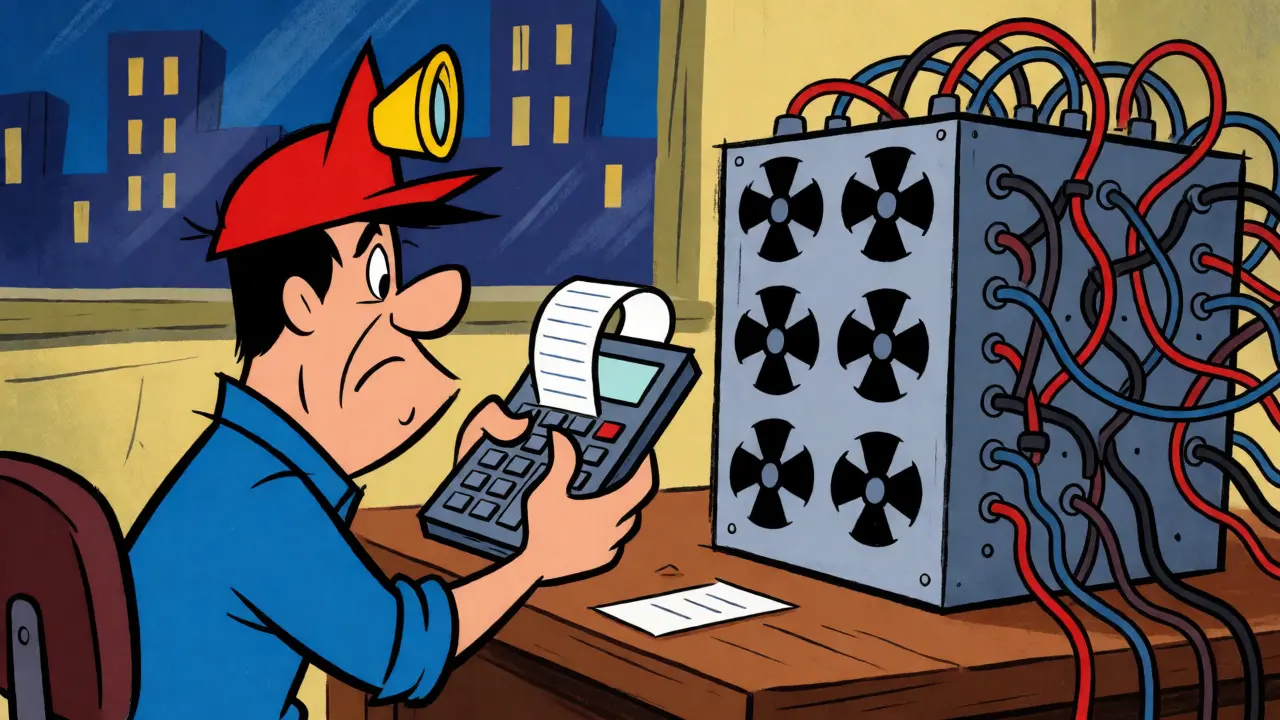
Buying an ASIC Miner is easy. Making money with it? That’s the hard part. You might think that if you plug in a machine and wait, cash flows out. Reality is messier. Electricity bills eat profits faster than you can blink, and network difficulty shifts every two weeks like sand under your feet.
An ASIC Miner Profitability Calculator is not just a fancy spreadsheet. It’s your survival tool in the brutal world of cryptocurrency mining. These tools estimate your potential earnings by crunching numbers on hash rate, power consumption, electricity rates, and market prices. But here’s the catch: most calculators lie to you. They often ignore hidden costs or use stale data, leading to projections that look great on paper but fail in practice. This guide cuts through the noise to show you how to use these tools correctly, avoid common traps, and actually turn a profit in 2026.
Why Your Calculator Might Be Lying to You
Let’s be real. If you rely on a single online calculator without checking its assumptions, you’re gambling. Dr. Alex de Vries, founder of Digiconomist, noted in a 2024 interview that many standard calculators overestimate profitability by 20-30%. Why? Because they rarely account for hardware degradation. An Antminer S19 Pro doesn’t run at peak efficiency forever. Dust builds up, fans wear out, and chips degrade. A calculator assuming constant performance will show you steady income while your actual output drops.
Another major flaw is ignoring cooling overhead. Most basic tools calculate power usage based solely on the chip’s rating. But keeping those chips cool requires fans, air conditioning, or immersion pumps. In Flagstaff, where I live, winter helps, but summer heat spikes energy costs. If your calculator doesn’t add a 10-15% buffer for cooling, your "profit" might actually be a loss. Always ask yourself: does this tool include thermal management costs? If not, adjust your expectations downward immediately.
The Core Inputs That Actually Matter
To get accurate results, you need to feed the right data into your Profitability Calculator. Garbage in, garbage out. Here are the non-negotiables:
- Hash Rate: Measured in Terahashes per second (TH/s). For example, the popular Antminer S19j Pro delivers around 100 TH/s. Don’t guess; check the manufacturer’s spec sheet.
- Power Consumption: Measured in Watts (W). The same S19j Pro uses roughly 3,050W. Note that this is peak power. Real-world usage fluctuates, so use the average from your own meter readings if possible.
- Electricity Rate: This is the killer variable. In the US, residential rates hover between $0.10 and $0.15 per kWh. Commercial rates can be lower, but only if you have a dedicated contract. Use your actual bill, not a national average.
- Network Difficulty: This adjusts every 2,016 blocks (about two weeks) for Bitcoin. Higher difficulty means fewer coins mined per unit of work. Good calculators pull this live from the blockchain.
- Pool Fees: Most miners join pools to smooth out income. These pools charge 1-3% of your rewards. Many free calculators forget to subtract this fee, inflating your net profit.
Missing even one of these inputs skews the result significantly. If you input a generic electricity rate instead of your specific tiered plan, you could be off by hundreds of dollars a month.

Comparing Top Calculators: Which One Fits Your Needs?
Not all calculators are created equal. Some prioritize speed, others depth. Here’s how the major players stack up as of late 2026:
| Feature | WhatToMine | Mining Now | ASICMinerValue |
|---|---|---|---|
| Data Refresh Rate | 5-10 minutes | Real-time (1 min) | Every 60 seconds |
| Coin Support | 150+ Altcoins | Bitcoin Focus | All Known ASIC Models |
| Best For | Comparing multiple coins | Instant BTC profit checks | Detailed model-specific ROI |
| Hidden Costs Included? | No | Partial | Yes (Cooling estimates) |
| User Rating | High for simplicity | High for accuracy | Medium (Complex UI) |
WhatToMine remains a favorite for beginners because it lets you compare Bitcoin against other mineable coins instantly. However, its slower refresh rate means during high volatility, your numbers might already be outdated by the time you read them.
Mining Now offers superior speed for Bitcoin-only miners. If you’re watching the markets closely, this is your go-to. Just remember, it focuses exclusively on BTC, so if you’re curious about altcoin ASICs, look elsewhere.
ASICMinerValue stands out for its detailed breakdowns. It includes cooling estimates and hardware lifespan projections, which aligns better with reality. The downside? The interface is cluttered, and it requires more technical understanding to interpret correctly.
How to Calculate True Return on Investment (ROI)
Profit isn’t just daily revenue minus electricity. It’s about when you break even. Let’s walk through a realistic scenario using current 2026 data.
Imagine you buy an Antminer S21 for $3,500. It hashes at 200 TH/s and consumes 3,500W.
- Calculate Daily Power Cost: 3,500W * 24 hours = 84,000 Wh = 84 kWh. At $0.12/kWh, that’s $10.08 per day just to keep the lights on.
- Estimate Daily Revenue: Based on current difficulty and BTC price ($65,000), let’s say the machine earns 0.00015 BTC/day. That’s roughly $9.75.
- Check the Math: $9.75 revenue - $10.08 electricity = -$0.33 loss per day. Wait, you’re losing money!
- Add Hidden Costs: Add 10% for cooling ($1.00) and pool fees (2% of revenue, ~$0.20). Total cost rises to $11.28. Net loss widens to $1.53/day.
- ROI Calculation: To recover the $3,500 hardware cost, you need positive cash flow. If BTC price doubles, your revenue jumps to $19.50. Now you make $8.22/day. Payback period becomes 3,500 / 8.22 ≈ 425 days.
This example shows why relying on static calculators is dangerous. A small change in electricity rate or BTC price flips profitability instantly. Always run scenarios: what if electricity goes to $0.15? What if BTC drops 20%? Stress-test your numbers.

Advanced Tips for Maximizing Accuracy
If you want professional-grade estimates, stop using default settings. Here’s how to refine your approach:
- Use Moving Averages for Difficulty: Network difficulty doesn’t jump randomly. It trends. Use a 30-day moving average for difficulty projections rather than the current snapshot. This smooths out short-term anomalies.
- Factor in Hardware Depreciation: ASICs lose value fast. After two years, your machine might be worth 40% less. Include this depreciation in your long-term ROI calculations, especially if you plan to sell before the next halving.
- Account for Downtime: Machines fail. Fans die. Internet drops. Assume 5% downtime. Multiply your expected revenue by 0.95 to get a realistic figure.
- Verify Pool Reliability: Not all pools pay out reliably. Check historical payout consistency. A high-fee pool with perfect uptime beats a low-fee pool that goes offline during spikes.
Also, consider regional regulations. In the EU, new MiCA compliance rules added 2-5% to operational costs for some miners starting mid-2024. If you’re operating there, ensure your calculator allows for custom regulatory cost inputs.
When to Ignore the Calculator
Sometimes, the best move is to trust your gut over the algorithm. During extreme market volatility-like the post-halving periods-calculators struggle. CryptoCompare analysis showed deviations of 15-20% when daily price movements exceed 10%. In these moments, the calculator reflects yesterday’s reality, not today’s risk.
Furthermore, if you’re running a large-scale operation (>100 PH/s), standard calculators miss the nuances of industrial power contracts and thermal management systems. Enterprise solutions like BlockForge integrate these factors but require significant setup. For hobbyists, stick to simple tools but add a safety margin. For pros, build your own model using raw API data from your miners and local grid providers.
Ultimately, an ASIC miner profitability calculator is a compass, not a GPS. It points you in the general direction, but you still need to watch the road. Use multiple sources, verify inputs, and always assume the worst-case scenario for costs. That way, when things go right, you’re pleasantly surprised. When they go wrong, you’re not broke.
How often should I update my ASIC miner profitability calculations?
You should check your calculations weekly at minimum. However, if Bitcoin price moves more than 5% in a day or network difficulty changes significantly (every two weeks), update immediately. During volatile markets, daily checks are recommended to catch negative profitability windows early.
Do ASIC calculators include electricity costs automatically?
No, most calculators do not know your location or electricity rate. You must manually input your specific cost per kilowatt-hour (kWh). Failing to do so will result in inflated profit estimates. Always use your actual utility bill rate, including any tiered pricing structures.
Which calculator is best for beginners?
WhatToMine is generally considered the most user-friendly for beginners due to its simple interface and broad coin support. NiceHash also offers a very intuitive calculator integrated directly into their platform, making it easy for users who want to start mining quickly without complex setups.
How does the Bitcoin halving affect profitability calculations?
The halving cuts block rewards in half, instantly reducing miner revenue unless the Bitcoin price doubles to compensate. Calculators must be updated with the new block reward (e.g., 3.125 BTC after the April 2024 halving). Post-halving, difficulty may drop temporarily, improving profitability for efficient machines, but older models often become unprofitable.
Can I use a profitability calculator for altcoin mining?
Yes, but accuracy varies. Tools like WhatToMine support many altcoins, but liquidity and exchange fees for smaller coins can impact real returns. Ensure the calculator accounts for the specific algorithm (e.g., Scrypt, SHA-256) and current market depth of the target coin.
Sheryl Nelsen Hutton
September 8, 2026 AT 19:08While the article rightly emphasizes the necessity of accounting for hardware degradation and thermal overhead which are often overlooked in standard profitability models, it is crucial to also consider the broader economic implications of energy consumption patterns on a macro scale as well as the micro-economic impact on individual miner cash flow stability over extended operational periods.
sri harni
September 9, 2026 AT 09:34Nice guide. Very helpful for beginners like me who just want to know if they will make money or not without getting too confused by all the technical stuff.
Duncan Fisher
September 10, 2026 AT 14:29I appreciate how you broke down the hidden costs so clearly. It’s easy to get excited about the hash rate but forgetting that electricity bills don’t care about our enthusiasm. The point about cooling overhead being 10-15% higher than chip ratings alone is something I’ve definitely experienced firsthand during summer months here in the UK.
adam veikkanen
September 11, 2026 AT 08:19You missed the impact of spot vs futures pricing on actual realized revenue when selling mined coins immediately versus holding them.
Rishi Mehta
September 12, 2026 AT 05:10This is exactly what happens every single time people rush into mining without thinking. They see a shiny machine and ignore the basic math because they want to believe they can beat the system. It's frustrating watching people lose money because they didn't read the fine print on their electricity contract or understand difficulty adjustments
Michael Rubin
September 12, 2026 AT 18:21Good breakdown. The section on stress-testing numbers with different electricity rates was particularly useful for my planning.
Kathryn Haber
September 14, 2026 AT 13:30isn't it funny how we try to calculate the uncalculable nature of value itself? we plug in numbers expecting certainty but the market is chaos wrapped in an enigma. maybe the calculator isn't lying, maybe reality is just refusing to be pinned down by spreadsheets
Emerson Droguet
September 15, 2026 AT 05:22The distinction between peak power consumption and average real-world usage is critical. Many users overlook this nuance leading to significant errors in ROI projections. Would you recommend specific metering hardware for verifying these averages?
Eugene McGrath
September 15, 2026 AT 06:43Typical tech elitism. You assume everyone has access to commercial contracts or immersion cooling setups. For the average guy running one S19 in his garage this whole 'advanced tips' section is useless noise. Just tell us if we're gonna break even or not based on simple residential rates
Robert Brabham
September 16, 2026 AT 22:06Don't trust any calculator that doesn't account for potential regulatory changes. Governments love to tax what they don't understand and crypto miners are an easy target. If your tool doesn't have a slider for 'unexpected legislation cost' then it's incomplete.
Sonya Kirkwood
September 17, 2026 AT 00:58I feel like these calculators are designed to keep us mining even when we should stop. There is always a slight optimism bias built into the algorithms. Did anyone else notice that the 'best case' scenarios rarely materialize while the 'worst case' feels almost guaranteed?
Charlotte Richardson
September 17, 2026 AT 18:09This is such a valuable resource for those starting out. I encourage everyone to take the time to input their specific local data rather than relying on national averages. Your detailed explanation of pool fees and downtime assumptions provides a much more realistic framework for decision-making.
Rachel Aldaco
September 18, 2026 AT 07:53Why do we even bother calculating profit when the world is falling apart around us? We count watts while the planet burns. It feels selfish to worry about ROI when there are bigger issues at play but I guess we need the money to survive the chaos right?
Ted Thoroughgood
September 19, 2026 AT 03:34Great post! Really helped me understand why my last miner didn't make back its cost. I think i forgot to add the fan power to my calc lol. Will use ASICMinerValue next time since it seems more detailed.
Sasha Wilde
September 19, 2026 AT 04:20Most people fail because they don't check their electricity tier 📉. If you are above $0.12/kWh you are basically donating to the grid ⚡. Simple math wins 💯
Ferdinand Friday
September 19, 2026 AT 08:08The notion of a static return on investment in a dynamic ecosystem is inherently flawed yet necessary for planning purposes. When we speak of depreciation we are essentially talking about the entropy of technology where each new model renders the previous obsolete not just in efficiency but in perceived value. This philosophical underpinning suggests that the calculator is less a predictor of wealth and more a measure of our willingness to accept risk in exchange for potential reward. One must consider that the true cost of mining is not just electrical but opportunity cost of capital tied up in depreciating assets that require constant maintenance and vigilance against obsolescence.
Gabriela Gonzalez
September 20, 2026 AT 10:49Love this! 🚀 Super clear explanation. Definitely going to double check my cooling costs now. Thanks for sharing! 🙌