Remember the early days of DeFi? You’d connect your wallet, pray to the blockchain gods, and wait ten minutes for a swap while paying more in gas fees than the trade was worth. That era is fading fast. In 2026, traders want speed, low costs, and an interface that doesn’t look like it was coded in 1995. Enter 1DEX, a decentralized exchange launched in 2025 that promises the best of both worlds: the security of decentralization with the slick, instant experience of a centralized exchange. But here’s the catch: new platforms make big claims. 1DEX says it handles over 10,000 transactions per second. It claims zero gas fees for users. It boasts biometric login instead of seed phrases. Before you bridge your ETH or SOL to this platform, we need to separate marketing hype from technical reality. This review breaks down exactly what 1DEX is, how its order book technology works, and whether it’s actually safe to use your money on it right now.
What Exactly Is 1DEX?
At its core, 1DEX is an order book-based decentralized exchange (DEX) designed for cross-chain trading. Most people know DEXs like Uniswap or PancakeSwap, which use Automated Market Makers (AMMs). AMMs are simple but can suffer from slippage and impermanent loss for liquidity providers. 1DEX takes a different approach. It uses an order book model-just like Binance or Coinbase-but runs it entirely on-chain via smart contracts. This distinction matters. An order book matches buy orders with sell orders directly. If you want to buy Bitcoin at $60,000, you place a limit order. When someone else sells at that price, the trade executes instantly. For active traders, this is crucial. It allows for precise entry and exit points, stop-losses, and leverage strategies that AMMs struggle to support efficiently. 1DEX positions itself as the "world's leading order book-based cross-chain decentralized exchange," aiming to bridge the gap between traditional finance interfaces and Web3 infrastructure.
The Technology: Serverless Architecture and Speed
The biggest pain point for DEX users has always been latency. Centralized exchanges (CEXs) are fast because they operate off-chain databases. DEXs are slow because every transaction must be validated by the network. 1DEX claims to solve this with a serverless architecture using automated smart contracts that eliminate single points of failure. Here is what that means for you:
- High Throughput: The platform claims to handle over 10,000 transactions per second (TPS). For context, Ethereum mainnet handles roughly 15-30 TPS without Layer 2 solutions. This speed suggests 1DEX likely operates on high-performance blockchains or utilizes advanced Layer 2 scaling solutions, though specific chain details require checking their current documentation.
- Instant Finality: Trades execute within milliseconds. No waiting for block confirmations that take minutes.
- Cross-Chain Capability: You can trade BTC, ETH, SOL, TRON, BSC, EOS, and XSAT assets without manually bridging them yourself. The protocol handles the complexity in the background.
Security: Biometrics vs. Seed Phrases
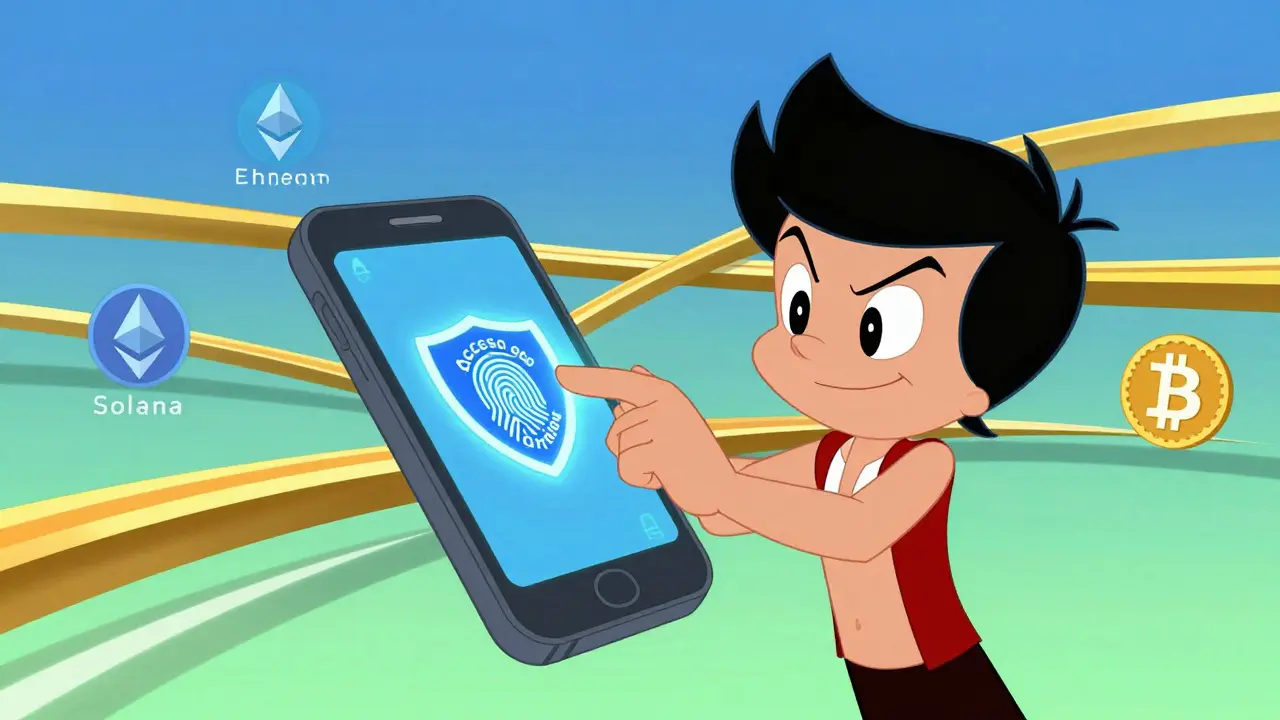
If there is one thing that scares new users away from crypto, it’s the 12-word seed phrase. Lose it, lose everything. Hackers love phishing sites that steal these phrases. 1DEX attempts to fix this with Passkey authentication integrated with blockchain account technology.
Instead of managing private keys manually, you log in using fingerprint or face recognition on your device. The cryptography happens behind the scenes. Your biometric data never leaves your device; it simply unlocks the encrypted key stored securely. This is a significant UX improvement. It makes trading feel like logging into Instagram rather than accessing a bank vault.
Regarding fund security, 1DEX states that assets are managed by regulated custodial institutions with on-chain verification. Wait-custodial? That sounds centralized. Let’s clarify. In many hybrid models, "custody" might refer to insurance wrappers or multi-signature cold storage setups for certain features, but true DEXs are non-custodial. 1DEX emphasizes that their smart contracts are open-source and have been audited by firms like Blocksec. These audit reports are public. Always check the latest audit date. A 2025 audit is good, but code changes constantly. Ensure any recent updates have also been reviewed.
Fees and Trading Costs
Costs eat into profits. Traditional CEXs charge maker/taker fees ranging from 0.02% to 0.1%. AMM DEXs charge protocol fees plus network gas fees, which can spike during congestion. 1DEX markets itself as a "stress-free trading" solution with low fees and, notably, eliminated gas fees in certain scenarios. How do they offset gas costs? Usually, through a subsidy model where the platform pays the network fees on behalf of the user, recouping this cost through slightly higher trading spreads or a subscription model. Without explicit fee schedules published in independent reviews, you should expect:
- Making Fees: Likely lower than taker fees to encourage liquidity provision.
- Taking Fees: Charged when you execute against existing orders.
- Hidden Spreads: Watch the difference between the bid and ask price. Sometimes "zero gas" comes with a wider spread.
User Experience and Interface
Design is not just about looks; it’s about functionality. 1DEX offers a familiar charting interface, likely powered by TradingView widgets, allowing you to draw trendlines and apply indicators. The order book is visible, showing depth and pending orders. This transparency is vital for serious traders who need to see market sentiment. The onboarding process is streamlined. You sign up with email or social accounts, set up your Passkey, and deposit funds. Because it supports cross-chain assets, you don’t need to worry about which network you’re sending from as much as you would on a legacy DEX. The platform automatically detects and routes assets. However, remember that 1DEX is relatively new (launched in 2025). Newer platforms often lack the deep liquidity of established giants. Low liquidity means larger trades can move the price significantly (slippage). If you are moving millions of dollars, test with small amounts first. For retail traders moving hundreds or thousands, the liquidity should be sufficient.
Comparison: 1DEX vs. Established DEXs
| Feature | 1DEX | Uniswap | Binance (CEX) |
|---|---|---|---|
| Type | Order Book DEX | AMM DEX | Centralized Exchange |
| Custody | Non-Custodial (User Wallet) | Non-Custodial | Custodial (Exchange holds keys) |
| Login Method | Biometric/Passkey | Wallet Connect (Seed Phrase) | Email/Password + 2FA |
| Gas Fees | Subsidized/Zero for users | User pays network gas | No gas fees |
| Cross-Chain | Native Support | Requires Bridges | Internal Conversion |
| Regulatory Risk | Low (Decentralized) | Low (Decentralized) | High (Subject to bans/seizures) |

Is 1DEX Safe? Risks to Consider
No platform is risk-free. Here are the specific risks associated with 1DEX in 2026:
- Smart Contract Risk: Even with audits, bugs can exist. Since 1DEX uses complex cross-chain logic, the attack surface is larger than a single-chain DEX. Always check if the team has bug bounties active.
- Liquidity Depth: As a newer entrant, sudden large withdrawals could impact prices more than on deeper venues.
- Regulatory Uncertainty: While decentralized, if the foundation is based in a restrictive jurisdiction, they could face pressure. However, since users hold their own keys, asset seizure is difficult.
- Phishing: The convenience of Passkeys does not protect you from clicking fake links. Always bookmark the official URL. Scammers create lookalike sites daily.
Who Should Use 1DEX?
This platform isn’t for everyone. Here is who will benefit most:
- Active Traders: Those who need limit orders, real-time price action, and low latency.
- Crypto Beginners: Users intimidated by seed phrases and gas fee calculations.
- Cross-Chain Investors: People holding assets across Solana, Ethereum, and Tron who want to rebalance without juggling five different bridges.
Final Verdict
1DEX represents a logical evolution in the DeFi space. By combining order book mechanics with serverless, cross-chain infrastructure and biometric security, it addresses the three biggest complaints about decentralized trading: slowness, complexity, and poor user experience. The claim of 10,000+ TPS and zero gas fees is compelling, provided the underlying economics are sustainable. However, caution is advised. It is a young platform in a volatile industry. Start small. Test the withdrawal process. Verify the audit reports. If it performs well for your initial trades, it could become your primary trading hub. But always keep your emergency funds in cold storage. In crypto, trust the code, verify the audits, but never blindly trust the marketing.
Is 1DEX a centralized or decentralized exchange?
1DEX is a decentralized exchange (DEX). It uses smart contracts for matching and settlement, meaning you retain custody of your funds in your own wallet. However, it employs a serverless architecture and may use custodial partners for certain regulatory compliance layers, so always read their latest whitepaper for specifics.
Does 1DEX require a seed phrase?
No, 1DEX uses Passkey authentication combined with blockchain account technology. You can log in using biometrics like fingerprints or face ID, eliminating the need to manually manage a 12-word seed phrase for daily trading access.
Which cryptocurrencies can I trade on 1DEX?
1DEX supports cross-chain trading for major assets including Bitcoin (BTC), Ethereum (ETH), Solana (SOL), TRON, Binance Smart Chain (BSC) tokens, EOS, and XSAT. The platform handles the cross-chain bridging automatically.
Are there gas fees on 1DEX?
1DEX claims to eliminate gas fees for users in many trading scenarios. The platform likely subsidizes these network costs through its business model, offering a smoother experience compared to traditional DEXs where users pay volatile gas prices.
How secure is 1DEX?
1DEX has undergone security audits by firms like Blocksec. Its open-source smart contracts allow for community scrutiny. However, as a newer platform launched in 2025, it lacks the long-term track record of older DEXs. Always use strong personal security practices and consider starting with smaller amounts.
Can I list my own token on 1DEX?
Yes, 1DEX offers automatic token listing through smart contracts without centralized review. This permissionless approach allows projects to launch tokens quickly, though it places the responsibility on users to verify the legitimacy of the tokens they trade.