
The United Arab Emirates doesn’t just let you make money from crypto - it lets you keep every single penny. As of 2026, UAE residents pay 0% personal income tax on cryptocurrency gains, making it one of the most powerful tax advantages in the world for digital asset holders. Whether you’re trading Bitcoin, staking Ethereum, mining altcoins, or flipping NFTs, your profits stay entirely yours. No capital gains tax. No reporting burden. No hidden fees. Just pure, untaxed growth.
What Exactly Is Taxed (and What Isn’t)?
The UAE’s tax policy is simple: if you’re a resident, your crypto gains are completely untaxed. That includes:
- Buying and selling Bitcoin, Ethereum, Solana, or any other digital asset for profit
- Staking rewards from proof-of-stake networks
- Mining cryptocurrency as a personal activity
- Earning interest from DeFi protocols
- Selling NFTs at a profit
- Receiving crypto as payment for freelance work
There’s no threshold. No exemption limit. No distinction between hobby trading and serious investing. If you’re a tax resident and you sell a Bitcoin you bought for $50,000 at $1.2 million, you walk away with the full $1.15 million profit - with zero tax taken out.
But here’s the catch: this rule applies only to individuals. Businesses aren’t so lucky. Companies operating crypto-related services - like exchanges, mining farms, or blockchain startups - are subject to corporate tax. If your business earns more than AED 375,000 in annual profit, you pay 9% tax. Some companies in free zones like Dubai Multi Commodities Centre (DMCC) or Abu Dhabi Global Market (ADGM) can qualify for 0% corporate tax if they meet strict substance requirements. But for most people, the 0% rule is personal - and personal only.
Who Qualifies as a UAE Tax Resident?
You can’t just show up with a laptop and claim tax-free crypto gains. To qualify, you must be a tax resident of the UAE. That means:
- You hold a valid UAE residency visa (not just a tourist visa)
- You spend at least 183 days per year physically present in the UAE
- You have established a genuine connection to the country - like renting an apartment, opening a local bank account, or registering a local address
The UAE doesn’t have a formal tax registration system for individuals, but residency is the key. Many crypto investors get a 10-year Golden Visa - available to investors, entrepreneurs, and skilled professionals - to lock in long-term residency. Others use employer-sponsored visas or property ownership visas. The goal isn’t just to live there - it’s to prove you’re not just a tourist passing through.
How This Compares to the Rest of the World
While the UAE lets you keep 100% of your crypto profits, most other countries take a big cut:
- United States: Up to 37% federal capital gains tax on crypto sales, plus state taxes (up to 13.3% in California)
- United Kingdom: 20-28% capital gains tax depending on income level
- Germany: 42% income tax on crypto sold within one year of purchase
- Canada: 50% of gains taxed as income, at your marginal rate (up to 53.5%)
- Australia: Capital gains tax applied, with no exemption for personal use
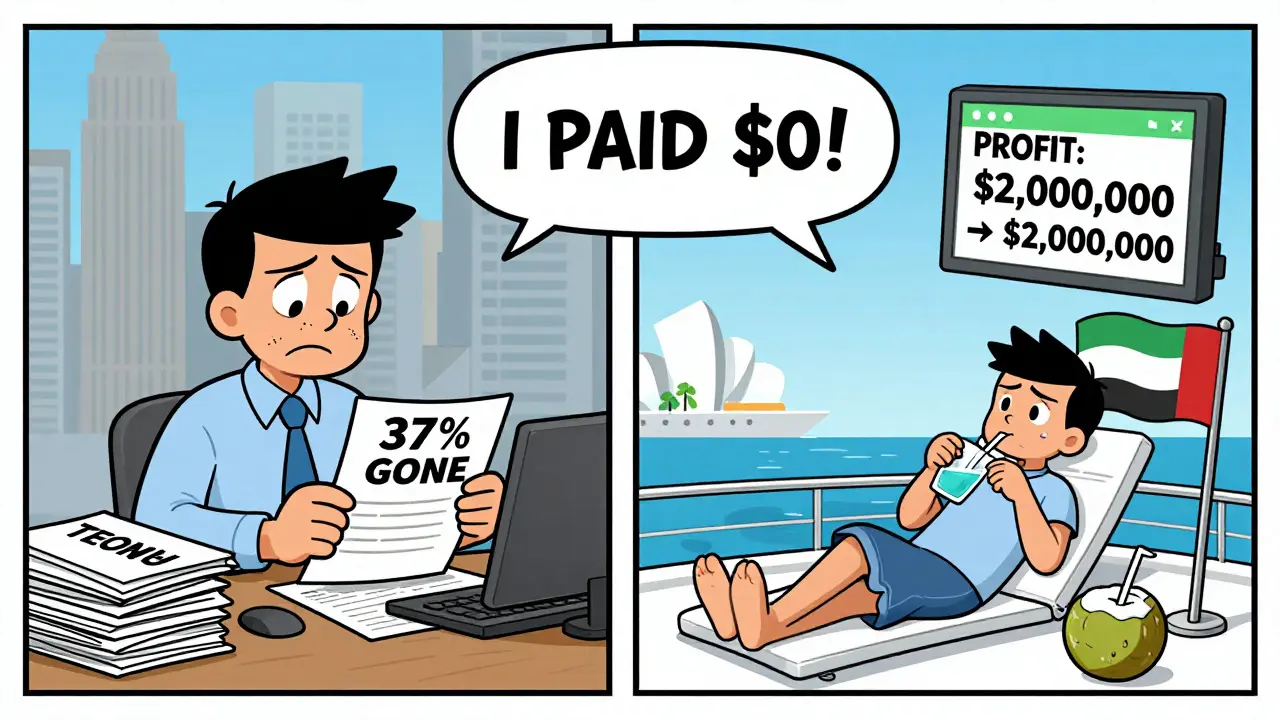
The difference isn’t just numbers - it’s life-changing. Someone who makes $2 million in crypto gains in the U.S. might owe $740,000 in taxes. In the UAE? They keep it all. That’s why thousands of crypto millionaires have relocated. Dubai’s luxury apartment buildings now have more Bitcoin wallets than most U.S. suburbs.

What About VAT and Other Fees?
While you pay no income tax on crypto gains, other rules still apply. The UAE charges 5% VAT on certain services. That means:
- Buying crypto through an exchange? No VAT - it’s treated as a financial service
- Hiring a crypto tax consultant? 5% VAT on their fee
- Using a crypto debit card to pay for goods? 5% VAT on the transaction
- Running a commercial mining operation? VAT applies on equipment purchases and electricity
The Federal Tax Authority has been clear: personal crypto trading is exempt from VAT. But if you’re treating crypto like a business - selling services, mining at scale, or running a crypto fund - you need to register for VAT and file returns.
What About Reporting? Is It Really That Free?
Yes - for now. The UAE has no requirement to report personal crypto transactions to tax authorities. You don’t file a crypto tax return. You don’t need to submit wallet addresses or transaction histories.
But that’s changing. In September 2025, the UAE announced the Crypto-Asset Reporting Framework (CARF), part of a global agreement signed with over 100 countries. Starting January 1, 2027, crypto exchanges, custodians, and wallet providers operating in the UAE will be required to collect and share user data with tax authorities worldwide. The first automatic data exchange happens in 2028.
This doesn’t change the 0% tax rate. It just means your transactions will be visible to foreign tax agencies. If you’re a U.S. citizen living in Dubai, the IRS will eventually get a report on your crypto activity. You’ll still owe nothing to the UAE - but you might still owe something to your home country.
Real-World Impact: Who’s Moving and Why?
Since 2023, Dubai has seen a flood of crypto entrepreneurs, traders, and investors relocating. Reddit threads from former Germans, Brits, and Americans detail how they sold homes, quit jobs, and moved families to Dubai - not for the weather, but for the tax code.
One trader from Berlin, who made €4.8 million from DeFi yield farming, moved to Dubai in 2024. He told a local news outlet: “I was paying over €1.9 million in taxes every year. Now? I pay €0. I reinvested that money into a crypto mining rig and doubled my returns.”
Another investor from London transferred $15 million in Bitcoin to a UAE-based wallet, bought a villa in Palm Jumeirah, and now runs a crypto education startup. He says: “The UAE didn’t just give me a tax break. It gave me freedom.”
What You Need to Do to Get Started
Getting the 0% tax benefit isn’t instant. Here’s what it takes:
- Obtain a UAE residency visa (Golden Visa preferred for long-term stability)
- Physically reside in the UAE for at least 183 days per year
- Open a local bank account - many banks now accept crypto investors
- Keep detailed records of all crypto transactions: purchase price, date, wallet addresses, fees
- Consider consulting a UAE-based tax advisor familiar with crypto - even if you don’t owe tax, you’ll need proof of compliance
The process takes 3 to 6 months. Costs vary: a Golden Visa can cost $10,000-$50,000 depending on legal help, property purchase, or investment requirements. But for someone with a $5 million crypto portfolio, the tax savings in one year can cover the entire cost - and then some.
What Could Change?
The UAE has no plans to tax crypto gains. The government has repeatedly stated that crypto is part of its economic diversification strategy. Dubai’s Virtual Assets Regulatory Authority (VARA) and Abu Dhabi’s ADGM are actively attracting crypto firms with clear rules and zero personal tax.
But two things could shift the landscape:
- If international pressure forces the UAE to impose reporting that triggers foreign tax liabilities (e.g., U.S. citizens still owe taxes to the IRS)
- If corporate tax rules tighten for free zone companies, indirectly affecting crypto businesses that rely on them
For now, the 0% rule is rock solid. The UAE is betting big on crypto. It’s not going to kill the golden goose.
Final Thoughts
The UAE doesn’t just offer tax-free crypto gains - it offers a new way to think about wealth. For the first time in modern history, you can build massive crypto wealth without the government taking a cut. No loopholes. No gray areas. Just a clear, legal, and powerful advantage.
If you’re serious about crypto, and you’re tired of paying 30%, 40%, or 50% of your gains to tax authorities - the UAE isn’t just an option. It’s the best option on the planet.
Do I have to move to the UAE to get 0% crypto tax?
Yes. You must be a UAE tax resident - meaning you hold a residency visa and spend at least 183 days per year in the country. Tourist visas, short-term stays, or remote work without residency don’t qualify. The tax exemption is tied to legal residency, not citizenship or passport.
Can I still be taxed by my home country if I move to the UAE?
Yes. The UAE doesn’t tax you, but your original country might. The U.S., for example, taxes its citizens on worldwide income. If you’re a U.S. citizen, you still need to file taxes with the IRS - even if you live in Dubai. The UAE’s 0% policy doesn’t override your home country’s rules. Always check your home country’s tax obligations before relocating.
Is mining crypto in the UAE tax-free?
Yes - if you’re mining as an individual. Personal mining, staking, and DeFi yield farming are all tax-free for UAE residents. But if you’re running a commercial mining operation with multiple rigs, employees, or infrastructure, you may be classified as a business. That triggers corporate tax (9%) and possibly VAT on equipment and electricity.
What happens if I sell crypto and buy property in the UAE?
You can use crypto to buy property - but you’ll need to prove the source of funds. UAE banks and real estate agencies require documentation: wallet addresses, transaction histories, and proof of purchase dates. This is an AML (anti-money laundering) requirement, not a tax rule. The sale itself is still tax-free, but you need to show it’s legitimate.
Will the UAE start taxing crypto in the future?
There’s no indication of that. The UAE government has publicly committed to maintaining 0% personal crypto taxation. Its economic strategy relies on attracting global crypto capital. While reporting rules are getting stricter (CARF), the tax rate itself remains unchanged. Experts expect this policy to last at least through 2030.
Dana Sikand
February 27, 2026 AT 08:35maya keta
February 28, 2026 AT 06:36Curtis Dunnett-Jones
March 1, 2026 AT 02:37Lilly Markou
March 2, 2026 AT 21:25McKenna Becker
March 3, 2026 AT 07:03precious Ncube
March 3, 2026 AT 14:25Phillip Marson
March 5, 2026 AT 07:13Tracy Whetsel
March 5, 2026 AT 11:20Ifeanyi Uche
March 5, 2026 AT 22:44Jeff French
March 6, 2026 AT 13:01Elana Vorspan
March 6, 2026 AT 15:11Danny Kim
March 7, 2026 AT 22:56Cathy Sunshine
March 9, 2026 AT 01:26Shannon Black
March 10, 2026 AT 18:29Richard Cooper
March 11, 2026 AT 01:47Dee Resin
March 12, 2026 AT 18:31Tanvi Atal
March 14, 2026 AT 01:31Sony Sebastian
March 15, 2026 AT 06:08Brian Lemke
March 16, 2026 AT 03:55Megan Lavery
March 18, 2026 AT 03:27