Most crypto traders assume that if a platform has low volume, it’s broken or abandoned. But Zenlink on the Astar network flips that script. It’s not trying to be Binance or Uniswap. It’s a specialized tool for people who live inside the Polkadot ecosystem and want to move assets without hopping between five different wallets.
If you’re holding ASTR tokens or using USDC on Astar, you’ve probably wondered where to trade them efficiently. The answer often points to Zenlink. However, with a reported 24-hour trading volume of just under $5,500, you might be asking: "Is this even worth my time?" Let’s break down what Zenlink actually does, how it fits into the Astar infrastructure, and whether it makes sense for your portfolio in 2026.
What Exactly Is Zenlink?
Zenlink is a decentralized exchange (DEX) aggregator that routes trades across multiple liquidity pools within the Polkadot ecosystem. Launched in 2022, it doesn’t hold your funds in a central vault like a traditional exchange. Instead, it acts as a smart router. When you click "Swap," Zenlink scans various DEXs connected to the Astar network to find the best price with the lowest slippage.
This distinction matters. A standard DEX like Uniswap relies on a single pool of liquidity. If that pool is thin, your price impact is high. Zenlink aggregates those pools. By combining liquidity from different sources, it aims to give you a better execution price than any single venue could offer alone. For users deep in the Polkadot stack, this means fewer bridges, fewer gas fees, and a smoother experience.
The Astar Network Infrastructure
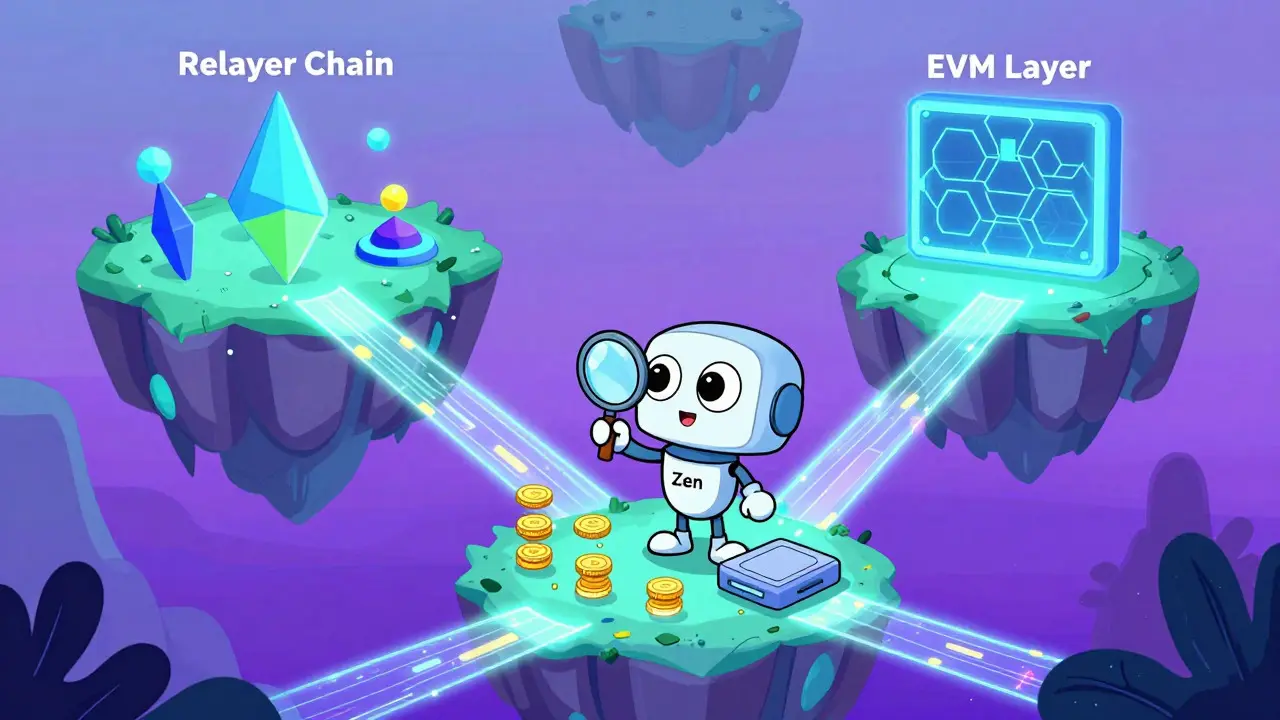
You can’t understand Zenlink without understanding its home base: the Astar Network is a two-layer blockchain architecture built on Polkadot that supports both EVM-compatible smart contracts and native Polkadot interoperability. Astar operates on a dual-layer design:
- Relayer Chain: Handles cross-chain communication, data storage, and governance. This layer ensures Astar stays connected to the broader Polkadot ecosystem.
- EVM Layer: Provides an execution environment compatible with the Ethereum Virtual Machine. This allows developers to deploy Solidity contracts without rewriting their code.
This setup is crucial for Zenlink because it allows the aggregator to interact with both native Polkadot assets and Ethereum-compatible tokens seamlessly. The native token, ASTR, serves as the utility token for paying gas fees and participating in dApp staking within the Astar ecosystem. With a total supply of 7 billion coins, ASTR is the fuel that powers transactions on the network Zenlink utilizes.
Trading Volume and Liquidity Reality Check
Here is where we get real. According to recent data, Zenlink (Astar) lists only two active trading pairs, primarily dominated by USDC/WASTR. The 24-hour trading volume sits at approximately $5,496.76. That number looks tiny compared to giants like Raydium or Curve, which process millions daily.
But context is everything. Zenlink isn’t a retail hub for Bitcoin traders. It’s a niche tool for specific asset classes on Astar. The USDC/WASTR pair accounts for nearly all that volume ($5,496.60). If you are trying to swap large amounts of ASTR for ETH here, you will face significant slippage. However, if you are moving smaller amounts of stablecoins or ASTR-native assets, the aggregated liquidity might still provide competitive rates compared to bridging out to Ethereum mainnet first.
| Metric | Zenlink (Astar) | Average Major DEX Aggregator |
|---|---|---|
| Active Pairs | 2 | 100+ |
| 24h Volume | ~$5,500 | $1M - $100M+ |
| Primary Function | Niche Aggregation on Astar | Cross-Chain Routing |
| Margin Trading | No | Varies |
| Network Fee Structure | Low (Polkadot-based) | Variable (Ethereum high) |

User Experience and Technical Features
Using Zenlink is straightforward if you already have a wallet connected to Astar. The interface focuses on speed and simplicity. There are no complex order books or margin controls. You connect your wallet, select the asset you want to sell, choose the asset you want to buy, and hit swap.
The "one-click" feature refers to the automated routing. You don’t need to manually check which DEX has the best rate; Zenlink does that in the background. For users familiar with MetaMask or Talisman Wallet, the integration is smooth. The lack of margin trading is a feature, not a bug, for many. It removes the risk of liquidation, making it safer for holders who just want to rebalance their portfolios without leverage exposure.
Security and Trust Considerations
Since Zenlink is a DEX aggregator, your security depends on two things: the smart contract code and the underlying Astar network. Astar has undergone audits and leverages Polkadot’s parachain security model, which adds a layer of robustness. However, as with any DeFi protocol, smart contract risk exists.
One thing to note is that Zenlink does not custody your funds. They stay in your wallet until the transaction is executed. This eliminates the risk of an exchange hack draining user balances. Your main risks are:
- Smart Contract Bugs: Errors in the routing logic.
- Liquidity Scams: Though rare on established networks, fake pools can appear. Always verify the token address.
- Network Congestion: If Astar gets busy, transaction times may increase.

Who Should Use Zenlink?
Zenlink isn’t for everyone. Here is a quick breakdown of who benefits most:
- Astar Native Holders: If you hold ASTR or other Astar-specific tokens, Zenlink is likely your fastest route to swap them without bridging.
- Polkadot Ecosystem Users: If you frequently move assets between Parachains, the integrated routing saves steps.
- Small-to-Medium Traders: The low volume suggests it’s best for smaller positions. Large institutional moves will likely slip the price too much.
On the other hand, if you are a Bitcoin trader or someone heavily invested in Solana or Ethereum mainnet assets, Zenlink offers little value. You’d be better off using aggregators that focus on those chains.
Frequently Asked Questions
Is Zenlink safe to use?
Yes, relatively. Since it is a non-custodial DEX aggregator, your funds remain in your wallet. The primary risk is smart contract bugs, but Astar’s infrastructure is audited and backed by Polkadot’s security model. Always double-check token addresses before swapping.
Why is Zenlink’s trading volume so low?
The low volume reflects its niche focus. It specializes in Astar and Polkadot ecosystem assets rather than major global pairs like BTC/USDT. Most high-volume trading happens on larger venues or centralized exchanges, while Zenlink serves specific local liquidity needs.
Can I trade Bitcoin on Zenlink?
Not directly. You would need to use a wrapped version of Bitcoin that exists on the Astar or Polkadot network. Direct native BTC trading is not supported because Astar is not a Bitcoin L1 chain.
Does Zenlink charge high fees?
Fees are generally lower than Ethereum mainnet due to Astar’s efficient architecture. You pay standard network gas fees plus a small protocol fee for the aggregation service. The exact percentage varies by pool depth, but it is typically competitive within the Polkadot ecosystem.
What is the difference between Zenlink and a regular DEX?
A regular DEX uses a single liquidity pool. Zenlink aggregates multiple pools to find the best price. Think of a regular DEX as one store, and Zenlink as a shopping mall that compares prices across several stores to save you money.
Laine Van Sickle
August 26, 2026 AT 20:12ok so the volume is like five thousand dollars?? that feels kinda sad tbh. i mean if your whole business model is moving money around and you only move a few grand a day, are we really supposed to be impressed? it just looks like a ghost town to me. why would anyone bother connecting their wallet if the pools are this thin?
Ashwin Bhandurge
August 28, 2026 AT 07:00Don't look at the absolute numbers, look at the utility! 🚀 This isn't about being the biggest fish in the ocean, it's about being the only fish in a specific pond. If you hold ASTR, bridging out to Ethereum costs more in gas than the trade itself saves. Zenlink solves the friction problem. It’s about ecosystem retention, not retail hype.
Teresa Watson
August 29, 2026 AT 16:06yeah right sure. "niche tool" is just what they call it when nobody wants to use it. i bet if you actually tried to swap anything real size it would slip your price into next week. its basically a fancy calculator for people who like pretending they are techies
Nadia Christian
August 30, 2026 AT 00:14It’s actually quite impressive how efficient Polkadot-based infrastructures are compared to our domestic blockchain efforts; the low fees here are a testament to superior engineering standards that we should strive to emulate domestically, don’t you think?! The US needs more of these focused, high-efficiency networks rather than broad but inefficient ones!
jeffry jones
August 30, 2026 AT 19:27Agreed on the fee structure. The MEV extraction on mainnet is brutal. Using an aggregator on a L2 or parachain like Astar minimizes the slippage vector significantly. It’s a smart routing play for native assets.
Aaliyah Simpson
September 1, 2026 AT 06:09I'm pretty sure the low volume is because the developers are siphoning off the liquidity before it hits the public. Typical DeFi rug pull setup. They pump the token, get the users to bridge in, and then quietly drain the pool. Watch out for those 'fake' token addresses mentioned in the article, that's usually the red flag.
Paul Needham
September 2, 2026 AT 21:16Oh, the horror. We are all going to die because a DEX has $5k in volume. Truly a crisis for global finance. I wonder if the author checked their own pulse while writing this. Probably didn't, since it's just another SEO farm post.
Jillian Pye
September 2, 2026 AT 22:43~The nature of value is subjective, yet you cling to objective metrics like volume as if they define worth. You see a desert where others see a garden in early bloom. Your cynicism is merely a shield against the complexity of decentralized systems.~
Jarnail Singh
September 4, 2026 AT 10:19One must understand that the true essence of such platforms lies not in their current trading figures, which are merely ephemeral fluctuations in the vast sea of market dynamics, but rather in their foundational architecture and long-term strategic positioning within the broader technological landscape of distributed ledger technology, which is something that only the truly discerning investor can appreciate fully 😎
Ashwini Chaskar
September 4, 2026 AT 14:21it feels like everyone is just ignoring the obvious risks here. if the contracts are buggy you lose everything. and who is really auditing these small projects? it feels like a trust fall with a stranger who might have a knife. i just think people are too excited about the tech to see the danger signs everywhere
Sam Ariafar
September 6, 2026 AT 01:41We often forget that security is paramount in any financial instrument. While the technology is novel, the human element of trust remains the weakest link. We must remain vigilant and ensure that regulatory frameworks keep pace with innovation to protect the common citizen from unnecessary risk.
Jane yuan
September 7, 2026 AT 03:24The concept of sovereignty in digital assets is paramount. By utilizing local infrastructure, we reduce dependency on foreign chains. This is a step toward economic independence for the node holders.
Ian Munro
September 8, 2026 AT 16:11Volume is a lagging indicator. Liquidity depth is the leading one. For small caps, volume is irrelevant until adoption spikes. The tech works. That's enough for now.
Trista Dennis
September 8, 2026 AT 21:30Sure, it's a 'specialized tool.' Let's just hope the specialization doesn't include specializing in losing your money. The interface looks clean, but I've been burned by clean interfaces before. Keep your bags tight, folks.
Ashwin Bhandurge
September 9, 2026 AT 09:05That's a fair point on the UI, but remember, simplicity reduces attack surface area. Less code means fewer bugs. And yes, keep your bags tight, but don't let fear stop you from using tools that actually work for your specific asset class. 🌟