
Imagine getting paid in cryptocurrency just for writing a blog post or curating good content. That’s exactly what Steem is all about. Launched in 2016 by Ned Scott and Dan Larimer, this blockchain platform was built to reward creators directly, without middlemen taking a cut. It’s not just another coin; it’s an entire ecosystem where your voice has monetary value.
If you’ve stumbled upon STEEM on a trading chart or heard about it from a friend who writes online, you might be wondering how it actually works. The short answer? It uses a unique three-token system and a voting-based governance model to keep things stable while paying out users. Let’s break down what makes this platform tick, how you can participate, and whether it still holds up in today’s crowded crypto market.
The Core Idea: Paying for Quality Content
At its heart, Steem is a decentralized social media backend. Unlike traditional platforms like Facebook or X (formerly Twitter), where ads fund the operation, Steem funds its users. When you post something on a dApp like Steemit, other users vote on it. Those votes aren’t just likes; they’re financial signals that determine how much of the daily token supply goes into your pocket.
This model creates a direct link between community approval and creator income. If your content resonates, you earn more. If it doesn’t, you earn less. There’s no algorithmic opacity here-just transparent math based on user participation. This approach aims to solve the "attention economy" problem by aligning incentives: writers want quality content because it pays, and readers want quality content because their votes have real-world value.
Understanding the Three-Token System
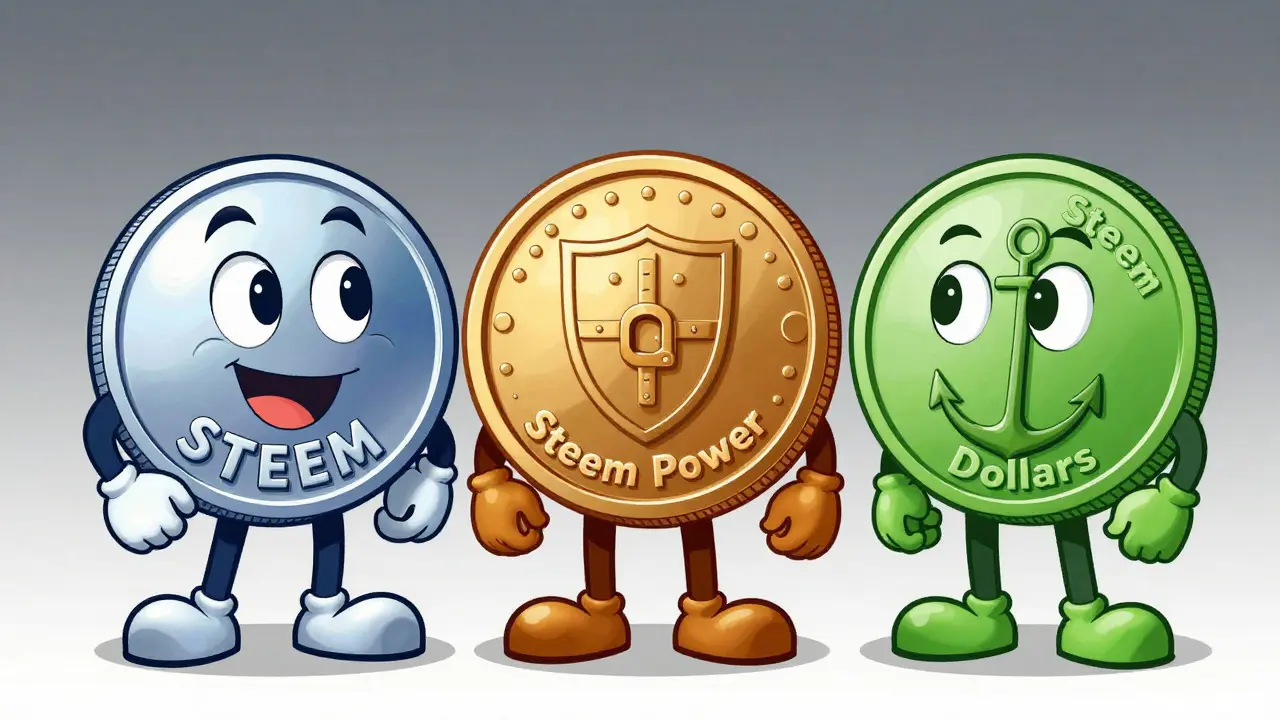
One of the most confusing parts for newcomers is why there are three different assets associated with the same network. It’s not accidental; it’s a deliberate economic design to balance liquidity, stability, and long-term commitment.
- STEEM: The native liquid currency. Think of it as cash. You can trade it, send it to friends, or deposit it on exchanges. It’s the primary unit of account and the block reward for validators.
- Steem Power (SP): The long-term stake. To get SP, you "power up" STEEM. This locks your tokens for at least 13 weeks. In return, you gain voting weight and receive annual interest (currently around 15% of newly minted STEEM). It’s like buying stock in the company rather than holding cash.
- Steem Dollars (SBD): A stablecoin pegged to the US dollar. SBDs provide price stability within the ecosystem. If you want to hold value without worrying about crypto volatility, you convert STEEM to SBD. Converting back takes about 3.5 days, which discourages quick flipping and encourages longer-term holding.
This triad ensures that the network has liquid traders (STEEM), committed stakeholders (SP), and stable savers (SBD). Each group plays a different role in maintaining the health of the network.
How Consensus Works: DPoS Explained
Steem doesn’t use mining. Instead, it relies on Delegated Proof of Stake (DPoS). In this system, token holders vote for "witnesses" who produce blocks. These witnesses are essentially validators elected by the community. They must maintain high uptime and low latency to stay in power.
Why does this matter? Speed and cost. Because only a limited number of active witnesses are producing blocks, transactions settle almost instantly and fees remain negligible. Compare this to Bitcoin, where you wait minutes and pay significant fees during peak times. For a social media platform where micro-transactions happen constantly, DPoS is a practical choice. Your influence in choosing these witnesses is proportional to your Steem Power, meaning long-term holders have a louder voice in governance.
The Ecosystem Beyond Just Blogging
While Steemit is the flagship app, the Steem blockchain supports many other decentralized applications (dApps). Developers can build anything from video sharing platforms to gaming ecosystems using the underlying reward structure.
For example, DTube emerged as a video alternative to YouTube, allowing creators to own their content and earnings directly. While some projects like Splinterlands migrated to the Hive fork, the core infrastructure remains robust for new entrants. The key benefit for developers is that they don’t need to build their own payment system; they can plug into Steem’s existing incentivization engine.
| Asset | Liquidity | Purpose | Yield/Benefit |
|---|---|---|---|
| STEEM | High | Trading, Transfers, Payments | Block rewards, Speculation |
| Steem Power (SP) | Low (Locked 13+ weeks) | Voting, Governance, Bandwidth | ~15% Annual Interest, Voting Weight |
| Steem Dollars (SBD) | Medium | Stable Store of Value | 10% Annual Return, Price Stability |
Inflation and Tokenomics: What to Expect
Like many proof-of-stake networks, Steem issues new tokens over time. The inflation rate started at 9.5% annually but decreases by 0.5% each year until it hits a floor of 0.95%. This gradual reduction helps control supply growth as the network matures. Most of the newly minted STEEM goes into a rewards pool, which means the money used to pay creators comes from fresh issuance, not necessarily from other users’ wallets.
This design creates a positive feedback loop: more activity leads to more rewards distributed, which attracts more users, leading to even more activity. However, it also means the value of STEEM depends heavily on demand. If fewer people are creating or voting, the same amount of new tokens gets spread thinner, potentially impacting price stability. This is why understanding the flow of STEEM, SP, and SBD is crucial for any participant.

Getting Started: A Practical Guide
So, how do you actually join? You don’t need to run a full node. Here’s the simple path:
- Create an account on a Steem-powered dApp like Steemit. You’ll need a referral code or a small fee in STEEM to cover transaction costs.
- Buy STEEM on a major exchange that lists it, then transfer it to your Steem wallet address.
- Decide your strategy. Do you want to write? Post content. Do you want to invest? "Power up" your STEEM to SP to earn interest and voting rights. Do you want stability? Convert to SBD.
- Engage. Vote on posts you like. Curate topics. The more you interact, the more you understand the dynamics of the reward pool.
Keep in mind that bandwidth is required to post and vote. This bandwidth is derived from your Steem Power. If you have very little SP, you might find yourself running out of "posting energy" quickly. This is a common pitfall for new users who try to post frequently without powering up enough.
Is Steem Still Relevant in 2026?
The crypto space moves fast, and newer Layer-1 chains often tout higher speeds or lower fees. So, does Steem still have a place? Yes, but its niche is specific. It’s one of the few mature blockchains dedicated entirely to social media and content monetization. While competitors exist, Steem’s longevity since 2016 gives it a proven track record of survival through multiple market cycles.
The challenge lies in adoption. Centralized giants still dominate user attention. For Steem to grow, it needs to attract not just crypto enthusiasts but regular creators who want fair compensation. The platform’s success hinges on whether its unique economic model can compete with the sheer convenience of traditional social networks. For now, it remains a compelling experiment in decentralized ownership of digital media.
Can I use STEEM for everyday purchases?
Directly, not really. STEEM is primarily a utility token for the Steem ecosystem. While you can spend SBDs in some virtual economies or partner merchants, most people convert STEEM to fiat or other major cryptos before spending. Its main use case is internal: earning rewards, voting, and staking.
What happens if I want to sell my Steem Power?
You can't instantly sell SP like you would STEEM. You must "power down," which converts SP back to STEEM in weekly installments over 13 weeks. Alternatively, you can transfer your SP to another account instantly, but the receiving account must have sufficient capacity. This lock-in period is designed to encourage long-term commitment.
How is Steem different from Hive?
Hive is a hard fork of Steem created in 2020 due to governance disagreements. Both share similar mechanics, but they are separate networks with separate tokens (HIVE vs. STEEM) and separate communities. Some apps moved from Steem to Hive, while others stayed. Users cannot easily swap between them without going through an exchange or bridge.
Do I need to be a developer to use Steem?
No. Most users interact via front-end applications like Steemit, which handle the technical complexity. You just need a web browser and a wallet. Developers are only needed if you want to build new dApps on top of the blockchain.
Is Steem secure?
The blockchain itself has been running securely since 2016. Security risks usually come from user error, such as losing private keys or falling for phishing scams. Since it uses DPoS, the network relies on honest witnesses. As long as the majority of witnesses act in good faith, the chain remains secure. Always double-check URLs and use hardware wallets for large amounts.