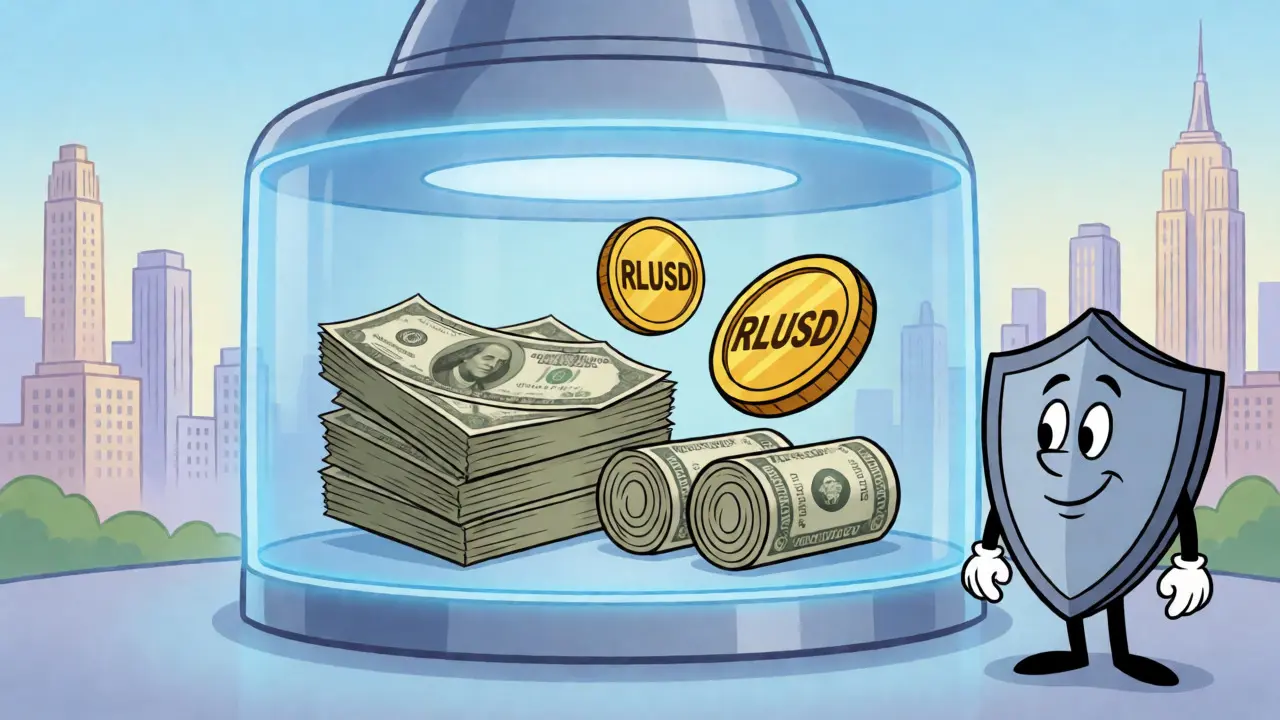
Imagine needing to move money across borders instantly, but you’re worried about the volatility of Bitcoin or the regulatory gray areas that have plagued other digital dollars. That’s exactly the problem Ripple USD (RLUSD) aims to solve. It’s not just another meme coin or speculative asset; it’s a fully regulated, U.S. dollar-backed stablecoin designed for serious financial infrastructure. If you’ve been watching the crypto space, you know that trust and compliance are becoming the new gold standard. RLUSD was built with that in mind from day one.
The Quick Lowdown on RLUSD
Before we get into the technical weeds, here’s what you need to know right now:
- It’s a Digital Dollar: One RLUSD always equals one U.S. dollar. It’s backed by real cash and short-term Treasuries.
- Regulated Issuer: It’s issued by Standard Custody & Trust Company LLC, a subsidiary of Ripple Labs, under strict New York State Department of Financial Services (NYDFS) oversight.
- Multi-Chain Presence: You can find it on the XRP Ledger (XRPL), Ethereum, and increasingly on Layer 2 networks like Optimism and Base.
- Institutional Focus: While traders use it, its primary engine is cross-border payments and enterprise liquidity through Ripple Payments.
- Growth Trajectory: Launched in late 2024, it hit a $1 billion market cap in under a year and sits near $1.78 billion as of mid-2026.
What Exactly Is RLUSD?
At its core, Ripple USD is a fiat-backed stablecoin. This means it isn’t trying to be "digital gold" or a decentralized experiment. It is a digital representation of the U.S. dollar. Every single token in circulation is matched by reserves held in segregated accounts. These reserves consist of U.S. dollar deposits, short-dated U.S. Treasury securities, and other high-quality cash equivalents. The goal is simple: maintain a constant value of exactly $1.00 per token.
Why does this matter? Because traditional stablecoins often faced scrutiny over whether their reserves were actually there. RLUSD sidesteps this by operating under a Limited Purpose Trust Company charter approved by the NYDFS. This puts it in the same regulatory bucket as many traditional financial products, offering a level of transparency and auditability that earlier stablecoins lacked. When you hold RLUSD, you’re holding a claim on real-world assets managed by a regulated trust company, not just code.
How RLUSD Works: The Technical Backbone
You might wonder how a single asset exists on multiple blockchains without breaking. RLUSD is implemented natively on both the XRP Ledger and Ethereum. On XRPL, it functions as a native issued currency, leveraging the ledger’s speed and low fees. On Ethereum, it operates as a standard ERC-20 compatible token, allowing it to plug into existing DeFi protocols and wallets.
But Ripple didn’t stop there. They are actively expanding RLUSD’s reach using the Wormhole interoperability protocol’s Native Token Transfers (NTT) standard. This allows RLUSD to exist natively on Layer 2 networks like Optimism, Base, Ink, and Unichain. This multi-chain strategy ensures that institutional users aren’t locked into one ecosystem. If your bank uses Ethereum for smart contracts but your payment partner uses XRPL for speed, RLUSD bridges that gap seamlessly.
| Feature | RLUSD | Generic Stablecoin |
|---|---|---|
| Issuer | Standard Custody & Trust Co. (Ripple Subsidiary) | Varies (often offshore entities) |
| Regulation | NYDFS Charter (Strict U.S. Compliance) | Fragmented or light regulation |
| Reserves | Cash, Short-Term Treasuries, Cash Equivalents | Mixed (sometimes commercial paper) |
| Primary Use Case | Institutional Cross-Border Payments | Trading, DeFi Yield Farming |
| Audits | Regular Independent Attestations | Varies in frequency/transparency |

Why Institutions Are Choosing RLUSD
If you’re a retail trader, you might care about price swings. But if you’re a bank or a multinational corporation, you care about reliability and compliance. This is where RLUSD shines. In April 2026, Ripple integrated RLUSD directly into Ripple Payments, their flagship cross-border solution. This means financial institutions can now use RLUSD as a default settlement asset. It replaces or complements fiat rails, reducing friction in foreign exchange transactions.
The appeal here is risk mitigation. By using a NYDFS-regulated token, banks don’t have to worry about sudden regulatory crackdowns freezing their assets. The reserve composition is deliberately conservative-focusing on short-term Treasuries rather than risky corporate bonds. This minimizes the chance that interest rate fluctuations will break the peg. For treasury managers, this predictability is worth more than the potential yield from riskier stablecoins.
Where to Buy and Use RLUSD
When RLUSD launched in December 2024, it wasn’t immediately available on every major U.S. retail exchange. Ripple intentionally targeted specific platforms first, such as Uphold, Bitso, MoonPay, Archax, and CoinMENA. This curated approach ensured that early adopters were aligned with the product’s institutional focus. By mid-2026, availability has expanded to include venues like Bullish, Bitstamp, Mercado Bitcoin, and Zero Hash.
For individual users, getting started looks similar to buying any other stablecoin. You open an account on a supported exchange, complete KYC procedures, and purchase RLUSD. However, note that it may not yet be listed on all mass-market apps like Coinbase or Robinhood, depending on current listings. Always check the latest exchange support before transferring funds. For institutions, access is often direct through Ripple Mint, which handles minting and redemption operations with higher-level compliance controls.

Market Performance and Growth
Numbers tell a compelling story. Launched in December 2024, RLUSD crossed the $1 billion market capitalization mark in November 2025. By May 2026, data from CoinGecko showed approximately 1.78 billion tokens in circulation, valuing the network at roughly $1.78 billion. As of August 2026, it ranks around #37 among all crypto assets globally.
This rapid growth suggests strong demand. Unlike some stablecoins that rely on marketing hype, RLUSD’s expansion is driven by utility. Its integration into Ripple’s payment corridors means it’s being used for actual money movement, not just sitting in wallets waiting for a pump. Price trackers consistently show RLUSD trading at exactly $1.00 with negligible intraday variance, proving that the peg mechanism works effectively even during periods of broader market volatility.
Future Outlook and Roadmap
What’s next for RLUSD? The roadmap focuses on deeper integration and broader chain support. We expect to see more Layer 2 deployments as regulatory approvals finalize. Additionally, Ripple continues to refine the user experience for institutional clients, aiming to make RLUSD the go-to digital dollar for regulated finance. The trend toward clearer crypto regulations in the U.S. favors RLUSD’s compliant model, potentially attracting more traditional banks looking to enter the digital asset space without taking on excessive regulatory risk.
Is RLUSD the same as XRP?
No. XRP is a native digital asset used for liquidity and bridging currencies, while RLUSD is a stablecoin pegged 1:1 to the U.S. dollar. XRP’s price fluctuates based on market demand, whereas RLUSD is designed to stay at $1.00.
Who issues RLUSD?
RLUSD is issued by Standard Custody & Trust Company LLC, a wholly owned subsidiary of Ripple Labs Inc. It operates under a Limited Purpose Trust Company charter approved by the New York State Department of Financial Services (NYDFS).
What backs the value of RLUSD?
Every RLUSD token is fully backed by segregated reserves consisting of U.S. dollar deposits, short-dated U.S. Treasury securities, and other high-quality cash equivalents. These reserves are audited regularly to ensure they match the total circulating supply.
Can I redeem RLUSD for cash?
Yes. Holders are contractually entitled to redeem RLUSD tokens at a fixed 1:1 rate for U.S. dollars through approved channels, such as Ripple Mint or authorized exchanges. The issuer maintains sufficient reserves to honor these redemptions.
Which blockchains support RLUSD?
RLUSD is natively issued on the XRP Ledger (XRPL) and Ethereum. Through interoperability standards like Wormhole’s NTT, it is also expanding to Layer 2 networks such as Optimism, Base, Ink, and Unichain.


Bill Patterson
September 1, 2026 AT 01:58still waiting for coinbase to list it like always
Rebecca Springer
September 1, 2026 AT 21:11It is refreshing to see a stablecoin that actually prioritizes regulatory clarity over hype cycles. The NYDFS charter really sets a different tone compared to the offshore entities we saw during the last bull run.
Matthew O'Neill
September 3, 2026 AT 12:53The reliance on Standard Custody & Trust Company introduces centralization risks that retail investors completely ignore. You are trading blockchain decentralization for traditional banking opacity wrapped in a token. It's not crypto, it's just a digital IOU with extra steps and higher counterparty risk than you think.
Liam Grimes
September 4, 2026 AT 22:28actually its pretty good for cross border stuff since xrpl is so fast. i tried sending some from ireland to a friend in the us and it was instant. way better than wire fees honestly
Sean Dalton
September 6, 2026 AT 04:05Oh please, spare me the 'regulated' narrative. Ripple has been trying to force this down our throats since forever. It’s just another tool for their enterprise clients who don't understand what decentralized finance actually means. Typical corporate co-opting of the movement.
Kelechi Precious Nwachukwu
September 7, 2026 AT 21:16I must say, the stability here is quite dramatic in its consistency! 🙌 While I respect the boundaries of regulation, seeing a peg hold this tight amidst market chaos is truly remarkable. It gives one hope for financial infrastructure in emerging markets too.
Rajni Mathur
September 8, 2026 AT 15:37This analysis is fundamentally flawed because it ignores the systemic fragility of centralized trust models. 📉 If the NYDFS changes policy tomorrow, your 'safe' asset becomes a frozen liability instantly. The emojis cannot hide the inherent paradox of using a centralized entity to solve decentralized problems. 😒
Steve Sulley
September 10, 2026 AT 04:21but wait isnt money just a social construct anyway? if we all agree rlusd is worth a dollar then it is right? or maybe the dollar itself is the illusion and xrp is the real truth. idk man just thinking out loud here lol
Valentine Okpala
September 11, 2026 AT 23:43🤔 interesting perspective on the institutional focus. most people just want yield farming though. 🌱 but yeah, compliance is boring but necessary. 🧐
David Powell
September 12, 2026 AT 11:41The article reads like a press release written by someone who has never touched a cold wallet. 'Serious financial infrastructure' is code for 'we want banks to use our tech.' It lacks any critical examination of the actual utility beyond Ripple's own ecosystem lock-in.
Ellie Brooks
September 13, 2026 AT 01:52I have been following the development of RLUSD closely since its inception and I find the multi-chain strategy particularly fascinating because it addresses the fragmentation issue that plagues so many other stablecoins which are often siloed on single networks causing liquidity issues for users who need to bridge assets frequently across different ecosystems without losing value or time to complex swaps.
Kevin Payette
September 14, 2026 AT 17:47Illusion of safety.
Centralized choke point.
You don't own the keys, you don't own the dollar.
Dave Worth
September 14, 2026 AT 20:52They are setting it up to freeze funds when they decide the government wants more control. 👀 Watch the reserves reports. They will change the definition of 'cash equivalents' eventually. 🕵️♂️ Don't be sheep. 🐑
J Shepherd
September 16, 2026 AT 06:04For treasury managers, the segregated reserve model is key. It reduces counterparty exposure significantly compared to commercial paper backed coins. The integration with Ripple Payments provides immediate liquidity depth which is crucial for FX desks handling high volume transactions daily.
Linda Jevne
September 18, 2026 AT 01:58There is something poetic about a digital dollar being born from the ashes of regulatory uncertainty. It reflects our collective desire for order in a chaotic financial landscape. We seek anchors, even if those anchors are made of code and law rather than gold.
liam & the bees
September 18, 2026 AT 07:47Hey everyone! Great discussion happening here. Just wanted to add that for folks in Europe, the MiCA regulations might actually make RLUSD an attractive option for cross-border EU-UK payments soon. The compliance framework aligns well with what regulators are looking for now. Keep the positive vibes going! 🐝💚
Alan Hawkins
September 19, 2026 AT 05:19Agreed with the points on institutional adoption. The seamless bridging via Wormhole NTT is a technical win that shouldn't be overlooked. It solves a real UX problem for developers building on L2s who need reliable stablecoin liquidity without managing multiple bridges manually.
Carey Thornton
September 20, 2026 AT 22:29What absolute drivel. This isn't innovation, it's bureaucratic masturbation. They dressed up a bank account in a hoodie and called it crypto. The 'multi-chain presence' is just a marketing gimmick to distract from the fact that it's still controlled by a single New York-based entity. Pathetic attempt at relevance.
Edward Ogunfolaju
September 21, 2026 AT 23:58Stop crying about centralization and look at the numbers! $1.78 billion market cap doesn't lie! People are using it because it WORKS. It moves money faster and cheaper than SWIFT. That is the only metric that matters. Get on board or get left behind!