
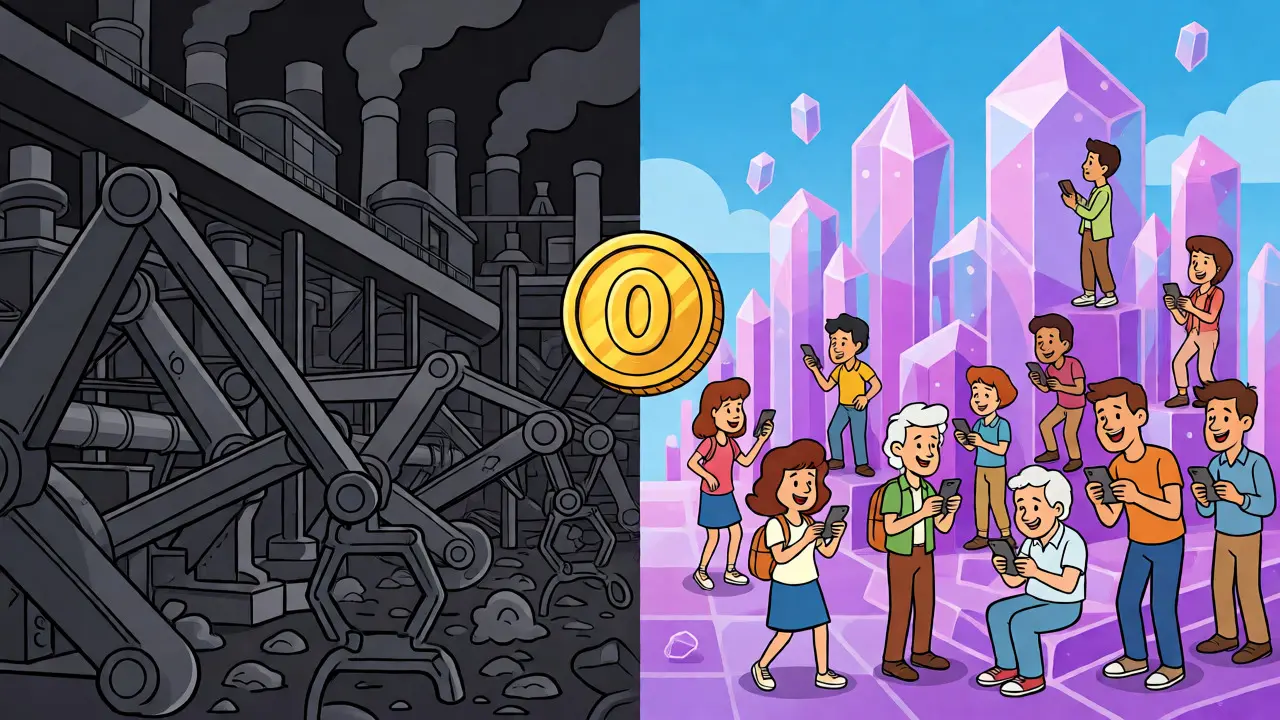
Imagine mining a new cryptocurrency using just your laptop or smartphone, without burning through electricity or buying expensive hardware. That is the core promise of Ore, also known as ORE, a unique token that brings Bitcoin-style mining to the high-speed Solana blockchain. Launched in late 2025, ORE attempts to solve one of crypto's biggest complaints: centralization. While Bitcoin mining is dominated by massive industrial farms, ORE lets anyone participate. But what exactly is this coin, how does it work, and is it worth your attention?
The Core Concept: Democratizing Mining
Most people think of mining as something requiring specialized rigs and warehouses full of GPUs. ORE flips this script. It operates as a Proof-of-Work protocol built directly on the Solana network. This hybrid approach combines the fairness and decentralization ethos of Bitcoin with the speed and low costs of Solana.
The idea originated from discussions on Twitter about rare mining supplies and the post-halving landscape of 2023. The project aims to be a digital store of value, similar to gold or cash, but with a distribution model that doesn't favor the wealthy or those with access to cheap energy. By allowing mining on standard devices, ORE tries to ensure that early adopters aren't locked out by capital barriers.
How ORE Mining Works on Solana
Technically, ORE is an SPL token, which means it follows the standard framework for tokens on Solana. However, its distribution mechanism is distinct. Unlike typical Solana tokens distributed via staking or initial sales, ORE uses a mining algorithm.
- Device Agnostic: You can mine ORE on laptops, smartphones, or home computers. No ASICs required.
- Low Energy Footprint: Because it runs on Solana's infrastructure, it avoids the massive energy consumption associated with traditional Proof-of-Work chains like Bitcoin.
- Speed and Cost: Transactions are fast and fees are negligible compared to Ethereum-based alternatives.
This setup makes ORE the only minable token currently operating within the Solana ecosystem. It leverages Solana's high throughput-thousands of transactions per second-to handle the frequent interactions required for mining rewards without clogging the network.
Tokenomics: Supply and Issuance
Understanding the supply schedule is critical for any investor. Sources vary slightly on the exact numbers, but the consensus points to a capped supply model designed to mimic scarcity.
| Metric | Details |
|---|---|
| Blockchain | Solana |
| Total Supply Cap | Conflicting reports: 5 million to 21 million tokens |
| Issuance Rate | Approximately 1 token per minute |
| Pre-mine | None reported |
| VC Allocation | None reported |
| Estimated Full Mined Date | Projected around 2064 |
The discrepancy between 5 million and 21 million total supply figures often stems from different reporting periods or confusion between circulating and maximum supply. Currently, only a fraction of the total possible supply is in circulation, estimated at over 426,000 ORE recently. The lack of pre-mining and venture capital allocations is a significant selling point for community members who dislike "insider" advantages.
Market Performance and Volatility
If you look at the charts, ORE has experienced extreme volatility since its launch. As of October 2026, the price hovers around $39.41, but this number tells only part of the story. The token reached an all-time high significantly higher than current levels, meaning many early buyers are sitting on substantial losses if they haven't sold.
Trading volume remains relatively low, often fluctuating between $30,000 and $500,000 daily across major exchanges. This indicates limited liquidity. In a risk-off market environment, low-cap altcoins like ORE face severe selling pressure. The sentiment is currently classified under "extreme fear," suggesting that traders are cautious and skeptical about long-term viability amidst broader crypto downturns.
Community and Utility: More Than Just Hype?
Is ORE just another meme coin? It shares DNA with meme tokens-community-driven, anonymous developers, and viral marketing-but positions itself differently. Most meme coins offer no utility beyond speculation. ORE claims to be a functional asset: a medium of exchange and store of value.
Holding ORE grants membership in a specific community focused on mining themes. However, it’s important to note that holding the token does not currently grant governance rights or complex utility functions. The value proposition relies heavily on the narrative of fair distribution and the technical novelty of mining on Solana. If the community maintains engagement and the mining difficulty adjusts appropriately, the token retains its niche appeal. If interest fades, it risks becoming illiquid and forgotten.
Risks and Challenges
Before jumping in, consider the hurdles. First, there is the issue of conflicting data regarding supply caps. When authoritative sources disagree on basic metrics, it raises questions about transparency. Second, the project lacks detailed public documentation on its specific problem-solving capabilities beyond "fair distribution." Third, competition is fierce. Other projects are experimenting with similar concepts, and Solana itself continues to evolve rapidly.
Additionally, the reliance on a single blockchain (Solana) introduces systemic risk. If Solana experiences outages or regulatory scrutiny, ORE moves in lockstep. Finally, the token's price action suggests it is still finding its footing. A 99% drop from peak values is a stark reminder of the speculative nature of early-stage crypto assets.
Conclusion: Who Is ORE For?
ORE appeals to two main groups: tech enthusiasts interested in novel consensus mechanisms and retail investors looking for accessible entry points into crypto mining. It removes the barrier to entry that defines modern Bitcoin mining. However, it requires a high tolerance for risk. The combination of low liquidity, volatile pricing, and evolving tokenomics makes it a speculative play rather than a safe haven.
If you believe in the power of decentralized, permissionless finance and want to participate in creating a new asset class from your phone, ORE offers a unique experiment. Just remember to verify contract addresses and monitor official channels closely, as the project is still young and subject to rapid change.
Can I mine Ore (ORE) on my smartphone?
Yes, one of ORE's primary features is accessibility. You can mine ORE on virtually any device, including smartphones and standard laptops, without needing specialized hardware like ASIC miners or high-end GPUs.
What is the total supply of ORE?
There are conflicting reports, with some sources citing a cap of 5 million tokens and others stating 21 million. Regardless of the exact cap, the issuance rate is approximately one token per minute, with full supply projected to be mined by 2064.
Is ORE a meme coin or a utility token?
ORE occupies a middle ground. It has meme-like community dynamics and viral origins but positions itself as a utility token functioning as a digital store of value and medium of exchange on the Solana blockchain.
Does ORE have a pre-mine or VC allocation?
According to available information, ORE launched with no pre-mine and no venture capital allocations. All tokens are intended to be distributed through the mining process, aiming for a fairer start for early participants.
Which blockchain does ORE run on?
ORE runs on the Solana blockchain. It utilizes the SPL (Solana Program Library) token standard, benefiting from Solana's high transaction speeds and low fees while implementing its own Proof-of-Work mining mechanism.