Imagine a decentralized exchange that keeps zero percent of the trading fees it collects. Sounds too good to be true? That is exactly the pitch behind Bored Candy City, a niche cryptocurrency project built on the Cronos Chain that combines a low-fee AMM with play-to-earn gaming and NFTs. If you have stumbled upon the ticker CANDY while scrolling through microcap lists, you are probably wondering if this sweet-sounding token has any real substance or if it is just another fleeting trend in the crowded crypto landscape. The reality sits somewhere in between: it offers unique utility mechanisms but comes with significant liquidity risks that every investor needs to understand before jumping in.
The Core Concept: A Community-Owned DEX on Cronos
At its heart, Bored Candy City isn't just a meme coin; it is an ecosystem designed around a specific economic model. It operates as an Automated Market Maker (AMM) and Decentralized Exchange (DEX) on the Cronos Chain. What sets it apart from giants like Uniswap or PancakeSwap is its fee structure. Most DEXs charge a standard 0.30% fee per trade, keeping a portion for their treasury. Bored Candy City charges only 0.15%-half the industry standard-and redistributes 100% of those fees back to the community.
This redistribution happens in two ways. First, 0.10% goes directly to Liquidity Providers (LPs) as immediate rewards. Second, the remaining 0.05% is used to buy back CANDY tokens from the open market. This creates constant buying pressure, theoretically supporting the price as more people trade. The platform markets itself as the "first community-owned DEX" on Cronos, emphasizing that no part of the revenue stays with the developers or a central company. For users who believe in decentralized ownership, this is a compelling narrative.
Tokenomics: Supply Confusion and Microcap Reality
If you look up CANDY data across different sites, you might feel confused. And you should be. There are notable inconsistencies in reported supply figures, which is a red flag for any serious analyst. Some sources list a maximum supply of 250 million tokens, while others report circulating supplies ranging from 30 million to over 220 million. As of late August 2026, major aggregators like CoinGecko and DropsTab suggest a circulating supply near 230 million, placing the market capitalization firmly in the microcap segment-hovering around $40,000 to $46,000 USD.
| Metric | Value / Range | Context |
|---|---|---|
| Price | $0.00018 - $0.00022 | Micro-price range typical for small-cap altcoins. |
| Market Cap | ~$41,794 - $46,147 | Extremely small compared to top-tier DeFi projects. |
| Daily Volume | $10 - $41 USD | Very low liquidity; large trades may cause slippage. |
| Global Rank | ~#5366 | Deep in the long tail of tracked cryptocurrencies. |
The token's price has fluctuated significantly over time. In early 2025, prices were recorded higher, around $0.0024, but by mid-2026, they had settled into the sub-$0.0002 range. This volatility is common for projects with such thin trading volumes. With daily volume often dropping below $50, selling even a modest amount of tokens can crash the price temporarily. Always check live data before making decisions, as static numbers become outdated quickly in this sector.
Gaming Integration: Mobile and Web3 Play-to-Earn
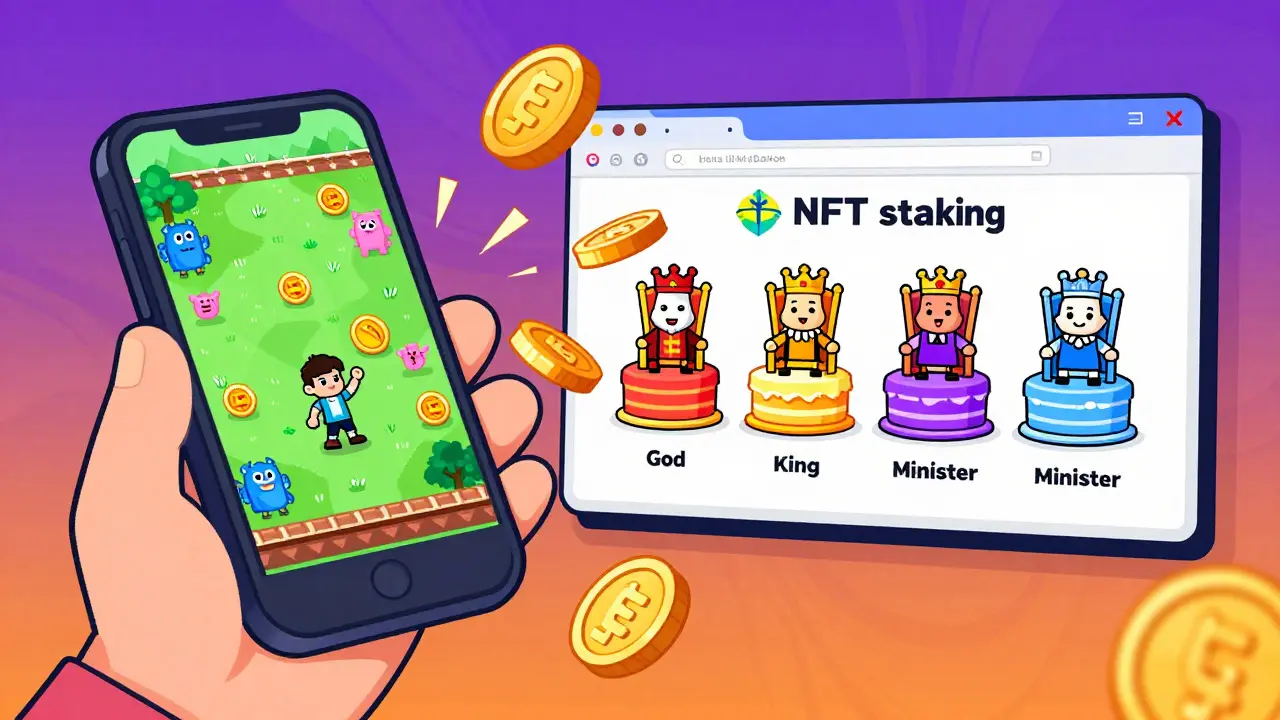
Why call it "Candy" City? Because the ecosystem leans heavily into gamification. Bored Candy City features two distinct games: a web3 browser-based game and a native mobile title. Notably, the mobile version was marketed as the first Play-to-Earn (P2E) game from the Cronos ecosystem to hit both the Apple App Store and Google Play Store. This accessibility matters because it lowers the barrier to entry for non-crypto natives who might not want to manage complex wallets immediately.
In these games, CANDY serves as the primary currency. You use it to pay for in-game actions, and you earn it by playing well. The economic loop is simple: players spend CANDY, creating demand, and successful players earn CANDY, creating supply distribution. Game revenue is calculated weekly based on net spending (CANDY spent minus CANDY earned). Then, 25% of that net revenue is distributed to holders of Bored Candy NFTs who stake them in the game interface. This ties the value of the NFTs directly to the health of the gaming economy.
NFT Utility: More Than Just Profile Pictures
The Bored Candy NFT collection is the backbone of the reward system. Unlike many NFT projects where art is the sole utility, here, the NFTs act as yield multipliers and revenue shares. There are five rarity tiers, each offering different daily staking rewards in CANDY:
- Candy God (50 NFTs): Earns 8 CANDY per day.
- Candy King (250 NFTs): Earns 4 CANDY per day.
- Candy Prince (1,200 NFTs): Earns 2 CANDY per day.
- Candy Minister (3,500 NFTs): Earns 1 CANDY per day.
- Candy Citizen (5,000 NFTs): Earns 0.54 CANDY per day.
Staking an NFT also boosts your farming APR on the DEX by up to 25%. This means if you provide liquidity to the CANDY pools, holding an NFT makes your returns significantly higher than someone without one. It’s a clever way to incentivize long-term holding of both the token and the NFT, reducing sell pressure from casual traders.
Risks and Challenges: Liquidity and Transparency
Let’s be real about the downsides. The biggest risk with CANDY is liquidity. With daily trading volumes sometimes dipping to $10 or $40, exiting a position can be difficult without moving the market against yourself. Slippage-the difference between the expected price and the executed price-can be severe for anything larger than a few hundred dollars.
Another concern is transparency. The core team remains largely pseudonymous, and there is no detailed public biography of the founders associated with Bored Candy City LTD. While anonymity is common in crypto, combined with inconsistent tokenomics data across providers, it requires extra due diligence. Furthermore, the project has not yet secured listings on major centralized exchanges like Binance or Coinbase, limiting its exposure to mainstream retail investors.
Who Should Consider CANDY?
This token isn’t for everyone. If you are looking for stable, blue-chip growth, this is likely too risky. However, if you are already active in the Cronos Chain ecosystem and enjoy experimenting with new DeFi mechanics, Bored Candy City offers a unique experiment in community-owned economics. It appeals to gamers who want tangible rewards for their time and DeFi users who prefer lower fees and direct revenue sharing over protocol treasuries.
Before investing, ask yourself: Can I afford to lose this money? Do I understand how AMMs work? Am I comfortable with the possibility that this project could fade away if user engagement drops? Given the microcap status, treat CANDY as a high-risk speculative asset, not a safe haven.
Is Bored Candy City a scam?
There is no evidence suggesting it is a scam, but it is a very small, high-risk project. The team is pseudonymous, and data inconsistencies exist. Always verify contracts and do your own research before interacting.
Where can I buy CANDY tokens?
CANDY is primarily traded on the Bored Candy City DEX itself on the Cronos Chain. It has limited presence on other decentralized exchanges and is not widely listed on major centralized exchanges as of late 2026.
How do I stake Bored Candy NFTs?
You connect your wallet to the official Bored Candy City website, navigate to the staking section, and choose whether to stake for fixed daily CANDY rewards or for a share of game revenues. Staking also boosts your DEX farming APR.
What is the maximum supply of CANDY?
Reports vary, but the most consistent figure cited in technical reviews is a maximum supply cap of 250,000,000 tokens. However, circulating supply figures differ across data aggregators, so check live blockchain explorers for current data.
Does Bored Candy City have a mobile app?
Yes, there is a P2E mobile game available on both iOS and Android stores. It allows users to play games using CANDY tokens and participate in the ecosystem without needing a desktop interface.
Teresa Watson
August 30, 2026 AT 10:53zero fees sounds great until you realize the liquidity is basically non existent so good luck getting out without eating half your gains in slippage lol
Ian Munro
September 1, 2026 AT 00:30The daily volume figures are concerning. $10 to $41 USD is negligible for any meaningful institutional or retail exit strategy.
Sean Dalton
September 1, 2026 AT 12:53Ah, the classic crypto narrative: 'We own nothing, we do everything, and we expect you to trust us.' It’s charming in its audacity, isn't it? A DEX that keeps zero percent of fees but somehow expects the community to provide infinite liquidity while they sit back and watch the charts go sideways. The 'community-owned' tagline is just marketing fluff designed to distract from the fact that the team remains pseudonymous and the tokenomics are a mess of inconsistent data points. If I wanted to gamble on a microcap with no real utility other than being a 'Candy City', I'd stick to my local pub's lottery tickets. At least there, the odds are transparent and the beer is cold. This feels like another attempt to sell hope to the desperate, wrapped in a shiny NFT package that will likely rot faster than fruit left in the sun. Bravo to the developers for creating a problem and then selling us the solution at a premium.
Ashwin Bhandurge
September 2, 2026 AT 02:48Hey everyone! Look, I get the skepticism, but let's look at the bigger picture here! 🚀
We are talking about true decentralization! Most exchanges take their cut, they hoard the wealth, they become these massive centralized entities despite calling themselves Web3. But Bored Candy City? They are actually putting the power back into the hands of the people!
Think about it. When you trade, you aren't just feeding a corporation; you are rewarding your fellow LPs directly. That is pure economic justice! And the gaming aspect? That is not just a gimmick, that is an engagement loop that creates organic demand. People play because it's fun, they earn CANDY, they spend CANDY. It's a circular economy that doesn't rely solely on speculative pumping.
I know the market cap is small right now. I know the volume looks scary. But remember where Bitcoin was? Remember where Ethereum was before smart contracts took off? Every giant starts as a seedling. We have to be supportive of these experimental projects! If we dismiss them all because they aren't perfect yet, we kill innovation!
Let's focus on the utility. Let's focus on the community ownership model. This is what crypto was supposed to be about! Not just gambling, but building something together. So don't let the naysayers bring you down. Look at the staking rewards. Look at the low fees. There is real substance here if you dig deep enough. Let's keep our spirits high and our eyes on the horizon! 💪🍬
Kevin Payette
September 2, 2026 AT 05:13You're confusing hope with substance. The 'circular economy' argument is weak when the external inflow is near zero. Without new buyers, the game economy collapses under its own weight. It's a closed loop bleeding out slowly.
Nadia Christian
September 3, 2026 AT 02:59This is exactly why American crypto projects struggle! We need strong national champions!!
Cronos Chain is trying hard, but this project lacks the patriotic drive to dominate global markets!!!
If we had more transparency and less anonymity, maybe we could compete with Asian DeFi protocols properly!!!
It is frustrating to see such potential wasted on vague promises instead of concrete results!!!
We should be leading the world in blockchain innovation, not hiding behind pseudonyms!!!
Get it together, devs!!!
Show us who you are!!!
Prove your worth to the free market!!!
Otherwise, this is just noise!!!
Jarnail Singh
September 3, 2026 AT 18:00My dear friend, you speak of 'national champions' with such fervor, yet you fail to grasp the fundamental nature of decentralized finance which transcends borders by design... 😌
One must understand that the beauty of Cronos and indeed all Layer 1 blockchains lies in their borderless nature, where code is law and mathematics is the only currency that truly matters across civilizations... 🧐
To impose nationalist sentiments upon a protocol that operates on consensus mechanisms is akin to judging quantum physics by the standards of classical mechanics-it is simply a category error of the highest order... 📚
Furthermore, the pseudonymity you criticize is not a bug but a feature, protecting the creators from regulatory overreach and allowing for pure meritocratic competition based on code quality rather than passport color... ✨
While I appreciate your enthusiasm, one must elevate their discourse beyond mere geopolitical tribalism to truly appreciate the philosophical underpinnings of Web3 economics... 🤔
Perhaps reading some Hayek or Nakamoto would help clarify why centralization-even national centralization-is antithetical to the very spirit of this revolution... 📖
Let us strive for intellectual rigor rather than emotional outbursts... 🙏
Sam Ariafar
September 5, 2026 AT 14:44It bothers me how casually people throw money at things they don't fully understand. Ethically, we have a responsibility to educate ourselves before participating in systems that might exploit the uninformed. The lack of clear founder identities isn't just a 'feature'; it's a barrier to accountability. If something goes wrong, who do we hold morally responsible? The community? The anonymous devs? It feels like a moral hazard disguised as innovation.
Matt Reckdenwald
September 7, 2026 AT 09:22I hear you, Sam, and I think that ethical concern is valid and important.
It really does feel unsettling when the lines of responsibility blur like that.
But maybe, just maybe, the community itself becomes the accountable entity?
It’s a shift from trusting individuals to trusting the collective governance structure.
Still, it requires a lot of emotional labor from participants to stay engaged and vigilant.
I wonder if the 'gamification' aspect helps mask that heavy cognitive load, making the risk feel more like play than investment.
That’s a fascinating psychological angle to consider.
Emmanuel Ogbomo
September 8, 2026 AT 23:32The interplay between gamification and financial risk is indeed complex. In many ways, the mobile app lowers the barrier to entry, which is crucial for adoption in regions where desktop crypto interfaces feel intimidating. However, the sustainability of the reward system depends entirely on continuous user acquisition. If growth stalls, the inflationary pressure from staking rewards could outweigh the buyback mechanisms. It is a delicate balance that requires constant monitoring of on-chain metrics, not just price action.
Melanie Armijo
September 9, 2026 AT 03:23There is a certain poetry to the idea of 'Bored Candy'. It suggests a state of mind-a longing for sweetness in a mundane world. Perhaps the value isn't in the token price, but in the shared dream of a sweeter, fairer exchange. We are all just looking for a little joy in the chaos, aren't we? 🍭✨
Jillian Pye
September 9, 2026 AT 18:00I tend to agree with the cautionary notes. The supply inconsistencies alone make me hesitant to put significant capital at risk. It feels safer to wait for clearer data before engaging. 🙂
Ashwini Chaskar
September 10, 2026 AT 09:28people always ignore the red flags and call it 'vision' when its actually negligence
if the team can't even agree on their own max supply how can they manage a treasury effectively?
it shows a lack of professionalism that i find deeply disappointing
we deserve better than guesswork
especially when real money is involved
its disrespectful to investors
they should fix the docs first
then worry about marketing
until then im staying away
simple as that