
You just realized it. The wallet is empty. The "investment" you poured your savings into has vanished, or worse, you sent Bitcoin to a stranger who promised to double it within hours. Panic sets in. Your first instinct might be to call your bank, but they can’t reverse a blockchain transaction. Your second instinct might be to hire a "recovery expert" found via a quick search, but beware-most of them are scammers preying on desperate victims.
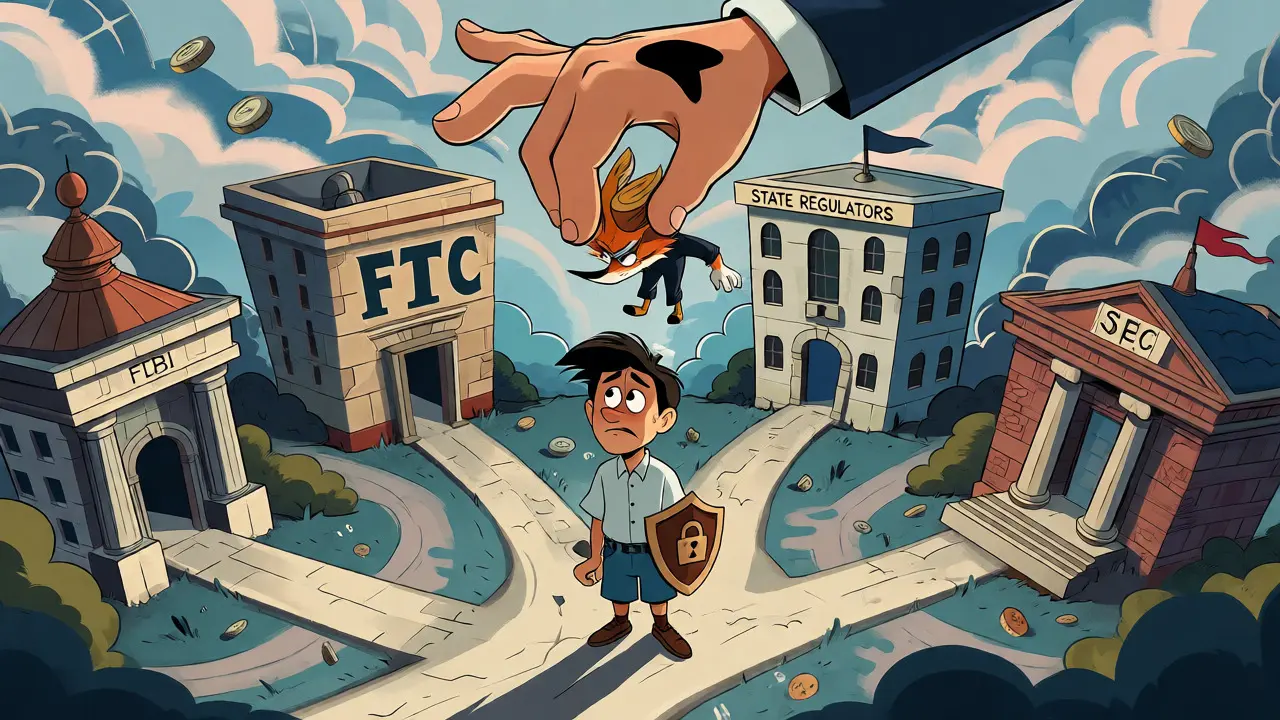
Here is the hard truth: reporting crypto scams doesn’t guarantee you’ll get your money back. In fact, full recovery is rare. But filing the right reports with the right agencies is the only path that offers any chance of restitution, especially if law enforcement seizes assets later. It also helps stop the scammer from hitting others. If you’re in the US, you’re dealing with a fragmented system involving the FBI, FTC, and state regulators. Knowing where to start saves time and prevents you from falling for secondary scams.
Stop the Bleeding Before You Report
Before you touch a keyboard to file a complaint, secure what’s left. If you still have funds in the compromised wallet or exchange account, move them to a new, secure hardware wallet immediately. Do not send more money to the scammer to "unlock" your profits. This is the classic "pig butchering" tactic-keeping the victim engaged by demanding small fees or taxes before releasing larger sums.
Disconnect all devices from the internet if you suspect malware gave the scammer remote access. Change passwords for your email, crypto exchanges, and social media accounts. Enable two-factor authentication (2FA) using an authenticator app, not SMS, as SIM-swapping attacks are common among crypto thieves. Document everything while your memory is fresh. Screenshots of chats, emails, transaction hashes, and website URLs are critical evidence. Once the scammer realizes you’ve gone silent, they often delete their profiles or change domains, making your early documentation invaluable.
The Federal Reporting Landscape: Who Does What?
There is no single "Crypto Police" button. Instead, you need to understand which agency handles which aspect of the crime. Filing with multiple agencies increases the odds that your case gets noticed, though coordination between them isn't always seamless.
The FBI Internet Crime Complaint Center (IC3) is your primary stop for criminal investigation support. The FBI tracks billions in losses; in 2024 alone, Americans reported $9.3 billion in crypto-related losses. When you file at ic3.gov, you aren't just complaining-you're feeding data into a national database used to identify patterns. The IC3 doesn't typically investigate individual cases unless they are part of a larger ring, but your report contributes to the aggregate data that triggers broader investigations.
Next, consider the Federal Trade Commission (FTC). While the FBI looks for criminals, the FTC focuses on consumer protection and deceptive practices. File here if the scam involved false advertising, fake investment platforms, or misleading claims about returns. The FTC uses this data to sue fraudulent companies and shut down deceptive marketing schemes. They don't offer direct restitution to individuals, but their legal actions can freeze assets that might eventually be distributed to victims.
If your scam involved securities-like tokens or unregistered investment contracts, the Securities and Exchange Commission (SEC) is relevant. They handle cases where the "investment" promised profits based on the efforts of others, fitting the Howey Test criteria. Similarly, if the scam involved futures or derivatives trading, the Commodity Futures Trading Commission (CFTC) takes jurisdiction. These agencies operate slower than the FBI but have significant power to seize assets from regulated entities.
Gathering Your Digital Evidence
Law enforcement agents are not blockchain wizards. They need clear, specific data to trace funds. Vague complaints like "I lost money" go nowhere. You must provide the technical breadcrumbs that allow analysts to follow the money trail across the blockchain.
Start with the transaction hash (or ID). This is the unique fingerprint of your transfer. For Ethereum-based transactions, it looks like 0xfa485de419011ceefdd3cd00a4ff64e52bf9a0dfa528e4fff8bb4c9c. For Bitcoin, it’s a similar long string. Include the exact amount and type of cryptocurrency (e.g., 1.02345 ETH). Provide the recipient's wallet address. If you know the date and time of the transaction, include that too, ideally in UTC to avoid timezone confusion.
Documentation extends beyond the blockchain. Save screenshots of the scammer’s profile, the website interface, and any chat logs. If the scam started via a phone call, note the number and time. If it was through a social media ad, capture the URL and the ad copy. The California Department of Financial Protection and Innovation (DFPI) specifically asks for browsing history to see all sites interacted with during the scam period. Even if you think some details seem minor, include them. Unique identifiers, such as usernames or internal reference numbers provided by the scam platform, help link your case to others.
| Agency | Primary Focus | Best For | Recovery Potential |
|---|---|---|---|
| FBI IC3 | Criminal Investigation | All scams; large losses; organized rings | Low individually; high for collective restitution |
| FTC | Consumer Protection | Deceptive ads; fake platforms; robocalls | Indirect via asset freezes |
| SEC | Securities Fraud | Token sales; unregistered investments | Moderate if assets seized from firms |
| State Regulators (e.g., DFPI) | State Laws | Local businesses; state-specific violations | Varies by state; often faster response |

Navigating State-Level Resources
Federal agencies are overwhelmed. With thousands of reports daily, your case might sit in a queue for months. This is where state-level resources become crucial. Many states have financial regulators that actively monitor local crypto businesses and may take action faster than federal bodies.
For example, California’s DFPI operates a robust reporting system that emphasizes "unfair, deceptive, or abusive practices." They require detailed timelines formatted clearly, such as "12/22/24 - Sent 0.5 ETH to 0x…". Other states like New York (NYDFS) and Texas (Texas Department of Banking) have dedicated crypto units. Check your state’s attorney general website for specific forms. Some states participate in multi-state task forces, meaning your report could trigger a coordinated crackdown on a scam operation operating across borders.
Don’t ignore local police. While they may not understand DeFi, filing a police report creates an official record. This document is often required by insurance companies or when hiring private forensic firms. It also adds weight to your federal filings, showing you’ve exhausted all avenues.
The Reality of Recovery: Can You Get Your Money Back?
Let’s manage expectations. Cryptocurrency transactions are irreversible by design. Unlike credit card charges, there is no chargeback mechanism. Once the block is confirmed, the money is gone from your control. Recovery depends entirely on whether law enforcement can track the funds to a centralized exchange (like Coinbase or Binance) and issue a subpoena or freeze order before the scammer withdraws to a cold wallet or mixes the coins.
Blockchain analytics firms like Elliptic and Chainalysis play a vital role here. They tag wallets associated with known scams and darknet markets. If your stolen funds moved to a tagged address, compliance teams at major exchanges might flag withdrawals. However, sophisticated scammers use "mixers" or "tumbleers" to obscure the trail. Cross-chain bridges add another layer of complexity, allowing funds to jump from Ethereum to Solana or Polygon, complicating tracking.
Beware of "recovery scams." After posting about your loss online, you might receive messages from people claiming they can recover your crypto for a fee. They often ask for upfront payment or access to your private keys. Legitimate recovery firms do not ask for private keys. They work with law enforcement or use court orders. If someone promises guaranteed recovery, run away. The FTC estimates that less than 5% of victims recover any funds, and most recoveries come from government seizures, not private interventions.
Emerging Threats: AI and Deepfakes
The landscape is shifting. In 2025 and 2026, we’ve seen a rise in AI-generated deepfake scams. Imagine receiving a video call from Elon Musk asking you to send Bitcoin to a specific address. The video looks real, the voice sounds familiar, but it’s synthetic. In June 2024, a deepfake stream solicited millions, with funds traced to MEXC and darknet markets within minutes.
These scams exploit trust and speed. When reporting these, explicitly mention the medium (video/audio) and any anomalies you noticed. Did the lips sync perfectly? Were there artifacts in the background? This context helps investigators categorize the threat. Additionally, FinCEN has highlighted the risk of Convertible Virtual Currency (CVC) kiosks-ATM-like machines that let you buy crypto with cash. Phone-initiated scams now account for nearly half of these kiosk frauds. If you used a kiosk, keep the physical receipt and photograph the machine’s location.
Step-by-Step Action Plan
To maximize your chances, follow this checklist:
- Secure Assets: Move remaining funds to a new wallet. Revoke permissions for any suspicious smart contracts.
- Document Everything: Collect transaction hashes, wallet addresses, dates, amounts, and communication logs.
- File with FBI IC3: Go to ic3.gov. Use the "Cybercrime" category. Be precise with blockchain data.
- File with FTC: Visit ReportFraud.ftc.gov. Describe the deception tactics used.
- Contact State Regulator: Search for your state’s financial protection department. Submit their specific form.
- Notify Exchanges: If the scammer’s address is linked to a known exchange, contact their support team. Provide the transaction hash and request they flag the withdrawal.
- Avoid Recovery Scams: Do not pay upfront fees to unknown "recovery experts." Verify credentials thoroughly.
Reporting is a marathon, not a sprint. Keep copies of all confirmation numbers. Follow up after 30 days if you haven’t heard back, but understand that silence is common. The goal is to build a paper trail that supports future legal actions. While the emotional toll is heavy, taking systematic steps ensures you’ve done everything possible to hold perpetrators accountable and potentially recover value.
Can I reverse a crypto transaction if I report it quickly?
No, blockchain transactions are immutable. Reporting does not reverse the transaction automatically. Recovery only happens if law enforcement intercepts the funds at a centralized exchange or if the scammer voluntarily returns them to avoid prosecution. Speed matters because it increases the chance of freezing assets before they are moved to private wallets.
What is the difference between FBI IC3 and FTC reporting?
The FBI IC3 focuses on criminal investigation and gathering intelligence on cybercriminal networks. The FTC focuses on consumer protection, deceptive trade practices, and civil litigation against fraudulent businesses. Filing with both covers different legal angles, increasing the likelihood that the scammer faces consequences.
Do I need a lawyer to report a crypto scam?
Not initially. Government reporting portals are designed for self-service. However, if your loss is substantial (over $50,000) or involves complex cross-border elements, consulting a lawyer specializing in digital assets can help navigate civil lawsuits or negotiate with exchanges. Beware of lawyers who promise guaranteed recovery.
How do I find my transaction hash?
Log into your crypto wallet or exchange account. Find the transaction history section. Click on the specific transfer. Look for a string of alphanumeric characters labeled "TxID," "Hash," or "Transaction ID." Copy this exactly. You can also paste it into a blockchain explorer like Etherscan or Blockchain.com to verify details.
Are "crypto recovery services" legitimate?
Most are not. Many are secondary scams targeting victims. Legitimate recovery usually comes from law enforcement seizures or court-ordered restitution. If a service asks for upfront fees or your private key, it is likely a scam. Only consider reputable forensic accounting firms recommended by law enforcement or established legal counsel.