
You might wonder why billions of dollars are suddenly flowing into digital assets when the market has been volatile for years. The answer isn't just about price charts or hype cycles. It is about regulatory clarity. For decades, big money sat on the sidelines, waiting for governments to define the rules of the game. Now that those rules are taking shape, institutional investors are moving in fast.
This shift isn't accidental. It’s a direct response to specific legal frameworks and compliance structures. When regulators provide clear guidelines, risk drops. When risk drops, capital flows. Let’s look at how regulatory impact actually drives institutional adoption, using real data from 2025 and 2026.
Why Institutions Wait for Rules Before They Move
Institutional investors-pension funds, hedge funds, banks-operate under strict fiduciary duties. They can’t just buy an asset because it looks promising. They need to prove that their decision was prudent, compliant, and legally sound. This is where Regulatory Impact Analysis (RIA) comes in. Defined by the OECD as a systematic method to assess the positive and negative effects of regulations, RIA helps institutions quantify risk before they commit capital.
Think of it this way: If you’re managing a $10 billion pension fund, you don’t care if Bitcoin goes up 10% tomorrow. You care if holding Bitcoin violates your charter or creates unexpected tax liabilities. Regulatory ambiguity creates these unknowns. Once a jurisdiction passes clear laws, those unknowns disappear. That’s why we saw a massive spike in interest after the U.S. Commodity Futures Trading Commission approved Bitcoin futures in 2017. It wasn’t just a product launch; it was a signal that the government recognized Bitcoin as a legitimate asset class within a regulated framework.
The Canadian model offers a great example of how structured analysis aids decision-making. Canada requires almost all new federal regulations to include a Regulatory Impact Analysis Statement (RIAS). This statement includes mandatory components like cost-benefit analysis and compliance enforcement details. For institutions, this transparency means they can predict operational costs and legal risks with high accuracy. Without this, adoption stalls.
The Data Speaks: How Clarity Changed Behavior in 2025
Numbers don’t lie. A January 2025 survey by Coinbase and EY-Parthenon revealed that 86% of institutional investors either maintain existing cryptocurrency exposure or plan allocations in 2025. More importantly, 59% of these investors target more than 5% of their Assets Under Management (AUM) for digital assets. That’s not a speculative bet; that’s a core portfolio strategy.
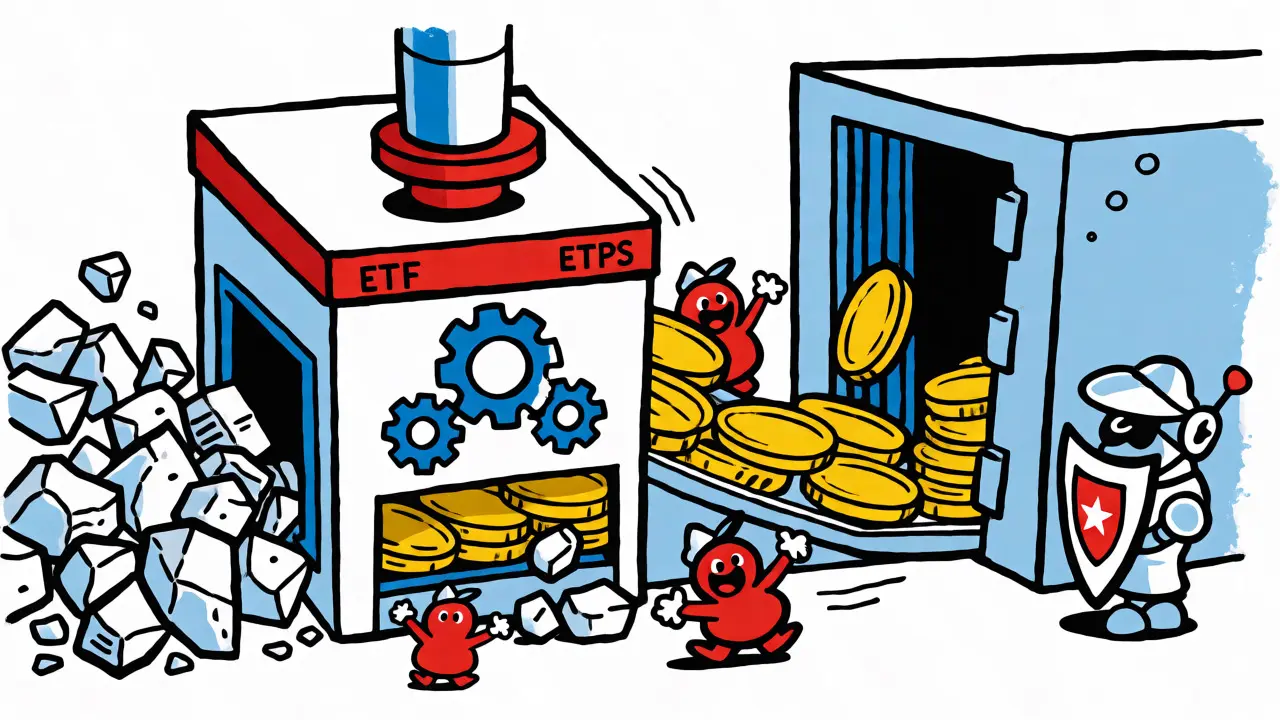
But here’s the key insight: These institutions aren’t buying raw coins on unregulated exchanges. They want regulated vehicles. The same survey showed that 60% of investors prioritize Exchange-Traded Products (ETPs) and ETFs. Why? Because these products come with built-in compliance frameworks, transparency, and investor protections. They solve the custody problem and the audit problem in one package.
We can see this preference in capital flow data. In August 2025 alone, Ethereum attracted $1.4 billion in institutional inflows, surpassing Bitcoin’s $748 million during the same period. Analysts describe this as a "seismic shift" triggered by regulatory green lights. Tokenized securities also reached $9.2 billion in early 2025, showing that institutions are comfortable with blockchain technology when it’s wrapped in familiar legal structures.
Global Frameworks: MiCA vs. U.S. Approaches
Regulation isn’t uniform. It varies by region, and institutions adjust their strategies accordingly. Two major frameworks dominate the conversation today: the European Union’s Markets in Crypto-Assets (MiCA) regulation and various U.S. initiatives.
MiCA provides a comprehensive set of rules for crypto asset oversight across the EU. It standardizes how issuers and service providers must operate, creating a single market environment. This harmonization reduces complexity for multinational firms. Instead of dealing with 27 different national laws, they follow one robust framework. This certainty encourages European banks and asset managers to enter the space aggressively.
In contrast, the United States relies on a patchwork of agency actions. The Securities and Exchange Commission (SEC) and the Commodity Futures Trading Commission (CFTC) often have overlapping jurisdictions. However, recent developments show progress. In September 2025, the SEC and CFTC hosted a joint roundtable to refine regulatory harmonization efforts. Additionally, the proposed GENIUS Act focuses specifically on custody solutions, addressing one of the biggest hurdles for U.S. institutions.
| Feature | EU (MiCA) | USA (Current Landscape) | Institutional Preference |
|---|---|---|---|
| Primary Focus | Comprehensive issuer/service provider rules | Agency-specific guidance (SEC/CFTC), Custody rules | Clear liability definitions |
| Custody Requirements | Standardized across member states | SAB121 impacts balance sheets; evolving rules | Segregated, insured storage |
| Product Access | Broad ETP availability | Spot ETFs approved; staking products emerging | Regulated exchange-traded vehicles |
| Market Stability | High due to uniformity | Moderate due to jurisdictional variance | Predictable compliance costs |
The Custody Bottleneck: SAB121 and Balance Sheet Risks
If there’s one thing keeping some traditional banks out of the crypto game, it’s custody. Specifically, the SEC’s Staff Accounting Bulletin 121 (SAB121). Published in March 2022, this bulletin requires SEC reporting entities holding crypto-assets in custody to record associated risks on their balance sheet. Unlike other custodied assets, this treatment significantly increases capital requirements for banks.
Imagine you’re a bank wanting to offer crypto custody. Under SAB121, you might need to hold much more capital against those assets than you would for stocks or bonds. This makes the business less profitable. While the SEC proposed changes to the Custody Rule in February 2023 to address this, comprehensive resolution remains pending. Until then, many institutions prefer third-party custodians who specialize in digital assets, rather than building the infrastructure themselves.
This friction explains why specialized custodians are thriving. Firms that meet institutional security standards and navigate these accounting nuances successfully are seeing huge demand. For RIAs (Registered Investment Advisors), the challenge is similar. They must safeguard client assets with qualified custodians, but the definition of "qualified" for digital assets is still evolving. This uncertainty forces advisors to be extra cautious, often delaying full integration of crypto into client portfolios.

Practical Steps for Investors Navigating Regulation
So, what should you do if you’re an investor or a business owner looking to engage with this market? Don’t just chase yields. Monitor the regulatory pulse. Here’s a checklist to help you stay ahead:
- Track Jurisdictional Changes: Regulations vary wildly between the US, EU, and Asia. Use resources from the OECD or local treasury boards to understand upcoming proposals.
- Prioritize Regulated Vehicles: As noted, 60% of institutions prefer ETFs and ETPs. These products offer easier exit strategies and clearer tax treatments.
- Vet Custody Solutions: Ensure your custodian complies with current accounting standards like SAB121. Ask for proof of insurance and segregation of assets.
- Monitor KYC/AML Compliance: Know Your Customer and Anti-Money Laundering rules are tightening globally. Non-compliant platforms face shutdown risks.
- Diversify Across Frameworks: Don’t put all your eggs in one regulatory basket. Exposure to both MiCA-compliant EU assets and SEC-regulated US products can hedge against regional policy shifts.
Remember, over-regulation can stifle innovation, but no regulation creates chaos. The sweet spot is where rules protect investors without banning technology. We are currently moving toward that sweet spot, which is why adoption is accelerating.
Future Outlook: What’s Next for Institutional Money?
The trend is clear: regulatory tailwinds are supporting institutional adoption. With global alignment improving through frameworks like MiCA, and U.S. innovations remaining competitive, the barrier to entry is lowering. Analysts predict continued inflows into ETF and ETP providers, compliant custodians, and tokenization platforms.
Tokenization, in particular, is gaining traction. By representing real-world assets like real estate and private equity on the blockchain, institutions can access liquidity and fractional ownership opportunities previously unavailable. But this only works if the legal status of these tokens is clear. That’s why regulatory bodies are now focusing on defining digital securities explicitly.
For now, keep your eyes on the SEC and CFTC. Their ongoing collaboration suggests a move toward unified oversight, which would be a massive win for stability. If they succeed, expect another wave of traditional finance players entering the space. The era of "wait and see" is ending. The era of "comply and deploy" has begun.
Why do institutional investors prefer regulated crypto products?
Institutional investors have strict fiduciary duties and compliance requirements. Regulated products like ETFs and ETPs offer built-in legal protections, transparent pricing, and established custody solutions. This reduces operational risk and simplifies auditing compared to holding raw cryptocurrencies on unregulated exchanges.
What is the impact of SAB121 on banks?
Staff Accounting Bulletin 121 (SAB121) requires SEC reporting entities to record crypto assets held in custody on their balance sheet. This increases capital reserve requirements for banks, making crypto custody more expensive and complex. Many banks delay entry into the space until these accounting rules are clarified or modified.
How does MiCA regulation differ from U.S. crypto laws?
The EU's Markets in Crypto-Assets (MiCA) regulation provides a comprehensive, unified framework for all crypto assets across member states. In contrast, the U.S. relies on a mix of agency rulings (SEC, CFTC) and state-level laws, creating a more fragmented regulatory landscape. MiCA offers greater predictability for cross-border operations.
Does regulatory clarity always increase crypto prices?
Not immediately, but generally yes in the long term. Clarity reduces uncertainty, which lowers the risk premium demanded by investors. This encourages more capital inflows, increasing demand and stabilizing prices. However, sudden restrictive regulations can cause short-term price drops due to panic selling.
What role does RIA play in institutional decisions?
Regulatory Impact Analysis (RIA) helps institutions quantify the costs and benefits of complying with new rules. It allows them to assess financial risks, operational burdens, and potential returns before committing capital. A well-documented RIA gives investment committees the confidence to approve crypto allocations.