Did you miss the NUUM airdrop? Or are you holding onto some NEER tokens from the Kusama days hoping for more? The landscape around Bit.Country’s metaverse infrastructure has shifted significantly since the initial launch. With the token now trading at a fraction of its peak value and liquidity remaining tight, understanding exactly how the distribution worked-and what it means for your wallet right now-is crucial before you make any moves.
This guide breaks down the mechanics of the NUUM distribution via the MNet ecosystem. We will look at the specific crowdloan parameters on the Pioneer network, the vesting schedules that apply to different groups, and the current technical status of the MNet Continuum parachain. Whether you are a long-term holder or just researching the project's history, these details explain where the tokens came from and where they are going next.
How the NUUM Airdrop Actually Worked
The primary mechanism for distributing NUUM was not a simple "claim now" button for everyone. Instead, it was tied directly to the success of the MNet Pioneer network on the Kusama testnet. If you participated in the crowdloan, you earned rewards in NEER, which then converted into NUUM during the Token Generation Event (TGE).
Here is the specific breakdown of that process:
- Crowdloan Victory: MNet Pioneer won Kusama Auction 13. They raised a total of 209,494 KSM, valued at approximately $3.17 million at the time.
- Reward Rate: Participants received at least 72 NEER tokens for every 1 KSM contributed to the crowdloan.
- Conversion: When the TGE occurred on February 29, 2024, these NEER holdings were effectively bridged or swapped into NUUM on the mainnet (MNet Continuum).
It is important to note that this wasn't an open-airdrop for random wallets. It was an incentive structure for early backers who helped secure the parachain slot. The referral system added another layer, offering a 5% bonus split between referrer and referred party, which encouraged rapid growth in the participant base during the November 2021 to October 2022 window.
Vesting Schedules and Token Unlocks
One of the biggest questions holders have is: "When can I sell everything?" The answer depends entirely on which allocation bucket you fell into. Not all NUUM tokens became liquid immediately after the TGE.
| Allocation Type | Lock Period | Release Schedule | Notes |
|---|---|---|---|
| Crowdloan Rewards (Immediate) | None | 30% at TGE | Distributed instantly on Feb 29, 2024 |
| Crowdloan Rewards (Remaining) | 12 Months | Linear over 12 months | 70% of total reward pool |
| Team/Investor Allocations | Varies | 30-day to 24-month linear | Depends on specific investor agreement |
| Employee Incentives | \nOngoing | Reserved Pool | 30M NUUM reserved; minimal release so far |
If you received your rewards during the initial phase, 30% was available immediately. The remaining 70% followed a linear release schedule over the following year. This means that by mid-2025, most crowdloan participants should have had full access to their tokens, barring any specific contractual extensions. However, always check the official dashboard, as individual vesting contracts can sometimes differ based on the exact date of contribution.
MNet Infrastructure: Continuum vs. Pioneer
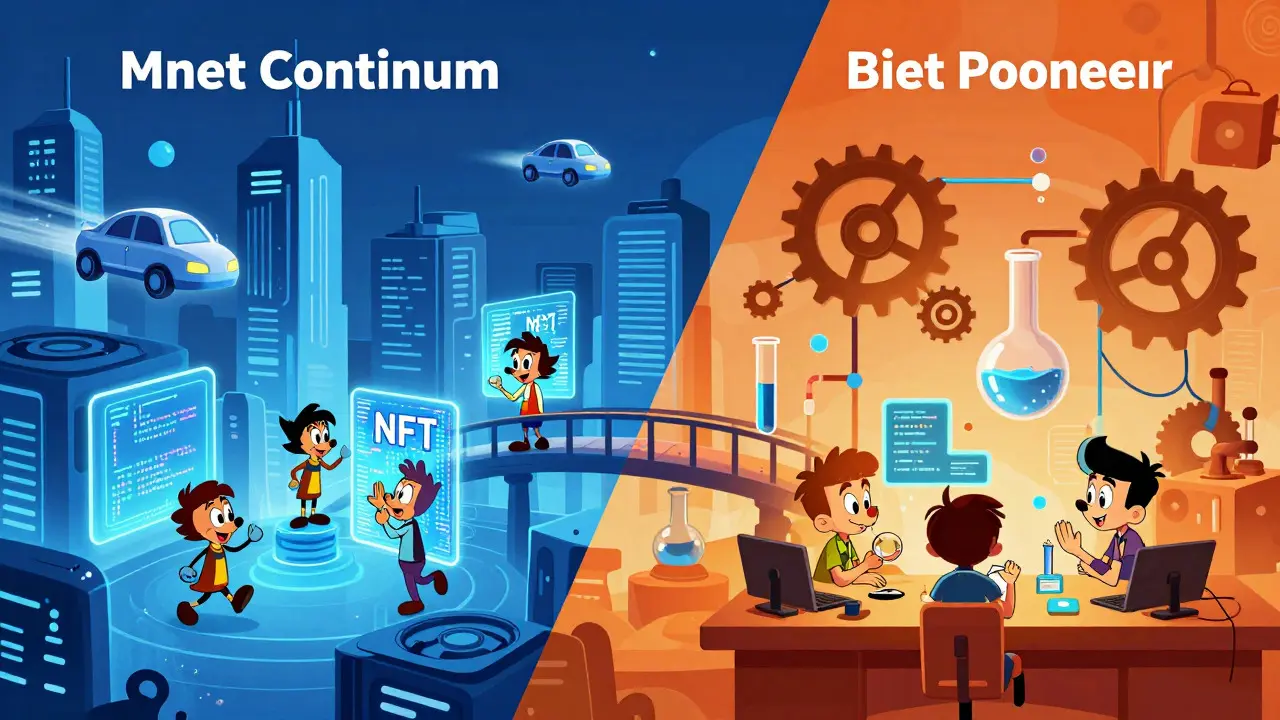
To understand the NUUM token, you have to understand the two networks it supports. Bit.Country operates a dual-network strategy that serves distinct purposes within the Polkadot ecosystem.
MNet Continuum is the production parachain on Polkadot where NUUM is the native utility token. It holds Leased Core ID 34 and is currently active. This is where the real economic activity happens-NFT minting, land purchases, and community token launches. The lease for this core extends until October 20, 2025, ensuring stability for the near future.
In contrast, MNet Pioneer is the experimental parachain on Kusama using the NEER token. It acts as a canary network, allowing developers to test WASM and Ethereum-compatible smart contracts without risking mainnet funds. While NEER still trades exclusively on Gate.io, its primary function is technical validation rather than financial speculation.
This separation allows Bit.Country to innovate rapidly on Pioneer while maintaining a stable, high-value environment on Continuum. For NUUM holders, this means the underlying technology is being stress-tested constantly, reducing the risk of major bugs affecting your assets on the mainnet.
Current Market Reality: Price and Liquidity
Let’s address the elephant in the room: the price action. NUUM reached an all-time high of $0.6046 in March 2024. As of August 2026, it trades around $0.001958. That is a decline of nearly 99.7%. Does this mean the project is dead? Not necessarily, but it does signal significant market challenges.
Key metrics to watch:
- Market Cap: Approximately $259,350. This is extremely low for a project that raised $40 million in funding.
- Daily Volume: Around $8,840. The volume-to-market-cap ratio is 3.41%, indicating low liquidity. Moving large amounts of NUUM could cause significant slippage.
- Total Supply: 132.41 million NUUM in circulation out of a maximum supply of 1 billion. This means there is substantial inflation potential if the remaining 867 million tokens enter circulation.
The low liquidity is a double-edged sword. On one hand, it makes buying and selling difficult. On the other hand, it means the price is highly sensitive to small buy or sell orders. If you are planning to exit your position, doing so in smaller batches is usually safer than dumping everything at once.
Technical Updates and Contract Migration
A critical detail often missed in general news is the recent contract migration. The NUUM token moved from an older implementation to a new one. If you are using a hardware wallet or a specific dApp interface, you may need to update your token address manually.
Why did this happen? The new contract likely includes optimizations for better interoperability with other Polkadot parachains and improved gas efficiency. Before swapping or staking, verify that your wallet recognizes the new contract address. Failing to do so might result in your tokens appearing "lost" in old interfaces, even though they are safe on-chain.
The platform itself continues to push features like the Bit Avatar system and 2.5D/3D world creation tools. The goal remains to let users create personalized metaverses in as little as 12 seconds. These features drive demand for the token by providing utility beyond mere speculation.
Frequently Asked Questions
Is the NUUM airdrop still open?
The primary airdrop linked to the Kusama crowdloan concluded with the Token Generation Event in February 2024. However, ongoing engagement incentives and community events may offer smaller distributions. Check the official MNet dashboard for any active campaigns.
Where can I buy or sell NUUM?
Liquidity is limited. NUUM is primarily traded on decentralized exchanges within the Polkadot ecosystem and a few centralized exchanges. Always check the current order book depth before executing large trades due to the low daily volume of ~$8.8K.
What is the difference between NEER and NUUM?
NEER is the token for the MNet Pioneer network on Kusama, used for testing and development. NUUM is the native token for MNet Continuum on Polkadot, used for production applications, governance, and fees. They serve different roles in the dual-network architecture.
Do I need to claim my NUUM manually?
For most crowdloan participants, the conversion happened automatically during the TGE. If you held NEER, it should have been credited as NUUM. If you don't see it, ensure your wallet is updated to the latest version and connected to the correct Polkadot network.
What happens when the Parachain lease expires?
The current lease for MNet Continuum ends in October 2025. The team must renew this lease or migrate to a new model (like Agile Coretime) to maintain independent operation. Failure to renew could impact the chain's performance and token utility, so keep an eye on governance votes regarding the renewal.